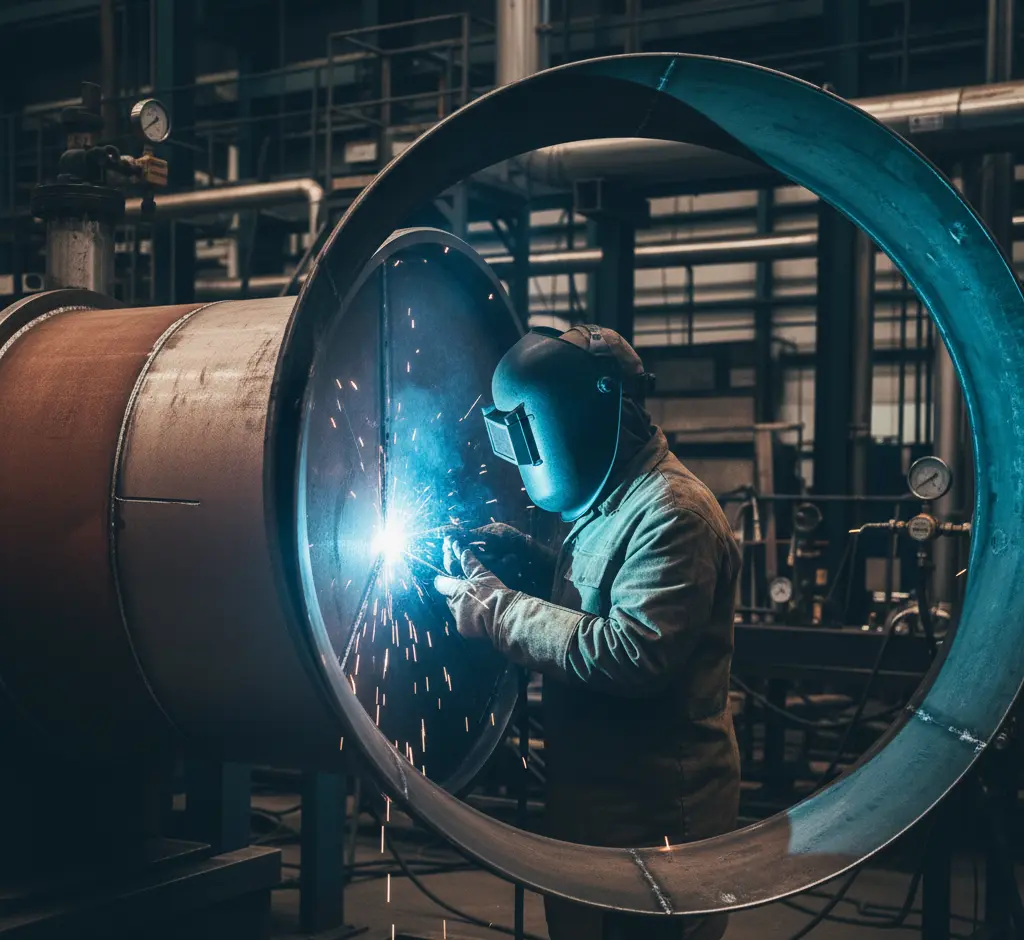
Welding in pressure vessel fabrication is the process that fuses all components into a single, durable structure. It ensures proper stress distribution and compliance with safety standards, allowing vessels to operate reliably under extreme pressure. RedRiver LLC applies specialized weld types and expert practices to guarantee long‑lasting performance.
Key Takeaways
- Welding is essential to every stage of pressure vessel fabrication.
- Weld quality directly affects vessel safety, durability, and performance.
- Compliance with ASME codes ensures proper welding procedures and inspections.
- RedRiver LLC uses engineering-driven welding practices for superior vessel reliability.
- Proper welding ensures strong joints that withstand pressure and operational demands.
Understanding How Is Welding Used in Pressure Vessel Fabrication
How is welding used in pressure vessel fabrication involves joining steel components to create a single, pressure-resistant structure capable of containing gases and liquids under extreme operating conditions. The joining process must be executed with precision to ensure the vessel performs safely, meets engineering specifications, and complies with strict industry standards. Pressure vessel welding techniques are critical for achieving structural integrity and long-term durability. This topic closely connects to Welding in Pressure Vessel Engineering, where engineers consider heat input, material selection, weld design, and inspection requirements using advanced pressure vessel welding techniques.
How Welding Functions Within Pressure Vessel Fabrication
How is welding used in pressure vessel fabrication becomes clearer when considering welds’ impact on strength, safety, and design. Stainless steel vessel welding ensures a unified, durable structure that withstands internal pressure, external loads, and temperature fluctuations. Engineers rely on stainless steel vessel welding for critical, high-performance components in these vessels.
Welding is applied at nearly every stage of fabrication. The process transforms plates and formed heads into completed pressure vessels by joining:
- Shell sections: connecting cylindrical segments for seamless pressure resistance (learn more)
- Heads: joining dished or flat ends to the shell
- Nozzles: integrating inlets, outlets, and instrumentation points
- Reinforcement pads: strengthening high-stress zones
- Brackets and support structures: enabling secure installation (modular skid solutions)
- Seam welds and internal components: ensuring vessel integrity throughout
Every weld must withstand demanding environments, including internal pressure, vibration, temperature cycling, and corrosion. RedRiver LLC ensures every joint meets the highest quality standards, with inspections integrated into the fabrication workflow (fabrication process overview).
Welding and Engineering Integration
Weld engineering plays a crucial role in understanding What is welding in pressure vessel engineering, because pressure vessels do not rely on mechanical fasteners the entire structure depends on welded integrity. Engineers must evaluate metallurgical factors, thermal expansion, contraction effects, and stress concentration zones to ensure weld quality and long-term durability, often applying ASME-certified welding standards for safety and compliance.
These considerations influence weld placement, weld type, filler metal choice, joint preparation, and post-weld treatment. Because welded joints are subjected to stress, they directly relate to What are the safety standards for pressure vessels and why compliance is essential.
Common Welding Methods Used in Pressure Vessel Fabrication
Understanding What are the common welding methods for pressure vessels helps reveal how welding is integrated into fabrication. Different methods offer unique advantages in terms of penetration, control, and material suitability. Many projects require ASME-certified welding to ensure compliance and safety. Welding processes commonly used include:
- TIG (GTAW) Welding: precise, contamination-free welds ideal for stainless steel and alloys (stainless steel fabrication)
- MIG (GMAW) Welding: Suited for repetitive welds and high-production environments. It offers consistent quality with efficient deposition rates.
- Stick (SMAW) Welding: Valued for flexibility and reliability. Frequently used for structural connections and fieldwork.
- Submerged Arc Welding (SAW): Excellent for long seams and thicker sections. Provides deep penetration and uniform weld quality.
Each method is selected to optimize penetration, control, and material suitability. Learn about our full metal fabrication services.
Why Welding Quality Matters in Pressure Vessel Fabrication
The success of a welded pressure vessel depends heavily on weld quality. A single flaw—such as a crack, pore, or lack of penetration, can compromise safety and performance. That is why understanding Pressure Vessel Safety Standards and Compliance becomes a central part of welding in vessel fabrication.
Key aspects influenced by welding quality include:
- Ability to withstand internal pressure
- Fatigue resistance during repeated cycles
- Corrosion resistance around heat-affected zones
- Structural longevity
- Leak prevention
- Proper stress distribution
RedRiver LLC integrates rigorous quality assurance and inspection practices to validate every weld.
How Welding Supports Safety Standards and Compliance
To understand how welding integrates into pressure vessel safety practices, it is necessary to understand How do pressure vessels comply with safety regulations. Compliance requires welds to meet strict guidelines set by international standards and industry codes.
These guidelines state how welding must be performed, inspected, and tested to ensure the vessel is safe for service. Standards such as What is ASME code for pressure vessel safety outline requirements for:
- Material selection: choosing compatible alloys and filler metals (material selection guide)
- Joint design and welding processes: ensuring consistent quality
- Welder qualifications: certified professionals trained for precision
- Inspectability and non-destructive examination: including radiography, ultrasonic, magnetic particle, and liquid penetrant testing (quality assurance in custom pressure tank manufacturing)
- Documentation and verification: maintaining audit-ready records
Compliance with standards like ASME certification ensures vessels perform safely throughout their service life.
Inspection and Quality Assurance in Pressure Vessel Fabrication
Welds are verified through extensive quality checks because pressure vessel failure can lead to catastrophic consequences. Inspections include visual examination and non-destructive testing to identify imperfections before the vessel enters service. Inspection methods may include:
- Radiography
- Ultrasonic testing
- Magnetic particle testing
- Liquid penetrant testing
These inspections are part of RedRiver LLC’s integrated quality control workflow, ensuring every vessel is verified before delivery.
RedRiver LLC integrates these inspection steps into every fabrication project, ensuring weld performance is validated before the vessel is completed.
Material Considerations in Welded Pressure Vessel Fabrication
Welding must match the metallurgical characteristics of the vessel’s base material. Engineers consider thermal conductivity, tensile strength, corrosion resistance, and ductility when determining how welding is used in fabrication. Because different metals behave differently under heat, filler materials must be chosen carefully.
This attention to material compatibility ensures each weld achieves proper fusion, mechanical strength, and resistance to service conditions such as heat, corrosion, and mechanical loading.
How Is Welding Used in Pressure Vessel Fabrication
Welding is at the heart of pressure vessel fabrication, delivering the structural integrity, stress resistance, and regulatory compliance needed for demanding industrial applications. Every weld contributes to the safety, longevity, and performance of the vessel. RedRiver LLC combines expert welding, advanced engineering, and rigorous inspection practices to deliver vessels that meet exacting standards (learn more about our pressure vessels).
Work With RedRiver LLC
For expertly welded pressure vessels built with precision, engineering excellence, and full compliance, RedRiver LLC is your trusted partner. Explore our full capabilities or request a quote to start your project today.
Frequently Asked Questions
1. What is welding in pressure vessel engineering?
It is the specialized process of joining components of a pressure vessel to create a strong, leak-proof and code-compliant structure.
2. What are the common welding methods for pressure vessels?
Common methods include TIG, MIG, SMAW, and SAW, selected based on material type and vessel design.
3. What are the safety standards for pressure vessels?
Safety standards define minimum requirements for welded joints, materials, inspection, and overall design.
4. What is ASME code for pressure vessel safety?
ASME BPVC establishes rules for welding, materials, design, fabrication, and inspection.
5. How do pressure vessels comply with safety regulations?
Compliance requires approved welding procedures, certified welders, and thorough inspection of welds.
Related Blog Post
Which Materials Suit Make-Up Water Service?
How Big Should Make-Up Water Tanks Be?
Make-Up Water Tanks: Design, Sizing, and Fabrication
When to Spec Equalization Tanks for Industrial Systems
How Do Equalization Tanks Balance Flow?
About Author