
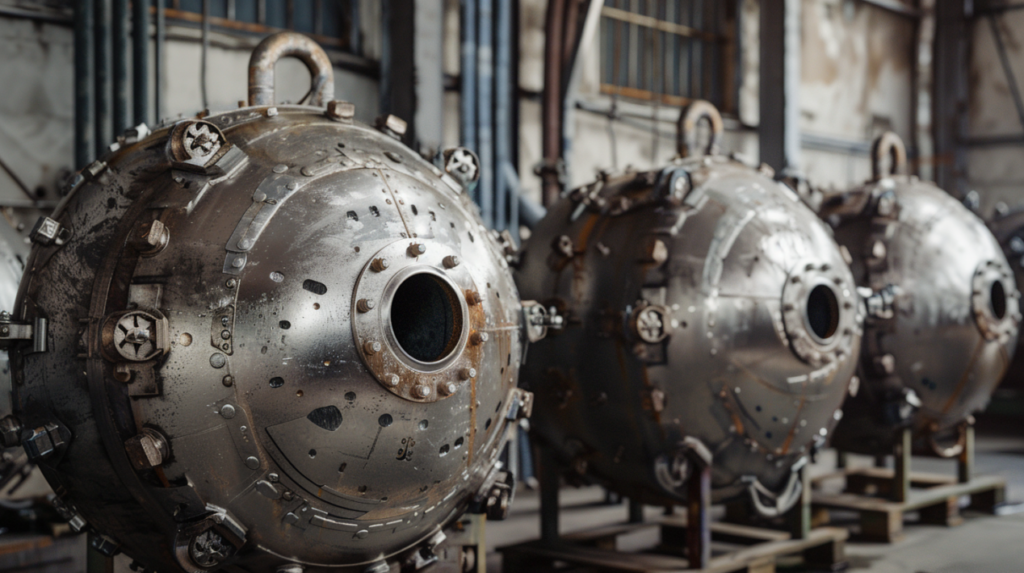
Selecting the wrong pressure vessel head type leads to stress concentrations, premature fatigue, and potential ASME noncompliance, all of which are preventable with the right design decision up front. This guide is for engineers and plant managers who need to evaluate head geometry against their operating conditions and project requirements. You’ll learn how hemispherical, elliptical, torispherical, and conical heads differ in pressure resistance, stress distribution, and manufacturing cost, and which design suits each application.”
Why Understanding Pressure Vessel Heads Matters
Selecting the correct pressure vessel head is a critical design decision that directly impacts safety, reliability, and lifecycle cost. Head geometry influences how internal pressure is distributed across the vessel shell and plays a major role in preventing failure mechanisms such as fatigue, yielding, or buckling.
Pressure vessel heads must be designed in accordance with recognized standards such as ASME Section VIII, which define allowable stresses, geometry limits, and fabrication rules, as discussed in understanding ASME standards for pressure vessels and understanding ASME Code Section VIII for pressure vessels.
Key factors influenced by head selection include:
- Operating Pressure: The maximum internal pressure the vessel will experience, tied closely to design pressure in pressure vessels
- Operating Temperature: Material strength reduction at elevated temperatures, addressed in design conditions for pressure vessels
- Material Compatibility: Resistance to corrosion, cracking, or chemical attack, explored in material selection for high-temperature pressure vessels
- Cost: Fabrication complexity, forming methods, and welding requirements affect overall expense, as outlined in Understanding the Costs of pressure vessel construction
- Application Requirements: Space constraints, flow patterns, and mounting needs are commonly addressed during pressure vessel design and fabrication
A poorly selected head can introduce localized stress concentrations, shorten service life, and increase the likelihood of failure scenarios documented in understanding the causes of pressure vessel failure and significant case histories of pressure vessel failures.
Hemispherical Heads: Strength and Efficiency
Hemispherical heads are shaped like half a sphere, providing uniform curvature that evenly distributes stress.
Advantages:
- Highest strength-to-thickness ratio among pressure vessel heads
- Ideal for very high-pressure applications such as reactors and deep-submergence systems
- Excellent fatigue resistance due to uniform stress distribution
These benefits align with the fundamental stress principles described in primary stresses in pressure vessels and types of pressure vessel stress.
Considerations:
- Higher fabrication cost due to complex forming requirements
- Increased welding length and inspection requirements are addressed in a comprehensive guide on welding a pressure vessel
- Typically justified only where pressure or fatigue demands are extreme
More detail on their geometry and use cases is available in understanding hemispherical ends in pressure vessels.
Elliptical Heads: A Balance of Strength and Cost
Elliptical heads, often 2:1 ratio ellipsoidal heads, balance strength, cost, and manufacturability.
Advantages:
- Stronger than torispherical heads while remaining more economical than hemispherical designs
- Favorable stress distribution for medium-to-high-pressure applications
- Widely accepted under ASME Section VIII rules
Elliptical heads are frequently used in chemical processing, refining, and gas handling equipment, consistent with applications described in understanding process pressure vessels and pressure vessels in the oil and gas industry.
Considerations:
- Standardized geometry simplifies forming and inspection
- Thickness requirements must still be verified using accepted methods such as calculating the thickness of a pressure vessel and determining the minimum thickness for a pressure vessel
A broader comparison of head geometries is available in understanding the four most common types of heads for pressure vessels.
Torispherical Heads: Versatility and Common Usage
Torispherical heads combine a spherical crown radius with a toroidal knuckle radius connecting to the shell.
Advantages:
- Cost-effective and versatile
- Easier to manufacture than hemispherical or elliptical heads
- Reduces stress concentrations at the shell junction
Applications:
- Boilers and storage vessels
- Moderate-pressure service where cost efficiency is important
Torispherical heads are frequently selected for equipment governed by ASME Section VIII Division 1, particularly where wall thickness can be increased to compensate for higher localized stress.
Limitations:
- Higher peak stresses at the knuckle region
- Often require thicker walls, increasing weight and material cost
Failure risks associated with improper sizing are covered in pressure vessel failure mechanisms and understanding pressure vessel hazards.
Conical Heads: Handling Transitions and Supporting Structures
Conical heads are shaped like a cone, ideal for transitions between different vessel diameters or mounting equipment.
Advantages:
- Facilitates gradual diameter changes
- Supports structures mounted on the vessel
- Used in hoppers, silos, and specialized vessels
Considerations:
- Not ideal for high-pressure service without reinforcement
- Cone angle strongly influences stress distribution
- Often require reinforcement rings or increased thickness
Design guidance for non-standard geometries can be found in finding the ideal shape for pressure vessels and essential criteria for designing a pressure vessel.
Selecting the Optimal Head Design
Choosing the right pressure vessel head involves balancing multiple engineering and economic factors:
- Required pressure and temperature ratings
- Applicable codes and standards, including demystifying pressure vessel standards
- Fabrication and inspection complexity
- Long-term maintenance and inspection requirements
Designers must also account for safety margins such as those discussed in typical safety factor for pressure vessels and lifecycle expectations outlined in understanding the design life of a pressure vessel.
Each head type offers distinct advantages for specific applications. Selecting the wrong head type for your operating conditions is one of the most common contributors to premature vessel failure. Getting it right from the start eliminates that risk.
Choosing the Right Pressure Vessel Head for Your Application
Each head type serves a distinct engineering purpose. Hemispherical heads deliver the highest pressure resistance but at a premium fabrication cost. Elliptical heads strike the most practical balance for medium- to high-pressure service. Torispherical heads offer cost efficiency for moderate applications. Conical heads solve specific geometry and transition challenges that no other design addresses as cleanly.
The right choice depends on your operating pressure, temperature, available budget, and applicable code requirements. Red River’s engineering team can help you evaluate those factors and select the head geometry that meets your specifications without overbuilding or cutting corners.
Partner With a Fabricator Who Understands Head Selection
Red River engineers and manufactures ASME-compliant pressure vessels built for your specific operating conditions. Red River engineers and manufactures ASME-compliant pressure vessels built for reliability, safety, and long-term performance.
Contact our team today to discuss your project requirements and discover how our American-made manufacturing solutions can support your operation.
Frequently Asked Questions
1. What factors influence the choice of pressure vessel head type?
Pressure, temperature, material compatibility, cost, application requirements, and manufacturing complexity all influence head selection.
2. Which type of pressure vessel head is the strongest?
Hemispherical heads provide the highest strength-to-weight ratio, ideal for high-pressure applications.
3. What is the difference between an elliptical and a torispherical head?
Elliptical heads have a semi-elliptical shape, while torispherical heads include both a crown radius and a knuckle radius for a distinct structural design.
4. Are conical heads suitable for high-pressure applications?
Conical heads are generally not ideal for high pressure unless reinforced to handle stress at the junction with the shell.
5. What is the standard ratio for elliptical heads?
The standard 2:1 ratio balances strength and manufacturability, making it widely used in industry.
6. Why are torispherical heads so commonly used?
They offer a cost-effective, versatile solution for moderate-pressure vessels with easier manufacturing and installation.
7. Where are conical heads commonly used?
Conical heads are used in hoppers, silos, and vessels requiring a gradual transition between diameters or mounting of equipment.
Key Takeaways
- Hemispherical heads: Strongest, best for high-pressure applications, most expensive
- Elliptical heads: Balanced strength and cost, widely used in medium-to-high-pressure systems
- Torispherical heads: Versatile, cost-effective, ideal for moderate-pressure vessels
- Conical heads: Best for transitions in diameter or supporting structures, may require reinforcement
Related Blog Post
Condensate Tanks: Types, Fabrication, and ASME Code
Which Tests Validate Deaeration in Pressure Systems?
Equalization Tanks: Design, Sizing, and Fabrication
What Are Thermal Storage Testing Standards for TES Vessels?
What Hydro Tests Are Required for Pressure Vessels?
No subpillar set for this blog post.
About Author



