When water heats up in a closed loop, it expands. When it cools, it contracts. In a sealed piping system with no mechanism to accommodate that volume change, the pressure rises and falls with every temperature fluctuation opening relief valves, drawing air into the system, or exceeding the pressure ratings of installed equipment. This guide is for mechanical engineers and facility managers who need to understand exactly how expansion tanks control loop pressure, what happens when they are incorrectly sized or pre-charged, and what design decisions determine whether the expansion tank delivers stable pressure throughout the system’s operating life.
The Physics Behind Loop Pressure Variation
Water is nearly incompressible, so small volume changes create large pressure increases in sealed systems. From 40°F to 180°F, water expands about 3.6%. In a 10,000-gallon system, a 40°F to 60°F rise adds roughly 240 gallons, sharply increasing pressure if unaccommodated. Governed by water’s bulk modulus near 300,000 psi, even minor volume changes drive significant pressure increases. While piping elasticity reduces extremes, the issue remains. Expansion tanks solve this by adding a compressible gas cushion, absorbing volume changes and stabilizing system pressure.
For fabrication standards governing the pressure vessels used in these systems, the ASME Boiler and Pressure Vessel Code sets the design, material, and inspection requirements that all certified expansion tanks must meet.
ASHRAE provides reference data on water volumetric expansion and chilled water system pressure design in the ASHRAE HVAC Systems and Equipment handbook.
How the Gas Cushion Controls Pressure
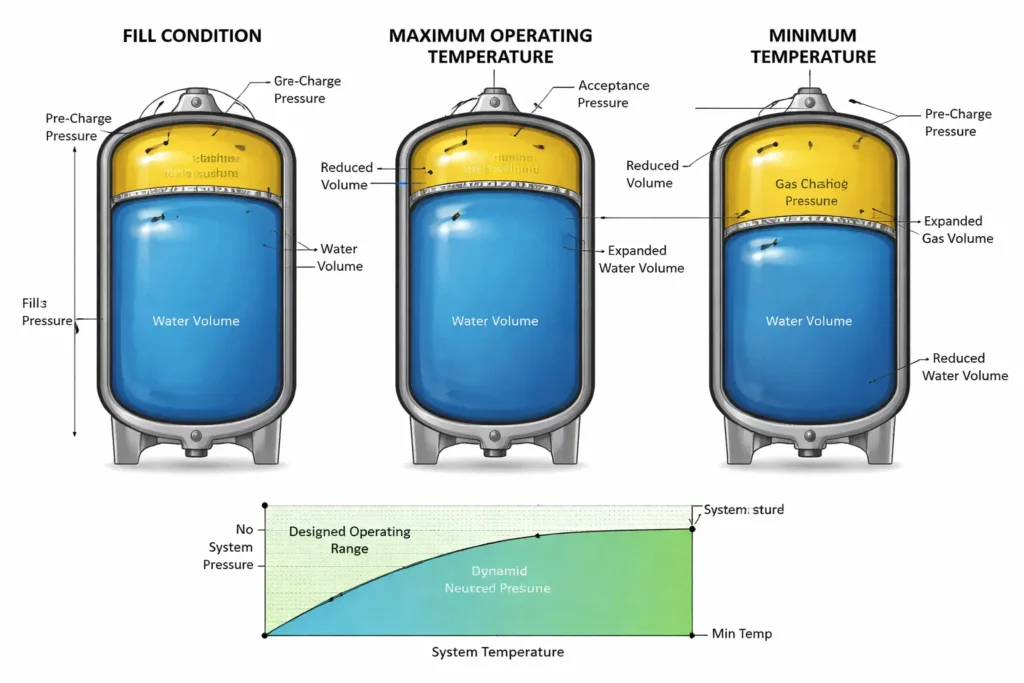
A diaphragm or bladder expansion tank has two chambers separated by a flexible barrier: system water and a pre-charged gas side. The gas, typically nitrogen or air, is set to a defined pre-charge before connection. As temperature rises, expanding water pushes the barrier, compressing the gas. System pressure increases, but at a controlled rate governed by gas compression, not rigid hydraulics. When temperature drops, compressed gas expands, maintaining positive pressure and preventing air ingress. This keeps system pressure within safe limits, avoiding both vacuum conditions and overpressure across all operating temperatures, ensuring stable, reliable operation of the chilled water loop.
For more on how ASME code stamped pressure vessels are certified for this service, Red River provides complete documentation from fabrication through delivery.
The Three Pressure Points That Govern Expansion Tank Operation
Understanding how expansion tanks control loop pressure requires understanding three specific pressure values that define the operating envelope.
Fill pressure (Pf): Fill pressure is static head at ambient temperature before operation; it equals water column weight at tank and sets expansion tank pre-charge baseline condition.
Maximum operating pressure (Pa): Maximum system pressure occurs at peak temperature; expansion tank gas is most compressed, so sizing ensures pressure stays below allowable maximum and relief valve setpoint.
Minimum operating pressure: Lowest system pressure occurs at highest elevation during minimum temperature; expansion tank must maintain gas pressure ensuring minimum loop pressure stays above air ingestion threshold.
These three pressure points define the acceptance volume of the expansion tank the volume of water the tank must accept between minimum and maximum operating conditions. Correct sizing requires that the tank’s acceptance volume equals or exceeds the system’s total water volume expansion across the operating temperature range. See our detailed guide on how much volume is needed for chilled water storage for sizing methodology reference.
Why Pre-Charge Pressure Is Critical to Pressure Control
Pre-charge pressure is the single most important setting in expansion tank commissioning. An incorrectly pre-charged tank fails to control loop pressure correctly even when the vessel volume is correctly sized.
Pre-charge too high: If gas pre-charge exceeds fill pressure, diaphragm shifts before water entry, reducing acceptance volume, making tank effectively undersized and increasing pressure rise during warmup.
Pre-charge too low: If pre-charge is below fill pressure, water enters tank early, reducing gas cushion, increasing pressure rise during warmup, potentially exceeding maximum operating pressure limits.
Correct pre-charge: Gas pre-charge equals system fill pressure at ambient temperature, placing diaphragm neutral so full gas cushion absorbs expansion, maintaining designed pressure curve across operating range.
Pre-charge pressure must be verified with the system depressurized and empty at initial commissioning not with the system pressurized and operating. Pre-charge verification with the system pressurized gives a false reading because system pressure is acting on the water side of the diaphragm. For guidance on which materials suit chilled water service in expansion tank fabrication, Red River evaluates each project’s fluid chemistry before specifying materials.
What Happens When Expansion Tank Pressure Control Fails
Understanding failure modes clarifies why correct expansion tank sizing and pre-charge matter for data center HVAC reliability.
Over-pressure failure: Undersized or mischarged expansion tanks cause pressure spikes during warmup or load recovery, triggering relief valves, wasting treated water, and often misdiagnosed as pump or valve issues.
Under-pressure failure: If an expansion tank loses pre-charge through diaphragm or bladder permeation, system pressure can drop below air-ingestion threshold at high points during cooldown or low load. Air enters through seals and fittings, causing cavitation, noise, corrosion, reduced reliability, and higher maintenance.
Waterlogged tank failure: A waterlogged tank from lost pre-charge becomes fully water-filled, provides no buffering, causes pressure spikes, and shows rapid gauge oscillation with minor load changes.
The National Board of Boiler and Pressure Vessel Inspectors provides inspection guidelines for pressure vessels in service that include expansion tank condition assessment protocols relevant to data center HVAC maintenance programs.
Need a Reliable Partner?
Red River fabricates ASME U-stamp certified expansion tanks sized and pre-charged to each project’s fill pressure, maximum operating pressure, and system water volume. Every tank includes full material traceability, certified weld documentation, and hydrostatic test records. Contact our team to discuss expansion tank specifications for your chilled water system.
Maintaining Pressure Control Throughout the Tank’s Service Life
Expansion tank pressure control is not a set-and-forget function. Three maintenance actions preserve correct pressure control throughout the tank’s service life.
Annual pre-charge verification: Diaphragm and bladder materials slowly lose gas, dropping pre-charge 1–3 psig yearly. Annual checks are required; significant loss effectively reduces tank capacity and performance.
Diaphragm and bladder inspection: Diaphragm tanks require full replacement on failure; bladder tanks allow bladder replacement. Inspection intervals depend on fluid chemistry, glycol levels, and temperature affecting membrane degradation rates.
System pressure monitoring: Relief valve activation, pressure oscillation, or persistent air indicate expansion tank failure. Verify pre-charge and inspect the tank immediately, rather than adjusting valves or purging air.
Red River’s engineering team can review expansion tank specifications for existing data center chilled water systems where pressure control symptoms suggest undersizing, incorrect pre-charge, or membrane failure. Contact our team to discuss an expansion tank assessment for your facility.
Frequently Asked Questions
1. What causes loop pressure to change in a chilled water system?
Water expands when heated and contracts when cooled, causing pressure changes in closed systems; expansion tanks absorb volume changes, maintaining pressure within safe operating limits.
2. How does the gas cushion in an expansion tank control pressure?
As water expands, it compresses the gas cushion, which absorbs volume changes with minimal pressure rise; as temperature drops, gas expands, maintaining positive system pressure.
3. What is the correct pre-charge pressure for an expansion tank?
Pre-charge pressure must equal static fill pressure at the tank connection and be set with the system depressurized, as pressurized conditions give inaccurate readings.
4. When to choose bladder vs diaphragm tanks?
Choose a bladder tank when the vessel is large and bladder replacement is more cost-effective than full vessel replacement over the service life. Choose a diaphragm tank for smaller systems where the compact, lower-cost design is sufficient and full tank replacement at end of diaphragm life is acceptable. Both types are available in ASME-certified configurations for chilled water service.
5. What precharge and rating do expansion tanks need?
Pre-charge pressure must equal the static fill pressure at the tank connection point the pressure of the water column above the tank at ambient temperature before system pressurization. The pressure rating must meet or exceed the system’s maximum allowable working pressure. ASME Section VIII Division 1 governs tanks operating above 15 psig most closed-loop data center systems operate between 50–150 psig.
Key Takeaways
- Expansion tanks control loop pressure by providing a compressible gas cushion that absorbs water volume changes caused by temperature gas compression and expansion keeps system pressure within the designed operating range during all thermal transitions.
- Pre-charge pressure must equal system fill pressure at the tank connection point pre-charge that is too high reduces acceptance volume while pre-charge that is too low leaves insufficient gas capacity for the full temperature operating range.
- A waterlogged expansion tank one that has lost all gas pre-charge through membrane failure provides zero pressure buffering and causes sharp pressure spikes with every temperature change, mimicking symptoms of undersizing or system over-filling.
- Red River fabricates ASME U-stamp certified expansion tanks with pre-charge set to each project’s fill pressure specification with full material traceability, certified weld documentation, and hydrostatic test records included as standard.
Related Blog Post
Condensate Tanks: Types, Fabrication, and ASME Code
Which Tests Validate Deaeration in Pressure Systems?
Equalization Tanks: Design, Sizing, and Fabrication
What Are Thermal Storage Testing Standards for TES Vessels?