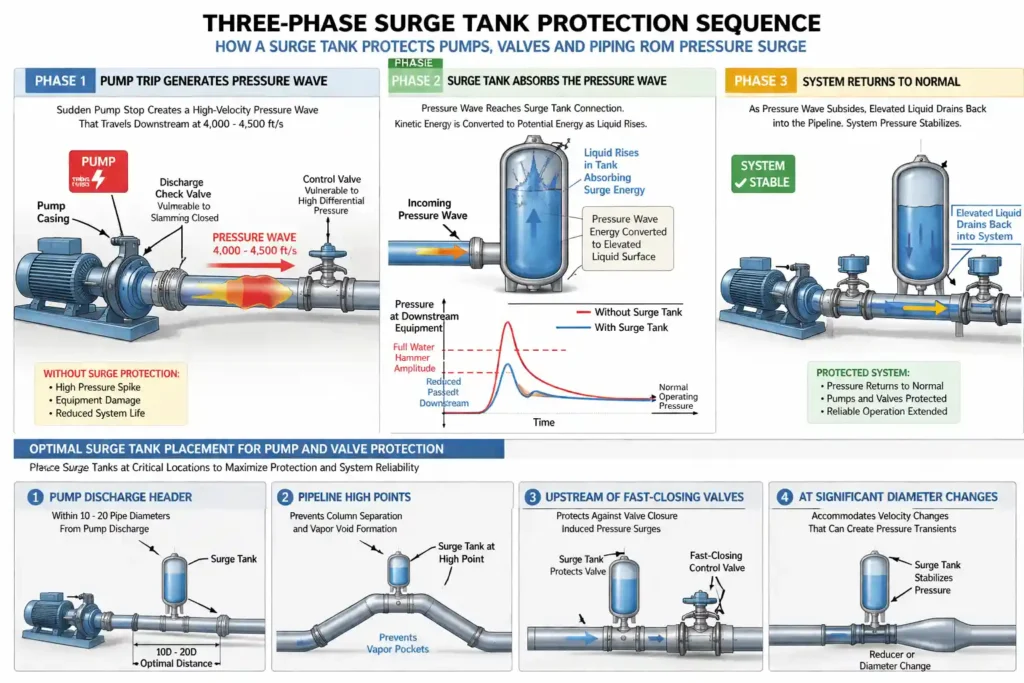
When a pump trips during a power failure, it can generate a 300–600 psi pressure wave that travels through discharge piping in milliseconds, putting pumps, valves, and piping at risk of catastrophic damage. This is a critical concern for mechanical engineers and facility managers responsible for chilled water and industrial cooling system reliability. This guide explains how surge tanks protect pumps and valves, where they should be installed, and what sizing and ASME certification requirements ensure effective protection.
The Mechanism of Pump and Valve Damage From Pressure Surge
Before understanding how surge tanks protect pumps and valves, it is essential to understand how pressure surge damages them in the first place. A single pressure transient can propagate through a cooling loop in milliseconds, creating high-impact loads that affect pumps, check valves, control valves, and pipe fittings in different ways. Understanding these failure mechanisms is key to answering how surge tanks protect pumps and valves and ensuring they are correctly sized and located to intercept damaging pressure waves before they reach critical equipment.
Pump Damage
Pump damage occurs from two main effects: discharge overpressure during a trip and reverse flow after shutdown. The pressure wave can exceed casing limits and force reverse rotation, damaging seals, bearings, and impellers before flow is stopped.
Check Valve Damage
If a pressure wave arrives before a check valve fully closes, the valve slams shut under reverse flow. This creates a secondary pressure spike that can crack valve bodies, damage seats, and fail actuators.
Control Valve Damage
Surge forces acting on partially open control valves can exceed actuator capacity. This can bend stems, crack plugs, and damage seats, with butterfly valves being especially vulnerable due to full disc exposure.
Pipe Fitting Damage
Flanges, threaded joints, and tees are often the weakest points in the system. Surge pressures can cause immediate gasket failure or long-term fatigue leaks from repeated pressure spikes.
For pressure vessel fabrication and surge protection components certified to ASME standards, Red River provides complete documentation from fabrication through delivery.
How Surge Tanks Intercept Pressure Waves
A surge tank protects pumps and valves by giving pressure waves a low-resistance volume to expand into before they reach downstream equipment. This reduces the peak pressure that would otherwise travel through the piping system.
- Phase 1, Wave arrival: A surge wave from a pump trip or fast valve closure reaches the tank connection and diverts flow upward into the vessel instead of continuing through the pipeline. This immediately limits the pressure rise at the connection point.
- Phase 2, Energy absorption: As liquid rises in the tank, surge energy is converted into potential energy in the elevated fluid column, lowering the effective pressure spike in the system.
- Phase 3, Recovery: The stored liquid drains back into the pipeline as conditions stabilize, restoring normal system operation without fluid loss.
This entire process happens within seconds, significantly reducing the pressure seen by pumps, valves, and piping downstream of the surge tank.
For more on how chilled water storage tanks and surge protection vessels are certified under ASME standards, Red River provides complete certification packages.
Where Surge Tanks Must Be Located to Protect Pumps and Valves
Surge tank placement is as important as sizing, incorrect location can significantly reduce or eliminate protection.
Pump Discharge Header
The most critical location is near the pump discharge, where the surge wave is generated. Installing the tank within 10 to 20 pipe diameters of the pump allows it to intercept the pressure wave early, protecting the pump, check valve, and downstream piping before full surge develops.
Pipeline High Points
High points are prone to column separation and vacuum formation. A surge tank here prevents liquid separation and reduces damaging secondary surges when the fluid columns reconnect.
Upstream of Fast-Closing Valves
Valves that close faster than the system’s critical closure time generate strong water hammer. A nearby surge tank absorbs the returning pressure wave before it propagates back to the pump.
Pipe Diameter Changes
Sudden expansions or reductions reflect and amplify pressure waves. Placing a surge tank near these transitions helps reduce wave reflection and localized pressure spikes.
For modular chilled water skid packages where surge tank placement is integrated into the pre-engineered piping configuration, Red River designs the full system layout before fabrication begins.
Sizing Surge Tanks for Pump and Valve Protection
Surge tank sizing ensures the vessel can absorb transient volume without overflowing or emptying, both of which eliminate protection.
Key Sizing Factors:
- Wave volume: Amount of fluid displaced during a pressure transient
- Tank geometry: Affects how pressure translates into liquid level rise
- Gas cushion: Provides compressible volume for additional surge absorption in pressurized tanks
Rule-of-Thumb Sizing: A preliminary estimate is 1 to 2 gallons of tank volume per GPM of pump flow, but final sizing requires full transient hydraulic analysis.
Proper sizing and material selection depend on system conditions, fluid properties, and surge severity. For which materials suit chilled water service in surge tank fabrication, Red River evaluates each project’s fluid chemistry before specifying shell material. The National Board of Boiler and Pressure Vessel Inspectors maintains registration records and inspection guidance for ASME-certified surge protection vessels.
Last Note on How Do Surge Tanks Protect Pumps and Valves
Pumps and control valves are among the most costly and failure-prone components in chilled water systems, and a single unprotected surge event can result in cracked casings, damaged valves, and repeated flange failures that quickly exceed the cost of proper protection. Surge tanks do not eliminate water hammer—they control it by capturing the pressure wave at a strategic location and converting destructive energy into a manageable rise in liquid level. When correctly sized and installed at pump discharge points, pipeline high points, and upstream of fast-closing valves, surge tanks provide a highly reliable, low-maintenance solution for protecting critical equipment over the full lifecycle of the system.
Need a Reliable Partner?
Red River fabricates ASME U-stamp certified surge tanks for pump and valve protection in chilled water systems, industrial pipelines, and data center cooling infrastructure sized and located based on each project’s transient hydraulic analysis, with full material traceability, certified weld documentation, and hydrostatic test records. Contact our team to discuss surge tank protection for your cooling system.
Frequently Asked Questions
1. What causes pressure surge in cooling loops?
Pressure surges in cooling loops are caused by rapid flow velocity changes pump trips, fast-closing valves, or sudden load changes that decelerate the moving liquid column and convert its kinetic energy into a pressure spike. The faster the flow change, the higher the resulting surge pressure.
2. Which NDE methods apply to surge tanks?
ASME Section VIII requires visual inspection of all welds during fabrication, radiographic testing (RT) or ultrasonic testing (UT) of seam welds based on the specified joint efficiency, and hydrostatic testing at 1.3× MAWP before the U-stamp is applied. The extent of RT or UT determines the joint efficiency used in the shell thickness calculation.
3. How does a surge tank prevent check valve slam?
When a pump trips, the pressure wave returns toward the pump before the discharge check valve has fully closed. Without a surge tank, this wave slams the check valve shut against full reverse flow pressure cracking valve bodies and destroying seat rings. A surge tank at the pump discharge absorbs the returning wave, reducing the differential pressure across the check valve during closure and allowing it to seat gently rather than slamming.
4. Why must a surge tank be located close to the pump discharge?
Every foot of piping between the pump discharge and the surge tank connection allows the pressure wave to build amplitude before reaching the tank. A tank located 200 feet from the pump discharge intercepts a wave that has already damaged equipment in the 200 feet of piping between the pump and the tank. The closer the tank is to the wave source, the more of the wave energy it absorbs before any damage can occur.
5. How do surge tanks protect control valves from pressure surge?
Surge tanks limit the peak pressure differential that the control valve experiences during a surge event. By absorbing the wave before it reaches the valve location, the tank reduces the force applied to the valve plug, disc, or ball during the transient keeping actuator forces within the valve’s mechanical design limits and preventing stem bending, seat damage, and actuator failure.
6. Can a surge tank protect equipment on both sides of its connection point?
A surge tank protects equipment downstream of its connection point from the forward pressure wave, and equipment upstream from the reflected wave that returns from closed valves and diameter changes. Positioning the tank between the wave source and the protected equipment maximizes protection in both directions. For systems with multiple surge sources, multiple tank locations may be required.
7.What is the difference between a surge tank and a pressure relief valve for pump protection?
A pressure relief valve opens when system pressure reaches its setpoint and discharges fluid to atmosphere or a drain wasting treated system water and chemicals with every activation. A surge tank absorbs the surge pressure and returns the fluid to the system without discharge. Surge tanks are the preferred protection method for systems where fluid loss, chemical waste, or system contamination from makeup water are unacceptable.
8. Does surge tank size affect how much protection it provides to pumps and valves?
Yes directly. An undersized surge tank fills completely during a large surge event and provides no further protection once full the remaining wave energy propagates through the system at full amplitude. An correctly sized tank maintains liquid level within its operating range throughout the transient, providing continuous pressure relief until the wave fully dissipates.
Key Takeaways
- Surge tanks protect pumps and valves by providing a low-resistance volume that pressure waves expand into before reaching downstream equipment converting wave energy into a temporary rise in liquid level rather than a pressure spike at equipment locations.
- Pump damage from surge occurs through two mechanisms discharge overpressure that exceeds casing and seal ratings, and reverse flow through the impeller before the discharge check valve closes. Surge tanks at the pump discharge address both mechanisms simultaneously.
- Tank placement is as critical as tank sizing the connection must be as close to the wave source as practical, typically within 10–20 pipe diameters of the pump discharge flange. Every additional foot of piping between the wave source and the tank allows the wave to build pressure before reaching the tank.
- Surge tanks differ from pressure relief valves in a critical way relief valves discharge fluid to drain and waste treated system water with every activation, while surge tanks absorb the wave and return all fluid to the system without loss.
- One-way surge tanks at pipeline high points prevent column separation the condition where sub-vapor-pressure zones form, liquid columns separate, and violent rejoining produces secondary surges more damaging than the original water hammer.
- Preliminary sizing of 1–2 gallons of tank volume per gallon per minute of pump flow rate provides a starting point final sizing requires a transient hydraulic analysis that models wave propagation, reflection, and tank interaction across all credible surge events.
Related Blog Post
Which Materials Suit Make-Up Water Service?
How Big Should Make-Up Water Tanks Be?
Make-Up Water Tanks: Design, Sizing, and Fabrication
When to Spec Equalization Tanks for Industrial Systems
How Do Equalization Tanks Balance Flow?
About Author