The right jacketing options prevent moisture ingress only when material selection and installation detail work together. This guide is for project engineers and procurement managers specifying industrial insulation systems, covering how each material performs and where installations fail.
Why Moisture Ingress Matters Before You Select a Jacket
Moisture enters insulation systems through predictable failure paths: unsealed longitudinal seams, lapped joints without sealant, penetrations around nozzles and supports, and damaged jacketing that develops pinholes or cracks. Once water enters, it does not leave easily.
Mineral wool and calcium silicate insulation materials are highly absorbent. Wet insulation loses most of its thermal resistance and holds moisture against the vessel wall continuously. For carbon steel vessels in cyclic temperature service or operating below the dew point, that continuous moisture contact drives corrosion under insulation (CUI).
The jacketing system cannot be evaluated in isolation from insulation material and operating conditions. A jacket that performs well on a high-temperature vessel in a dry climate may be completely inadequate on a cold service vessel in a coastal environment. Red River incorporates jacketing and insulation specifications into the design review for all pressure vessel and prefabrication projects where CUI risk is a factor. Getting the jacketing options to prevent moisture ingress right at the design stage is far less expensive than field corrections after installation.
The Main Jacketing Options Prevent Moisture Ingress: Material Comparison
Jacketing options prevent moisture ingress: Aluminum
Aluminum is the most widely used jacketing material in industrial insulation systems. Lightweight, easy to work in the field, and available in smooth or corrugated profiles, it performs well against moisture ingress when installed correctly. Corrugated aluminum adds stiffness that helps maintain contact with the insulation and reduces gaps that trap water.
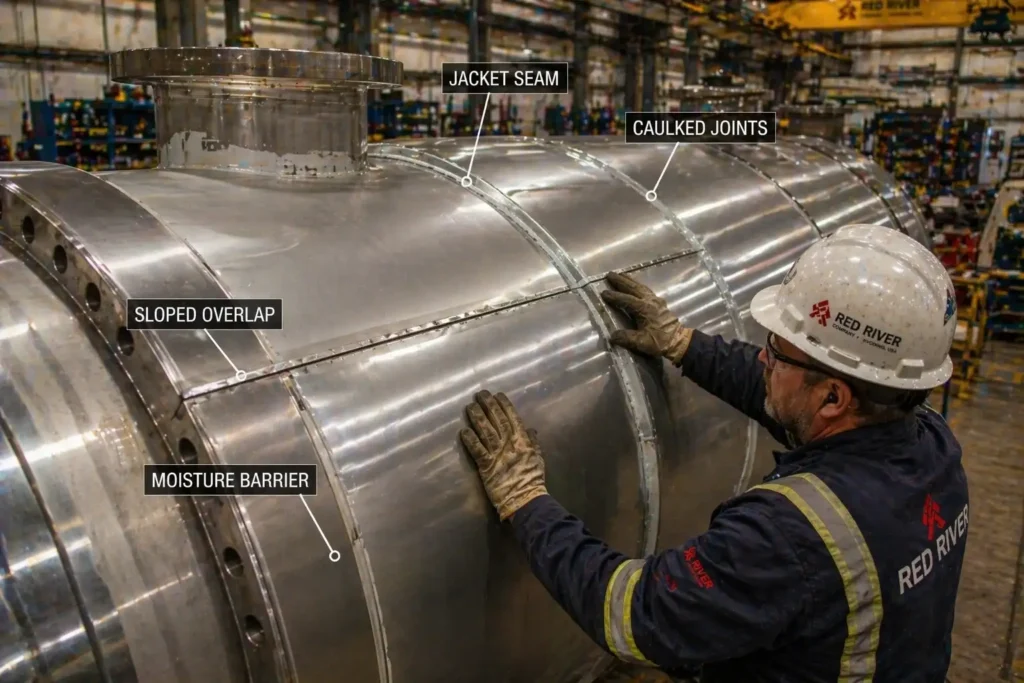
Moisture performance depends heavily on seam and joint treatment. Longitudinal seams lapped in the direction of water runoff with a minimum two-inch overlap and correctly applied sealant at all terminations provide good moisture exclusion in most environments.
Aluminum is not suitable for high-chloride environments, including coastal marine facilities. Chloride-induced stress corrosion cracking creates moisture pathways that are difficult to detect visually until the jacket has already failed.
Stainless steel jacketing
Stainless steel jacketing, typically Type 304 or Type 316, offers superior corrosion resistance compared to aluminum. Preferred for high-humidity environments, marine service, and facilities with aggressive chemical exposure, it provides significantly better long-term moisture protection in demanding service.
Type 304 is suitable for most inland industrial applications with moderate humidity and no significant chloride exposure. Type 316 is the correct choice where chloride exposure is a concern. Its molybdenum content provides resistance to chloride-induced pitting that Type 304 does not offer. For coastal facilities and offshore platforms, Type 316 is the baseline. Stainless steel’s dimensional stability also maintains seam geometry better than aluminum across thermal cycles. Red River’s fabrication capabilities include stainless steel jacketing installation as part of the vessel and skid scope.
Galvanized steel jacketing
Galvanized steel is used where cost is the primary constraint and the operating environment is relatively benign. The zinc coating that provides corrosion resistance can be damaged during installation by cutting or bending. Damaged areas corrode preferentially, and once corrosion establishes at a seam or penetration point, moisture ingress follows. Galvanized steel requires more frequent inspection than stainless steel to maintain moisture exclusion over the system’s service life.
Vapor barrier systems for cold service
For cold service applications, jacketing selection alone is not sufficient. A vapor barrier applied directly to the vessel or pipe surface, under the insulation, is required to prevent condensation from forming on the cold metal surface. Vapor barriers are typically polyethylene film, foil-faced kraft paper, or mastic coatings applied before insulation installation.
Red River’s modular skid packages are fabricated with insulation and jacketing systems fully installed in the shop, so vapor barrier and seam geometry are correct before the unit ships. Without a correctly installed vapor barrier, no jacketing material alone will prevent moisture damage on cold service equipment.
Installation Details That Determine Moisture Performance
Selecting the right jacketing options to prevent moisture ingress requires correct installation detail as much as correct material choice.
Seam orientation and overlap
Longitudinal seams must be oriented so the upper sheet overlaps the lower sheet in the direction of water runoff. A reversed lap creates a water trap. Minimum overlap of two inches on longitudinal seams and three inches on circumferential joints is standard practice.
Sealant selection and application
Sealant at termination ends and penetration flashings must be compatible with both the jacketing material and the operating temperature range. Silicone-based sealants are generally preferred for thermal stability across wide temperature ranges.
Penetration flashings
Every nozzle, support, or instrument connection that penetrates the jacketing is a potential moisture entry point. A flashing that does not fully seal the annular gap around a penetration allows water ingress regardless of how well the surrounding jacket is installed.
Support and hanger details
Where insulation support rings or cleats penetrate the jacketing, the geometry must shed water rather than collect it. Red River’s prefabrication services include fabrication of insulation support rings designed for correct water management geometry from the start.
Matching Jacketing Options to Prevent Moisture Ingress in Your Environment
For hot service vessels in dry inland environments, corrugated aluminum with correctly sealed seams performs well at a reasonable installed cost. For cold service or cyclic temperature vessels, a vapor barrier system under the insulation is required before jacketing selection is even relevant. For any vessel in a marine, coastal, or high-humidity environment, Type 316 stainless steel jacketing is the defensible choice regardless of additional cost.
NACE SP0198 provides the industry framework for CUI risk assessment and insulation system specification. ASTM International publishes material specifications for insulation jacketing materials that define minimum performance requirements for each material type. Getting jacketing right at the design stage is significantly less expensive than field modifications after installation.
Ready to Specify the Right Jacketing Options to Prevent Moisture Ingress?
If you are specifying jacketing for a pressure vessel, pipe spool, or modular skid package, Red River works through material selection, seam geometry, vapor barrier requirements, and penetration flashing details as part of the fabrication scope. Getting the right jacketing options to prevent moisture ingress confirmed before fabrication begins is the most cost-effective CUI prevention strategy on any industrial vessel project.
Request a quote or call 1-307-257-5332 to discuss which jacketing options prevent moisture ingress for your specific application with Red River’s fabrication team.
Frequently Asked Questions
1. What is the most common cause of moisture ingress in industrial jacketing systems?
Unsealed or poorly sealed termination ends and penetration flashings are the most common entry points. Longitudinal seams with reversed laps are the second most common failure point. Both are installation errors rather than material failures, which is why the same jacketing material can perform very differently depending on installation quality.
2. How often should jacketing systems be inspected for moisture ingress?
Annual visual inspection of jacketing condition, seam integrity, and sealant condition is a reasonable baseline for most industrial applications. High-risk systems, including cold service vessels and vessels in marine environments, warrant more frequent inspection. Infrared thermography can identify wet insulation behind intact jacketing without requiring removal.
3. Can existing jacketing be retrofitted to improve moisture performance?
Yes, in many cases. Replacing deteriorated sealant at seams and terminations, installing correctly fabricated penetration flashings where they are missing, and correcting reversed laps can significantly improve moisture performance without full jacket replacement.
4. Does jacketing material affect CUI risk on stainless steel vessels?
Yes, but differently than on carbon steel. Stainless steel vessels are susceptible to chloride-induced stress corrosion cracking under insulation rather than general corrosion. Jacketing materials that introduce or trap chloride-containing moisture against the vessel surface increase CUI risk on stainless steel.
5. What role does insulation material play in moisture ingress risk?
Insulation material affects how quickly moisture that enters the system causes damage. Hydrophobic materials, including cellular glass and certain aerogel blanket products, absorb very little moisture and dry out more readily when the moisture source is eliminated. Mineral wool and calcium silicate are highly absorbent and retain moisture for extended periods once wetted.
Key Takeaways
- Moisture ingress into insulation systems is driven by unsealed seams, penetrations, and joints, not by jacketing material failure alone. Installation detail is as important as material selection.
- Aluminum jacketing performs well in most dry to moderately humid environments when seams and terminations are correctly sealed. Not suitable for high-chloride environments.
- Type 316 stainless steel jacketing is the correct choice for marine, coastal, and chemically aggressive environments. Its dimensional stability maintains seam geometry better than aluminum across thermal cycles.
- Cold service and cyclic temperature vessels require a vapor barrier under the insulation in addition to jacketing. No jacketing material alone prevents condensation moisture ingress without it.
- Penetration flashings at nozzles, supports, and instrument connections are the highest-risk moisture entry points in any jacketing system. Correctly fabricated and installed flashings are non-negotiable.
Related Blog Post
Condensate Tanks: Types, Fabrication, and ASME Code
Which Tests Validate Deaeration in Pressure Systems?
Equalization Tanks: Design, Sizing, and Fabrication
What Are Thermal Storage Testing Standards for TES Vessels?
What Hydro Tests Are Required for Pressure Vessels?
About Author