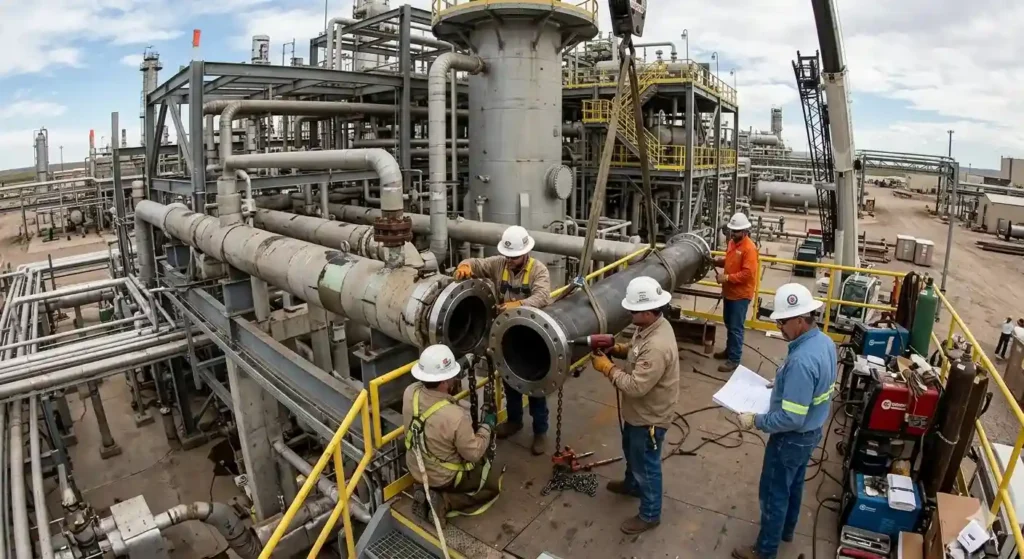
The answer comes down to three variables: how much field work is required at the connection point, how thoroughly that work was planned before the outage window opened, and whether fabricated components match actual field conditions. Each variable compounds the others. A field fit-up problem on an inadequately planned tie-in, using components that do not match field geometry, can double or triple the outage duration against the original schedule.
Key Takeaways
- Tie-ins impact downtime through four primary variables: field fit-up problems, weld inspection hold points, incomplete isolation and purging, and unmapped sequential dependencies. Pre-outage planning addresses all four before the window opens.
- Pre-fabricated pipe spools dimensioned to actual field conditions eliminate most fit-up corrections, compressing field work to the final connection weld and pressure test only.
- Modular skid packages pre-assembled and pre-tested before shipment reduce tie-in scope to utility and process connections with no field assembly required, which is the most effective approach for oil and gas, power generation, and biogas applications.
- ASME-certified fabrication with complete weld and inspection documentation, governed by OSHA 29 CFR 1910.147 isolation requirements, helps inspection hold points move on schedule during the outage.
- Tie-in fabrication should begin six to eight weeks before the planned outage date, and 10 to 14 weeks for ASME-coded components or long-lead materials.
What Is a Tie-In and How Does It Create an Outage Window?
A tie-in connects a new system to an existing operating process. The outage window opens when the system is isolated and depressurized. It closes when the tie-in is complete, inspected, pressure tested, and the system is returned to service. Every hour between those two points carries a measurable operating cost.
Three variables determine how long that window runs: how much field work is required at the connection point, how thoroughly that work was planned beforehand, and whether fabricated components match actual field conditions. Red River’s prefabrication services are built around reducing field work at the tie-in point, compressing the outage to the final connection weld, pressure test, and inspection rather than fabrication, fit-up correction, and then connection.
What Causes Tie-In Outage Windows to Run Long?
Four causes account for most extended tie-in outages: field fit-up problems, weld inspection hold points, incomplete isolation and purging, and unmapped sequential dependencies. Each one is preventable with planning that happens before the outage window opens.
Field Fit-Up Problems
Field fit-up problems are the most common cause of extended tie-in outages. Drawings show design intent. Field measurements reveal what years of thermal cycling, settlement, and previous modifications have produced.
A nozzle two inches off its design location, a header that has shifted from its original position, or a flange face not in the plane the drawings show all require field correction time that was not in the outage schedule. For pressure vessel tie-ins, these corrections often involve welding in restricted access environments, which compounds the time impact significantly.
Weld Inspection Hold Points
Tie-in welds on operating process systems are typically full-penetration welds subject to non-destructive examination (NDE) before the system returns to service. If a weld requires repair, the inspection and repair cycle adds the time to complete the repair weld, perform post-weld heat treatment (PWHT) where required, and reinspect.
ASME certification requirements for process vessel and piping tie-ins mean only qualified welders using qualified procedures can perform the connection weld. Coordinating certified welding personnel, inspection hold points, and NDE resources as part of pressure vessel tie-in planning directly affects how quickly the tie-in moves through its required sequence.
Incomplete Isolation and Purging
For tie-ins on hydrocarbon systems, hazardous chemical lines, or high-pressure steam headers, the isolation and purging sequence before work can begin is frequently underestimated. According to OSHA, the Control of Hazardous Energy standard, OSHA 29 CFR 1910.147, governs how hazardous energy control must be sequenced and documented. If the isolation plan is not fully developed before the outage starts, the window expands while isolation is worked out in real time.
Sequential Dependencies
Many tie-in outages affect more than one system. A new vessel connection to a process header may require isolating downstream equipment to maintain safe working conditions. If those dependencies are not mapped before the outage, discovering them during field work adds unplanned scope and time.
How Do Fabrication Decisions Affect Tie-In Downtime?
Fabrication decisions directly determine how much field work remains at the connection point. The quality and dimensional accuracy of components arriving at the tie-in determine whether the outage window runs to schedule or beyond it. Tie-in fabrication done in the shop under controlled conditions consistently outperforms field fabrication on both quality and cost.
Pre-Fabricated Pipe Spools
A tie-in using pre-fabricated spools with final field welds only at the connection points moves significantly faster than one where fabrication happens in the field. Shop fabrication under controlled conditions produces better weld quality at lower cost than field fabrication in restricted environments.
Red River fabricates pipe spools to tight dimensional tolerances with field fit-up in mind. For tie-in projects where existing conditions have been field-measured, spools can be fabricated to match actual field geometry rather than nominal drawing dimensions, eliminating fit-up corrections at the connection point. This approach also reduces the number of field welds required, which directly compresses the NDE and inspection hold point sequence during the outage.
Modular Skid Integration
For tie-ins involving a complete new process system, modular skid packages pre-assembled and pre-tested in the shop reduce the tie-in scope to utility connections and the process connection itself. The skid arrives ready to operate.
This approach is particularly effective for oil and gas applications where extended downtime carries significant revenue impact. It also works well for power generation and biogas upgrading projects where the process cannot be offline for extended periods without affecting operations downstream. See Red River’s modular skid packages for how this applies to complete process system tie-ins.
Fit-Up Provisions in the Fabrication Scope
Shop-fabricated tie-in spools and vessel connections built with fit-up provisions, including dimensional allowance at field weld joints or adjustable flanges, give the field crew flexibility to close fit-up gaps without fabricating new components during the outage. Red River’s pressure vessel fabrication includes close coordination with field engineers during the design phase to identify tie-in fit-up risk points and build appropriate provisions before the spool leaves the shop.
What Is the Difference Between a Hot Tap and a Standard Tie-In?
A hot tap makes a new connection to a live line without shutting the system down, which removes the outage for that connection entirely. A standard tie-in requires the system to be isolated and depressurized first, but it applies across a far wider range of service conditions and vessel types. The table below shows how the two compare from a downtime standpoint.
| Factor | Hot Tap | Standard Tie-In |
| Outage required | None for the connection | Full isolation and depressurization |
| Service conditions | Limited pressure, temperature, and fluid ranges | Broad range of services and vessel types |
| Equipment | Specialized hot tap equipment and crew | Standard welding and inspection resources |
| Inspection sequence | Performed on the live connection | NDE and pressure test before return to service |
| Best fit | Connections that cannot tolerate shutdown | Coded vessels and complex multi-point work |
For coded pressure vessel work and multi-point connections, a standard tie-in with pre-fabricated components is usually the controlling path, and downtime is governed by how well that fabrication and isolation were planned.
What Planning Practices Shorten Tie-In Outage Windows?
The outage window is set largely by decisions made before the outage starts. The following practices consistently shorten outage windows on both pipeline and process vessel tie-ins.
Field verification of tie-in geometry before fabrication is released eliminates the most common cause of outage extension. Pre-positioning of all materials, inspection resources, and NDE equipment before the outage begins removes discovery time from the window. Complete isolation and purging procedures developed and reviewed in advance ensure compliance with OSHA 29 CFR 1910.147 and prevent the window from expanding while isolation is worked out in real time.
ASME-certified fabrication with complete weld and inspection documentation helps inspection hold points move on schedule. The National Board provides guidance on repair and alteration documentation that applies when tie-in work modifies a coded pressure vessel.
For complex tie-ins with multiple connection points or sequential isolation dependencies, a pre-outage walkdown that traces every step of the planned work sequence identifies schedule risks while there is still time to address them. Walkthroughs also confirm that all required tools, consumables, and inspection equipment are on-site and staged before the outage window opens, a detail that commonly adds hours to an outage when skipped.
How Far in Advance Should Tie-In Fabrication Begin?
Tie-in fabrication should begin at least six to eight weeks before the planned outage date for most projects. For ASME-coded components or projects with long-lead materials, 10 to 14 weeks is more appropriate. Starting fabrication after the outage date is set and treating it as a constraint is the most common cause of components arriving late and outages running long.
Red River’s fabrication capabilities apply directly to process system tie-in work across Wyoming and the Rocky Mountain region, verifying field dimensions, designing spools with fit-up provisions built in, and delivering components that minimize field work at the connection point before the outage schedule is set.
Tie-In Downtime Is Decided Before the Outage Window Opens
Downtime on your next tie-in is set by how thoroughly the fabrication scope, field fit-up risks, and isolation requirements are resolved before the outage window opens, not by how fast the field crew works once it is open. Field-verified spools, pre-staged inspection resources, and a fully developed isolation plan are what keep the window running to schedule.
Request a Tie-In Fabrication Review From Red River
Red River holds the ASME U Stamp and NBBI R Stamp certifications and has fabricated precision pipe spools, pressure vessels, and modular skid packages for oil and gas, power generation, and biogas clients out of Gillette, Wyoming, since 2003. Ask us to review your field conditions, isolation requirements, and outage schedule so fabrication scope is accurate before the window opens. Request a quote, contact our team, or call 1-307-257-5332 to discuss your tie-in fabrication scope.
Frequently Asked Questions
1. How Do Tie-Ins Impact Downtime on Oil and Gas Facilities Specifically?
Oil and gas tie-ins typically carry the highest downtime cost per hour because production is directly affected during the outage window. Hydrocarbon system tie-ins also require more extensive isolation and purging procedures under OSHA 29 CFR 1910.147, which adds pre-work time before field welding can begin. Pre-fabricated spools with verified field dimensions and pre-positioned inspection resources are the most effective ways to compress the outage window on oil and gas tie-in work.
2. Can a Hot Tap Always Replace a Standard Tie-In to Avoid Downtime?
No. A hot tap avoids shutdown only when pressure, temperature, and fluid service fall within the limits the hot tap equipment can safely handle. Coded pressure vessel connections, high-pressure steam headers, and many multi-point tie-ins fall outside those limits and require a standard isolated tie-in. The right choice depends on the specific service conditions and the scope of the connection.
3. How Does Prefabrication Reduce Tie-In Downtime?
Prefabrication moves fabrication work from the field to the shop, where conditions are controlled and quality is easier to maintain. A tie-in spool fabricated and inspected in advance arrives at the site ready to install. The field scope reduces to the final connection weld, pressure test, and inspection, a fraction of the time required for field fabrication of the same connection.
4. What Documentation Is Required for a Tie-In on a Coded Pressure Vessel?
Tie-in welds on ASME-coded pressure vessels require weld procedure specifications, welder performance qualification records, NDE reports for the completed weld, and a pressure test record. For vessels, an R Stamp repair record may also be required depending on the scope. Red River maintains these records as part of every fabrication project.
5. What Happens to the Outage Schedule if a Tie-In Weld Fails Inspection?
A failed NDE result triggers a repair cycle that adds time to grind out and re-weld the joint, perform post-weld heat treatment where the code requires it, and reinspect before the system returns to service. This is why qualified welders, qualified procedures, and shop-controlled fabrication matter so much: they reduce the chance of a repair cycle landing inside the outage window. Verified field dimensions and pre-staged inspection resources keep the sequence moving when a hold point is reached.
Related Blog Post
Condensate Tanks: Types, Fabrication, and ASME Code
Which Tests Validate Deaeration in Pressure Systems?
Equalization Tanks: Design, Sizing, and Fabrication
What Are Thermal Storage Testing Standards for TES Vessels?
What Hydro Tests Are Required for Pressure Vessels?
About Author