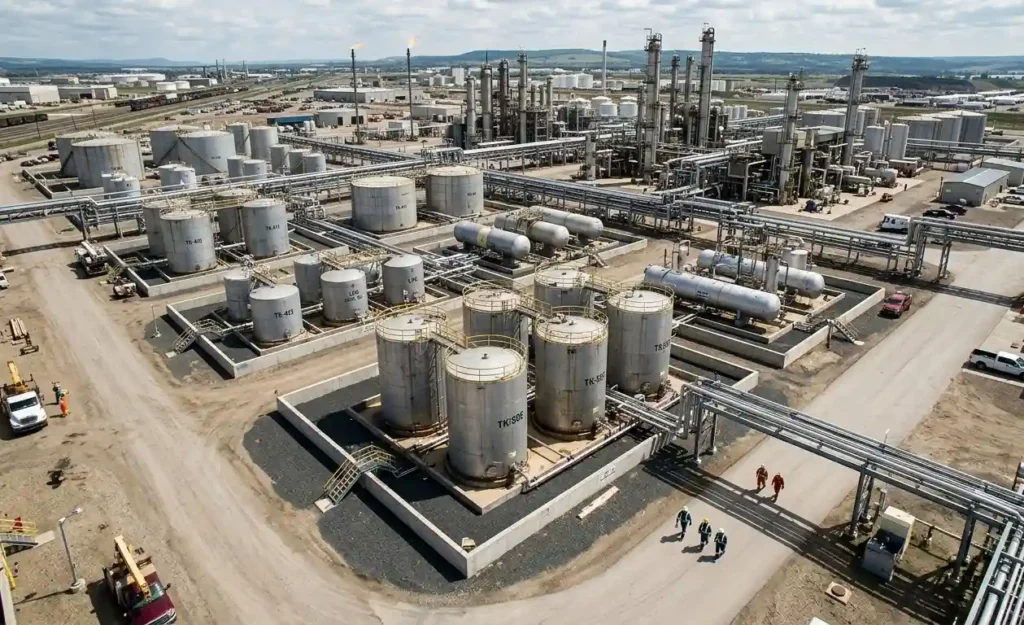
Industrial tanks should be sited based on six factors: safety separation distances, prevailing wind direction, process flow efficiency, secondary containment geometry, maintenance access, and future expansion provisions. Tank location is a foundational design decision, not a siting afterthought, because getting it wrong forces costly compromises on every downstream system.
Key Takeaways
- Safety separation distances from property lines, buildings, and ignition sources are the first and most constraining siting factor. NFPA 30 is the primary reference for above-ground storage tanks; ASME Section VIII provisions apply for pressure vessels.
- Prevailing wind direction matters for tanks storing volatile, flammable, or toxic materials. Vapor dispersion modeling under OSHA 29 CFR 1910.119 should inform siting before placement is finalized.
- Tank location directly determines piping length and complexity. Placing tanks close to their process connections reduces capital cost and pressure drop across the life of the facility.
- The EPA SPCC Rule requires secondary containment for above-ground oil storage above threshold quantities. Clustered tanks within a shared containment area cost significantly less than tanks in individual cells.
- Maintenance and inspection access, including crane clearance for NBBI R Stamp repair work, must be physically achievable at the installed location.
- Future expansion provisions should be part of the initial siting decision. Reserving adjacent space at the design stage eliminates expensive layout compromises when capacity needs increase.
Why Does Tank Location Affect the Entire Facility Design?
Tank placement constrains virtually every downstream system in a facility. Piping runs, secondary containment geometry, fire suppression coverage, access road routing, electrical area classification boundaries, and future expansion corridors all flow from where the tank sits.
Red River works with clients during early project planning to resolve how vessel location, orientation, and support configuration interact with the broader facility layout. Vessel geometry, nozzle orientation, and support type are all shaped by where the tank is going and how it will be accessed, which means siting decisions directly define fabrication scope.
What Are the Safety Separation Distance Requirements for Industrial Tanks?
Safety separation is the first and most constraining factor in tank siting. NFPA 30 (Flammable and Combustible Liquids Code) is the primary reference for above-ground storage tank separation requirements in most U.S. jurisdictions.
What NFPA 30 Specifies
NFPA 30 sets minimum distances between tanks, between tanks and property lines, between tanks and buildings, and between tanks and ignition sources. These distances vary based on tank capacity, the flash point of the stored liquid, and whether the tank is protected by a fixed fire suppression system.
How Far Should an Industrial Tank Be From Property Lines and Buildings?
NFPA 30 Table 4.2 defines the baseline separation distances for above-ground tanks. For tanks with a capacity of 275 gallons or less holding Class I-A liquids, the minimum distance from a property line is three feet. For larger tanks, separation distances scale with capacity and can range from five feet to 100 feet depending on the stored product and whether a fixed suppression system is present. Tanks storing Class I and Class II liquids in volumes above 12,000 gallons require at least 20 feet of separation from property lines in most configurations. Confirm the applicable table row and any local amendments with the authority having jurisdiction before finalizing any location.
Pressure Vessel Siting Under ASME
For pressure vessels storing gases or process fluids under pressure, additional separation requirements may apply under ASME (American Society of Mechanical Engineers) Section VIII provisions and local building codes. Getting separation distances wrong is not just a regulatory violation. It is a safety failure that proper siting prevents at the design stage.
How Does Prevailing Wind Direction Affect Tank Placement?
Prevailing wind direction is a siting input that is frequently underweighted for tanks storing volatile, flammable, or toxic materials. Vapor releases, whether through normal venting, emergency pressure relief, or accidental spills, disperse downwind. Placing a tank upwind of an ignition source, a populated work area, or a facility air intake creates a vapor dispersion hazard that correct industrial tank placement eliminates.
When Is Dispersion Modeling Required?
Dispersion modeling for hazardous material releases is a standard component of process hazard analysis (PHA) under OSHA’s Process Safety Management standard (29 CFR 1910.119) for facilities handling regulated substances. The results of that modeling should inform tank placement before location is finalized, not confirm it afterward.
How Does Tank Location Affect Piping Cost and Efficiency?
A tank’s position in the facility layout directly determines the length, complexity, and cost of the piping that connects it to the process. Longer pipe runs require more material, more structural support, more insulation, more heat tracing where needed, and produce greater pressure drop. For high-flow applications, that pressure drop carries real energy cost implications across the operating life of the facility.
How Modular Skid Packages Simplify Siting
Placing tanks as close as safely possible to their process connections reduces piping complexity and capital cost. Red River’s modular skid packages are frequently sited as integrated units because consolidating the vessel, piping, and instrumentation on a single skid reduces field piping scope and simplifies the placement decision.
When Is Secondary Containment Required and How Does Tank Location Affect It?
Secondary containment is required under the EPA Spill Prevention, Control, and Countermeasure (SPCC) Rule for above-ground oil storage facilities that exceed threshold quantities, generally 1,320 gallons aggregate above-ground or 42,000 gallons underground. Many state environmental regulations impose similar requirements for other hazardous materials.
How Tank Clustering Reduces Containment Cost
The containment structure must be sized to hold the full capacity of the largest tank within it, plus freeboard for precipitation accumulation. Tank location determines the geometry and cost of the secondary containment structure. Tanks clustered together within a shared containment area cost significantly less to contain than tanks scattered across the facility in individual containment cells. Terrain, drainage patterns, and proximity to surface water all affect where containment can be constructed and how it must be designed to meet EPA requirements.
What Maintenance and Inspection Access Does a Pressure Vessel Require?
Every industrial tank requires periodic inspection, maintenance, and in many cases repair. A vessel positioned against a facility boundary with no room for scaffolding, mobile equipment access, or crane positioning creates maintenance problems that are not discovered until the first inspection interval.
ASME and NBBI R Stamp Access Requirements
ASME and jurisdictional inspection requirements specify access conditions for both internal and external inspection that must be built into the siting layout from the start. For vessels requiring NBBI R Stamp repair work, crane access for head removal or nozzle replacement must be physically achievable at the installed location. Red River designs vessels with maintenance access as a siting input, including nozzle orientation, manway placement, and support configuration matched to actual site conditions. See how Red River approaches this through its pressure vessel fabrication capabilities.
Why Should Future Expansion Be Part of the Initial Tank Siting Decision?
A facility that is well-designed today will likely need additional capacity in the future. Tank siting should account for where additional vessels will go, what infrastructure will need to be extended to serve them, and whether the current layout reserves that expansion room.
The Most Common Siting Mistake
The most common error is placing the first tank in the most convenient location without reserving adjacent space for future capacity. When expansion happens, the second tank ends up in an awkward position that drives up piping costs, compromises secondary containment geometry, or creates new separation distance conflicts with the existing tank. Building expansion provisions into the initial siting decision costs nothing at the design stage.
How Should You Involve a Fabricator in the Tank Siting Decision?
Tank location decisions made without fabricator input can produce geometry, nozzle orientation, or support configuration requirements that are more expensive or complex than necessary. A fabricator who understands the intended installation site can design a vessel that fits the location cleanly rather than requiring field modifications after construction.
What Early Fabricator Involvement Prevents
Late fabricator involvement can create mismatches between the vessel design and the installation site. Nozzle orientations may conflict with piping routes, support configurations may not match the foundation design, and access clearances may be insufficient for future inspection or repair. Correcting these issues after fabrication adds cost and schedule time. Involving the fabricator during the siting phase, before drawings are finalized, eliminates most of these conflicts at no additional cost.
Red River’s prefabrication services engage with clients on siting questions as part of early project planning. Clients who bring Red River into the siting conversation early get vessels designed for their actual installation environment, not generic configurations that require field adaptation.
Six Factors. One Decision. Get It Right Before Fabrication Begins.
Industrial tank placement is a design decision with compounding consequences. Every factor, from NFPA 30 separation distances to crane access for NBBI R Stamp repair, needs to be resolved before fabrication scope is set. Red River has worked with clients across oil and gas, power generation, and biogas since 2003 to work through these siting questions early, so the vessel that arrives on site fits the location cleanly. See Red River’s capabilities overview for how siting connects to overall fabrication planning.
Ready to Work Through Your Tank Siting Requirements?
Ask us to review your siting conditions when you request a quote. Call 1-307-257-5332 or submit through the request a quote to discuss how vessel location affects fabrication scope before the design is finalized.
Frequently Asked Questions
1. How Far Should an Industrial Tank Be From Property Lines and Buildings?
NFPA 30 Table 4.2 governs minimum separation distances for above-ground storage tanks in most U.S. jurisdictions. Distances scale with tank capacity, stored product flash point, and whether a fixed fire suppression system is present. For tanks holding Class I or Class II liquids above 12,000 gallons, at least 20 feet of separation from property lines is typically required. For pressure vessels, ASME Section VIII and local building codes impose additional separation requirements. Always confirm applicable requirements with the authority having jurisdiction before finalizing location.
2. Does tank orientation affect where a vessel can be located?
Yes. A horizontal vessel requires more linear footprint but less overhead clearance than a vertical vessel of the same capacity. Vertical vessels require crane access overhead for installation and future maintenance, which affects what can be located adjacent to them. Nozzle orientation determines where process piping connects, which affects how the vessel relates to adjacent equipment. These factors should be considered together during the siting decision, ideally with fabricator input before location is finalized.
3. When is secondary containment required for industrial tanks?
The EPA SPCC Rule requires secondary containment for above-ground oil storage facilities that exceed threshold quantities, generally 1,320 gallons aggregate above-ground or 42,000 gallons underground. Many state environmental regulations impose similar requirements for other hazardous materials. The containment structure must be sized to hold the capacity of the largest tank within it plus freeboard for precipitation. Tank location determines containment geometry and cost, making siting and containment planning closely linked decisions.
4. How does Red River support clients with tank siting decisions?
Red River engages with clients on siting questions as part of early project planning. The team reviews installation site conditions, access requirements, nozzle orientation needs, and support configuration options to ensure the vessel fits the intended location without requiring field modification. Clients who involve Red River early in the siting conversation get vessels designed for their actual installation environment. Call 1-307-257-5332 or visit our request a quote to start that conversation.
5. What happens if tank location is finalized before the fabricator is consulted?
Late fabricator involvement can produce mismatches between the vessel design and the installation site. Nozzle orientations may conflict with piping routes, support configurations may not match the foundation design, and access clearances may be insufficient for future inspection or repair. Correcting these issues after fabrication adds cost and schedule time. Involving the fabricator during the siting phase eliminates most of these conflicts at no additional cost.
Related Blog Post
Condensate Tanks: Types, Fabrication, and ASME Code
Which Tests Validate Deaeration in Pressure Systems?
Equalization Tanks: Design, Sizing, and Fabrication
What Are Thermal Storage Testing Standards for TES Vessels?
What Hydro Tests Are Required for Pressure Vessels?
About Author