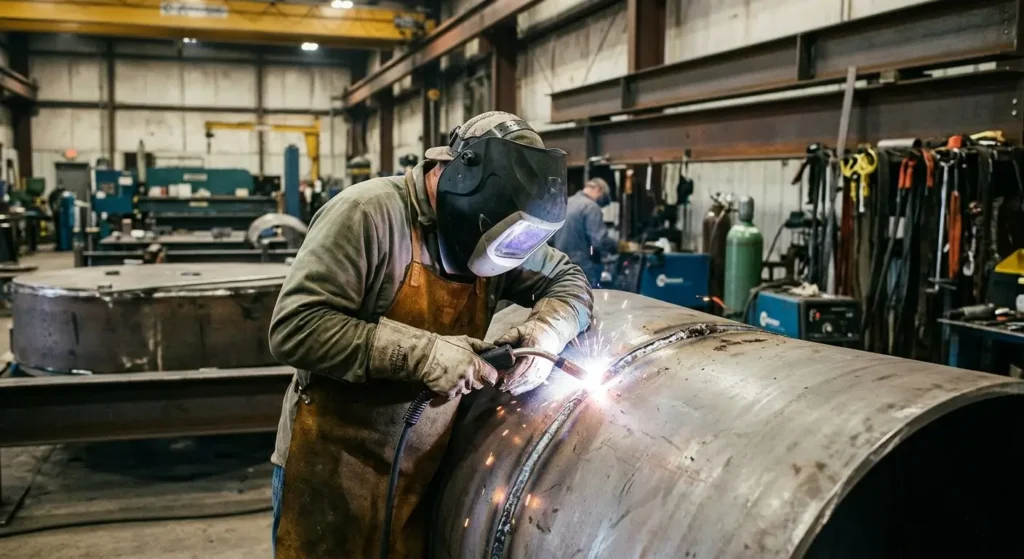
The five common weld procedures industrial fabrication relies on for coded vessels are Shielded Metal Arc Welding (SMAW), Gas Tungsten Arc Welding (GTAW), Gas Metal Arc Welding (GMAW), Flux Cored Arc Welding (FCAW), and Submerged Arc Welding (SAW). Process selection depends on base material, joint position, production volume, and whether work is shop or field, and every process must be executed to a qualified Weld Procedure Specification supported by a Procedure Qualification Record under ASME Section IX.
Key Takeaways
- The right weld procedure depends on material, joint position, production volume, and whether the work is shop or field. SMAW, GTAW, GMAW, FCAW, and SAW each cover specific application ranges.
- Every WPS must be supported by a Procedure Qualification Record documenting mechanical test results. A WPS without a PQR is not a qualified procedure under ASME Section IX.
- GTAW root passes followed by SMAW or FCAW fill and cap passes are the standard combination for alloy pipe and nozzle welds where root quality and all-position capability are both required.
- SAW delivers the highest deposition rates for flat-position shell seam welding on large-diameter carbon steel vessels. Positioner use is required to orient seams for flat welding.
- PWHT requirements are material and thickness dependent. Chrome-moly alloy vessels require PWHT regardless of thickness; carbon steel vessels require PWHT above defined thickness thresholds per ASME Section VIII.
What Is the Code Foundation for Weld Procedures on Coded Pressure Vessels?
Every weld on an ASME-coded pressure vessel must be performed to a qualified Weld Procedure Specification (WPS). ASME welding procedures pressure vessel fabricators use are governed by ASME Section VIII for design and ASME Section IX for qualification. The WPS documents the essential variables governing the weld: base material specification, filler material classification, preheat and interpass temperature requirements, welding position, heat input range, and post-weld heat treatment requirements where applicable.
How WPS and PQR Qualification Works Under ASME Section IX
WPS qualification under ASME Section IX requires a Procedure Qualification Record (PQR) that documents the actual variables used during a test weld and the mechanical test results proving the procedure produces welds meeting code mechanical requirements. The WPS qualification ASME Section IX process requires a Procedure Qualification Record before a procedure can be used on coded work. A WPS without a supporting PQR is not a qualified procedure under ASME code.
Red River maintains qualified WPS and WPQ records covering all five common processes across carbon steel, stainless steel, and chrome-moly alloy materials. See Red River’s pressure vessel fabrication for how this qualification program applies across vessel types and industries.
Where Is Shielded Metal Arc Welding Used on Pressure Vessels?
SMAW is used for root passes, tack welds, repairs, and structural attachments where all-position capability and access to restricted joints matter more than deposition speed.
What SMAW Is and Where It Applies
Shielded Metal Arc Welding (SMAW), also called stick welding, remains one of the most widely used welding processes in industrial fabrication. SMAW uses a consumable coated electrode that provides both the filler metal and the shielding flux. The process works in all positions and is well-suited to field repair, restricted access joints, and low-volume production.
How SMAW Is Used on Coded Vessels
SMAW is commonly used for root passes on pipe and nozzle welds, tack welds during fit-up, repair welds on existing vessels, and structural attachment welds. For full-penetration groove welds on pressure-retaining joints, SMAW produces lower deposition rates than wire-fed processes, making it slower for high-volume shell seam production. Its position flexibility and access make it the standard process for joints where other processes cannot reach.
Where Is Gas Tungsten Arc Welding Used on Pressure Vessels?
GTAW is the standard for high-purity root passes on stainless steel and chrome-moly alloy pipe, thin-wall nozzles, and joints where complete, clean penetration is critical to long-term service reliability.
What GTAW Is and Where It Applies
Gas Tungsten Arc Welding (GTAW), also called TIG welding, uses a non-consumable tungsten electrode and a separate filler rod fed manually into the weld puddle. GTAW produces the highest quality welds in terms of cleanliness and control, making it standard for root passes on stainless steel and chrome-moly alloy pipe, thin-wall nozzles, and joints where incomplete penetration would create a service failure risk.
How GTAW Is Used on Coded Vessels
GTAW root passes followed by SMAW or FCAW fill and cap passes are a standard combination for alloy pipe and nozzle welds across Red River fabrication scopes. The GTAW root provides a clean, fully fused root with controlled penetration. The faster fill process completes the joint efficiently. Red River’s fabrication capabilities include GTAW procedures qualified for carbon steel, stainless steel, and chrome-moly alloy base materials across the pressure and temperature ranges common in oil and gas, power generation, and thermal storage vessel work.
Where Is Gas Metal Arc Welding Used on Pressure Vessels?
GMAW is used for higher-deposition shell seam fill, structural attachments, and nozzle fill passes, with transfer mode chosen to match material thickness and joint position.
What GMAW Is and Where It Applies
Gas Metal Arc Welding (GMAW), also called MIG welding, uses a continuously fed wire electrode and a shielding gas. GMAW produces higher deposition rates than SMAW or GTAW, making it well-suited for high-volume production welding on plate and structural members. Short-circuit transfer covers thin materials and out-of-position work; spray and pulse transfer modes cover thicker flat and horizontal applications.
How GMAW Is Used on Coded Vessels
GMAW is commonly used for shell seam fill and cap passes, structural attachment welds, and nozzle fill passes on larger-diameter connections. For ASME-coded vessel fabrication, GMAW procedures must address transfer mode, wire classification, and shielding gas composition as essential variables in the WPS.
Where Is Flux Cored Arc Welding Used on Pressure Vessels?
FCAW is used for high-deposition fill and cap passes on carbon steel shell seams and structural welds, with self-shielded variants suited to field tie-in and outdoor repair work.
What FCAW Is and Where It Applies
Flux Cored Arc Welding (FCAW) uses a tubular wire electrode containing flux in the core. The flux provides shielding and influences weld chemistry and mechanical properties. Self-shielded FCAW requires no external shielding gas and is well-suited to outdoor work and field installation. Gas-shielded FCAW uses an external shielding gas in addition to the core flux, producing cleaner welds with better mechanical properties and tighter control over chemistry.
How FCAW Is Used on Coded Vessels
FCAW is among the most common weld procedures for fill and cap passes on carbon steel pressure vessel shell seams and structural welds. Its higher deposition rate compared to SMAW, combined with all-position capability for gas-shielded variants, makes it productive for high-volume flat and vertical work. Self-shielded FCAW sees use in field tie-in and repair applications where external gas shielding is impractical.
Where Is Submerged Arc Welding Used on Pressure Vessels?
SAW is the standard for long, flat-position shell seams on large-diameter vessels, delivering the highest deposition rates of any common arc process in automatic operation.
What SAW Is and Where It Applies
Submerged Arc Welding (SAW) uses a continuously fed wire electrode and a granular flux that covers the arc completely, eliminating spatter and arc flash. SAW produces the highest deposition rates of any common arc welding process and delivers consistent weld quality in automatic and semi-automatic operation. The process is limited to flat and horizontal positions, requiring a positioner to orient joints for flat welding.
How SAW Is Used on Coded Vessels
SAW is the standard process for longitudinal and circumferential shell seam welds on large-diameter vessels where the seams can be oriented flat. The high deposition rate and automatic operation make SAW highly productive for long straight seams on thick-wall carbon steel and low-alloy vessels. Red River’s prefabrication services include SAW-welded shell seams on larger vessel configurations where the process delivers both productivity and weld quality advantages over manual processes.
When Is Post-Weld Heat Treatment Required for Pressure Vessel Welds?
PWHT requirements are tied to the welding process, base material specification, and wall thickness. For carbon steel vessels above defined thickness thresholds and for chrome-moly alloy vessels regardless of thickness, PWHT is required by ASME Section VIII to relieve residual stresses and restore material toughness in the heat-affected zone.
What the PWHT Cycle Must Document
The PWHT cycle, including heating rate, hold temperature, hold duration, and cooling rate, must be documented in the WPS and the heat treatment record. Thermocouples attached to the vessel during PWHT produce time-temperature records that become part of the vessel documentation package reviewed by the National Board authorized inspector. The PWHT record is a required component of the final documentation package delivered with every coded vessel.
Weld Procedures Red River Maintains for Coded Vessel Fabrication
Red River maintains qualified WPS and WPQ records covering SMAW, GTAW, GMAW, FCAW, and SAW across carbon steel, stainless steel, and chrome-moly alloy materials, with all personnel held to AWS and ASME Section IX requirements. Every coded vessel is welded by qualified personnel with a third-party authorized inspector on-site for all required hold points. Red River has held ASME U Stamp and NBBI R Stamp certifications since 2003, fabricating pressure vessels, pipe spools, and modular skid packages for oil and gas, power generation, and biogas clients from Gillette, Wyoming. The same code-qualified weld procedures apply to thermal storage vessels across these industries.
Ready to Discuss Your Vessel Welding Scope?
Request a quote or call 1-307-257-5332 to discuss your vessel welding scope and procedure requirements with Red River’s team. Whether the project involves carbon steel shell seams, alloy nozzle work, or a complete modular skid package, Red River’s qualified procedures and third-party inspection program are in place before fabrication begins.
Frequently Asked Questions
1. Which Weld Procedures Are Common for Full-Penetration Groove Welds on Pressure Vessels?
SMAW, GTAW, GMAW, FCAW, and SAW are all used for full-penetration groove welds on pressure vessels depending on material, position, and production volume. GTAW root passes followed by SMAW or FCAW fill and cap passes are standard for alloy materials. SAW covers high-volume flat seam welding on large-diameter carbon steel vessels.
2. What Is the Difference Between a WPS and a PQR Under ASME Section IX?
A Weld Procedure Specification (WPS) is the instruction document that defines how a weld must be made. A Procedure Qualification Record (PQR) documents the actual variables used during a test weld and the mechanical test results that support the WPS. The PQR is the evidence that the procedure produces acceptable welds. A WPS without a supporting PQR is not a qualified procedure under ASME code.
3. When Is Post-Weld Heat Treatment Required for Pressure Vessel Welds?
PWHT is required by ASME Section VIII for carbon steel vessels above defined wall thickness thresholds and for chrome-moly alloy vessels regardless of thickness. The specific requirements depend on the material P-number, thickness, and service conditions. PWHT relieves residual welding stresses and restores heat-affected zone toughness in materials susceptible to hardening during the weld thermal cycle.
4. Can a Welder Qualified Under One WPS Weld to a Different Procedure?
A welder’s qualification is tied to the essential variables of the process they tested on: welding process, base material group, filler metal group, position, and thickness range. If a different WPS involves variables outside the welder’s tested range, the welder must requalify. Welder performance qualification records are maintained and reviewed as part of the vessel documentation package.
5. What NDE Methods Are Used to Verify Weld Quality After Welding?
Radiographic testing (RT) and ultrasonic testing (UT) verify internal weld quality on full-penetration joints. Magnetic particle testing (MT) and liquid penetrant testing (PT) verify surface and near-surface weld quality. The applicable NDE method and extent of examination are specified by the vessel design code and the vessel’s design specification for each joint category.
Related Blog Post
Condensate Tanks: Types, Fabrication, and ASME Code
Which Tests Validate Deaeration in Pressure Systems?
Equalization Tanks: Design, Sizing, and Fabrication
What Are Thermal Storage Testing Standards for TES Vessels?
What Hydro Tests Are Required for Pressure Vessels?
About Author