
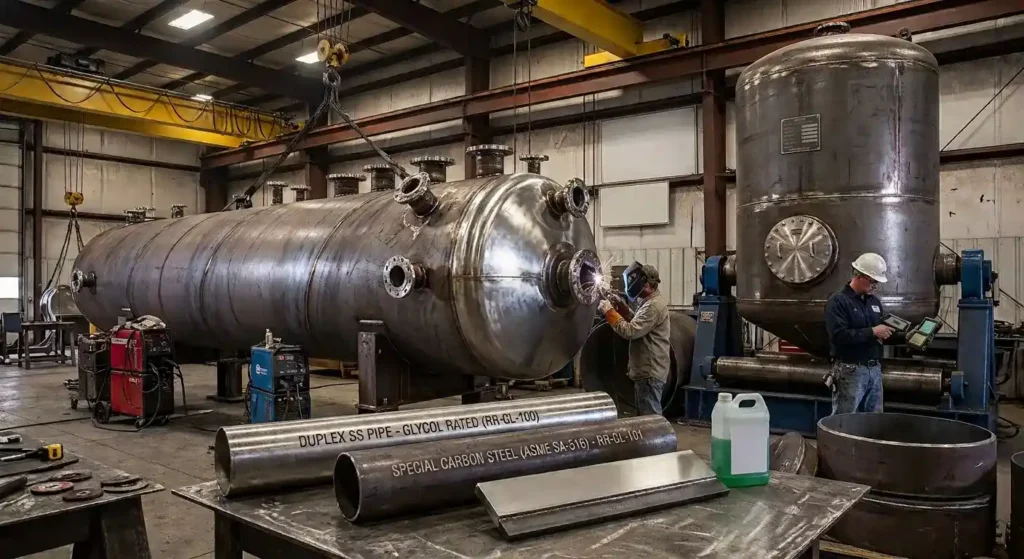
Stainless steel and inhibited carbon steel are the two materials that suit glycol service reliably, with stainless preferred where purity and corrosion resistance are priorities and inhibited carbon steel the cost-effective choice for industrial loops with consistent fluid maintenance. Galvanized steel and bare aluminum must be kept out of glycol systems entirely, because both react with glycol and its inhibitors in ways that foul the loop.
Key Takeaways
- Stainless steel offers the best corrosion resistance and purity for glycol service, especially food-grade propylene glycol loops where fluid contamination is a product safety concern.
- Carbon steel works well for industrial glycol service when the correct inhibitor package is carried and maintained through periodic monitoring.
- Galvanized steel must be avoided. The zinc coating reacts with glycol inhibitors, forms sludge, and fouls strainers and heat exchangers.
- Bare aluminum corrodes in most glycol mixtures unless the fluid is specifically formulated for it.
- Glycol chemistry, not just the metal, drives vessel life. Material choice and fluid maintenance are the same decision.
Which Materials Suit Glycol Service Best?
The two materials that suit glycol service are stainless steel and inhibited carbon steel. The choice between them depends on purity requirements, corrosion risk, and budget. Both can provide long service life in a glycol loop when matched to the fluid and maintained properly.
Why Fluid Chemistry Is the Starting Point
Glycol is relatively mild when fresh and properly inhibited. Problems begin when the inhibitor package depletes or the fluid degrades, turning acidic and attacking the tank wall. The right metal is the one matched to the fluid it will actually hold across years of operation. Red River’s pressure vessel fabrication process confirms the material specification against the actual glycol and service conditions before fabrication begins.
The Practical Decision Rule
For most glycol tanks and vessels: stainless steel where purity or corrosion resistance is the governing factor, and inhibited carbon steel where consistent upkeep makes the material cost savings worthwhile.
Why Stainless Steel Is the Preferred Choice for Glycol Service
Stainless steel is the premium material for glycol service because it resists corrosion as glycol ages, does not introduce metals into the fluid, and meets cleanability requirements for high-purity applications.
Grades 304 and 316 for Glycol Applications
The common grades for glycol vessels are 304 and 316. Grade 316 offers greater corrosion protection in more aggressive or chloride-bearing conditions, while 304 suits most standard propylene and ethylene glycol service. For food and beverage plants running propylene glycol, stainless is often the specification default because purity and cleanability matter as much as mechanical strength.
When the Higher Material Cost Is Justified
Stainless costs more upfront than carbon steel, but for food-grade, high-purity, or long-design-life glycol systems, that cost buys corrosion resistance across the full service life. See Red River’s glycol tank fabrication for how material selection is applied across glycol vessel types.
When Does Carbon Steel Work for Glycol Service?
Carbon steel works well for industrial glycol service when the fluid carries the correct corrosion inhibitors and those inhibitors are actively maintained. It is the cost-effective choice for many closed loops where food-grade purity is not a requirement.
How Inhibited Glycol Protects Carbon Steel
Properly inhibited glycol forms a protective film on the steel surface and suppresses corrosive attack. Industrial glycol loops running on carbon steel have long service histories when the fluid is kept in spec. The protection depends entirely on the inhibitor package remaining effective, which makes periodic fluid testing a maintenance requirement rather than an option. Red River’s process tanks and capabilities cover carbon steel glycol vessel fabrication across buffer, storage, and feed tank configurations.
The Maintenance Commitment Carbon Steel Requires
Carbon steel’s cost advantage over stainless carries an obligation: the inhibitor package must be monitored and replenished before depletion. When inhibitors deplete and the fluid turns acidic, corrosion accelerates rapidly. For facilities with disciplined maintenance programs, carbon steel is the sensible, economical choice.
Which Materials Must Be Avoided in Glycol Service?
Several metals cause more problems in a glycol loop than they solve and must be excluded from tanks, piping, and fittings.
Galvanized Steel
Galvanized steel is the most clearly incompatible material for glycol service. The zinc coating reacts with glycol corrosion inhibitors, forming zinc-based sludge that clogs strainers, coats heat exchanger surfaces, and accumulates on tank walls. A single galvanized fitting or section of pipe can contaminate an otherwise correctly specified loop.
Bare Aluminum
Bare aluminum corrodes in many glycol mixtures because general-purpose industrial glycol is not formulated for aluminum compatibility. Where aluminum is structurally required, the glycol formulation must be specifically confirmed for aluminum compatibility rather than assumed.
Copper in Aging Glycol
Copper is compatible with properly inhibited glycol but becomes vulnerable as the fluid degrades and turns acidic. Copper appears most often in coils and small fittings rather than in tank walls, but it shares the same dependence on healthy, in-spec fluid.
Do Seals and Gaskets Matter for Glycol Service?
Seals and gaskets matter as much as the metal for glycol service, because the wrong elastomer swells, hardens, or leaks when exposed to glycol over time. EPDM is the common, compatible elastomer choice. Other elastomers, including some nitrile grades, degrade in glycol contact. Seal compatibility is confirmed alongside the metal material selection during the design review, not selected from available inventory at fabrication.
How Does Glycol Chemistry Affect Vessel Life Over Time?
Glycol chemistry affects vessel life as much as the metal choice, because the fluid condition changes over years of operation in ways that directly stress the tank wall.
Inhibitor Depletion and pH Drop
As glycol ages, its corrosion inhibitor package depletes. When inhibitor concentration falls below the effective threshold, the fluid can drop in pH and turn acidic. Acidic glycol corrodes carbon steel rapidly and will eventually attack other materials that would be stable in correctly inhibited service.
Testing Cadence and Fluid Maintenance
Periodic testing of glycol concentration, pH, and inhibitor level is standard maintenance practice for any glycol system. Catching depletion before the fluid turns acidic, then recharging or replacing the inhibitor package, protects the vessel and all connected components. ASHRAE publishes glycol fluid property guidance that supports concentration and inhibitor decisions for hydronic and process cooling applications. Material grades and vessel construction follow ASME Section VIII standards.
What This Means When Specifying a Glycol Vessel
The materials that suit glycol service depend on three factors: the glycol type and formulation, the purity requirements of the application, and the facility’s commitment to fluid maintenance. A stainless vessel in a poorly maintained loop still faces acid attack. A carbon steel vessel in a well-maintained loop with correct inhibitors can run cleanly for decades. Getting the material wrong shows up as fluid contamination, tank wall corrosion, or joint leaks months or years into service, after the correction has become a retrofit.
Discuss Glycol Vessel Material With Red River
Red River has fabricated ASME-certified glycol tanks in stainless and carbon steel for oil and gas, food and beverage, biogas, and industrial process applications from Gillette, Wyoming, since 2003. Red River holds active ASME U Stamp and NBBI R Stamp certifications and is an American Welding Society (AWS) member. Request a quote or call us to discuss your glycol vessel material and fabrication scope.
Frequently Asked Questions
1. Is Stainless Steel or Carbon Steel Better for Glycol?
Stainless is better where purity and corrosion resistance matter, such as food-grade propylene glycol loops. Carbon steel is the more economical option for industrial loops running properly inhibited glycol with consistent maintenance. The right answer depends on the fluid, purity requirements, and maintenance program.
2. Can You Use Galvanized Steel With Glycol?
No. The zinc coating reacts with glycol corrosion inhibitors, strips the protection, and forms sludge that fouls strainers, heat exchangers, and tank walls. Even a single galvanized fitting can contaminate an otherwise correctly specified system.
3. Does Aluminum Work in Glycol Systems?
Bare aluminum is generally avoided because it corrodes in most glycol mixtures unless the fluid is specifically formulated for aluminum compatibility. General-purpose industrial glycol is not always compatible with aluminum, and unmatched components can pit and fail. Where aluminum is required, the glycol must be selected and confirmed for aluminum service rather than assumed to be compatible.
4. Why Does Glycol Turn Corrosive Over Time?
Glycol degrades and its corrosion inhibitors deplete over years of service. When the inhibitor concentration falls below the effective threshold, the fluid’s pH can drop and the mixture becomes acidic. Acidic glycol corrodes carbon steel rapidly and will eventually attack other materials. Periodic testing of pH and inhibitor level, followed by recharging or replacing the fluid, prevents this progression.
5. What Material Does Red River Use for Glycol Tanks?
Red River fabricates glycol tanks in both stainless and carbon steel, with the material selected against the specific glycol type, purity requirements, and service conditions. Stainless is used for food-grade and high-purity service. Inhibited carbon steel suits most industrial glycol loops with a consistent maintenance program. Material is confirmed during the engineering review before fabrication begins.
Related Blog Post
Which Materials Suit Make-Up Water Service?
How Big Should Make-Up Water Tanks Be?
Make-Up Water Tanks: Design, Sizing, and Fabrication
When to Spec Equalization Tanks for Industrial Systems
How Do Equalization Tanks Balance Flow?
About Author



