
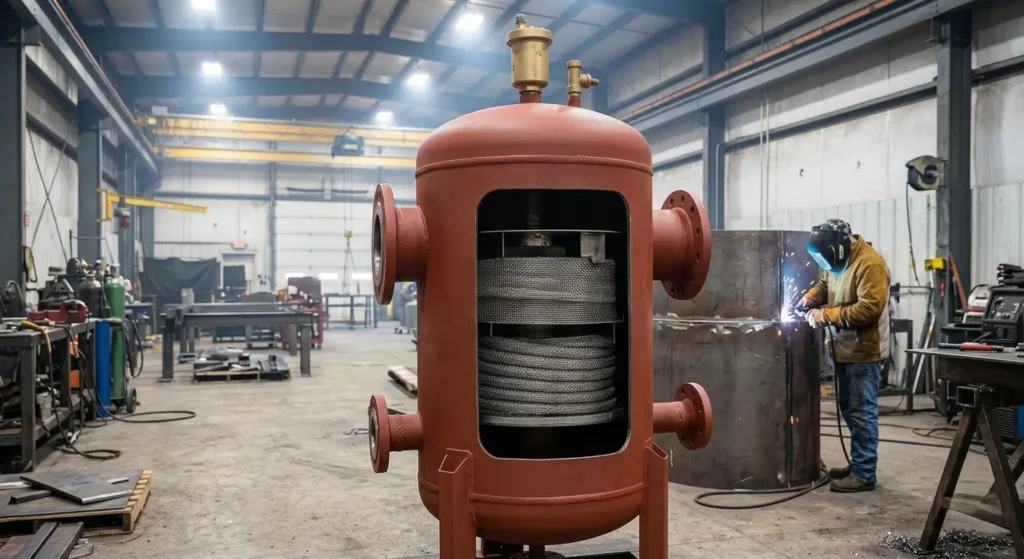
Air separator tanks are vessels installed in a hydronic loop to remove air from the circulating fluid by creating a low-velocity zone where trapped air gathers, rises, and escapes through a vent. They protect the system from corrosion, noise, poor heat transfer, and pump damage, and larger units are built as ASME-coded pressure vessels.
Key Takeaways
- Air separator tanks pull air out of a hydronic loop so it cannot collect in high points and disrupt flow.
- Trapped air causes corrosion, noise, cavitation, lost heat transfer, and pump wear. Removing it restores capacity and protects equipment.
- The main types are tangential, microbubble, and combination air and dirt separator designs, each suited to different loops and flow conditions.
- An air separator removes air from the fluid; an expansion tank manages volume and pressure. Most systems need both.
- When operating pressure exceeds 15 psig, an air separator becomes an ASME pressure vessel and must be designed, built, and stamped accordingly.
What Do Air Separator Tanks Do in a Hydronic Loop?
Air separator tanks remove unwanted air from a hydronic heating or cooling loop. Their job is to take the entrained air that enters during fill, makeup, and normal operation and move it out of the fluid before it can cause problems elsewhere in the system.
Why Air Accumulates in a Hydronic Loop
Water always carries some dissolved and entrained air. As that fluid heats up and moves through the loop, the air comes out of solution and forms bubbles that collect at high points, pump volutes, and dead legs. Left alone, those pockets block flow, corrode steel, and wear out pumps.
What the Separator Does for the System
An air separator gives the air a place to gather and leave, keeping the loop full of fluid rather than a mix of fluid and gas. The result is a quieter, more efficient, and longer-lasting system. Because the vessel handles system pressure and temperature, it is engineered and built to the same standards as other coded tanks, which is why air separator tanks in larger plants are treated as fabricated pressure vessels rather than off-the-shelf fittings.
Why Is Air a Problem in Hydronic Systems?
Air is a problem because a hydronic loop is designed to move liquid, not gas, and entrained air hydronic systems interfere with nearly every part of that job. The trouble shows up as corrosion, noise, poor performance, and equipment damage.
Corrosion and Oxygen Attack
The oxygen carried in entrained air is the main driver of corrosion in a steel loop. It attacks pipe walls, vessel surfaces, and components, producing rust and the sludge that fouls strainers and heat exchangers. Removing the air removes the oxygen supply, which slows corrosion and extends the life of the whole system.
Noise, Cavitation, and Dead Spots
Air pockets create the gurgling and banging that building occupants notice first. Worse, bubbles reaching a pump can cause cavitation, where they collapse violently against the impeller and erode it over time. Air trapped in a high point or a coil also creates a dead spot where no fluid circulates, leaving part of the system cold or unheated.
Lost Heat Transfer and Pump Wear
Air is a poor conductor of heat, so any pocket of it in a coil or heat exchanger reduces transfer and forces the equipment to work harder. Bubbles passing through a pump disrupt smooth flow and accelerate wear. Pulling the entrained air out restores rated capacity and protects the pump.
How Do Air Separator Tanks Work?
Air separator tanks work by slowing the fluid down and giving the air a path out. Inside the vessel, the flow conditions change just enough to let bubbles separate from the liquid and rise to an automatic air vent at the top.
The Low-Velocity Zone
The core principle is velocity. When fast-moving fluid enters the larger cross-section of the vessel, it slows down, and slower fluid releases its bubbles more readily. That low-velocity zone is where separation happens, so the vessel is sized to the flow rather than simply matched to the pipe diameter.
Coalescing Media and Microbubbles
Many designs add an internal coalescing element, a mesh or array of surfaces that catches the smallest bubbles. A microbubble separator uses this media to merge tiny bubbles into larger ones that can rise on their own, capturing air that a plain chamber would miss. This is what lets a microbubble separator strip out the fine entrained air that ordinary venting leaves behind.
The Automatic Air Vent
At the top of the vessel sits an automatic air vent, a float-operated valve that opens to release collected air and closes against the fluid. As air accumulates in the dome of the separator, the vent discharges it without anyone needing to bleed the system by hand, making the separator continuous rather than a periodic chore.
What Are the Main Types of Air Separator Tanks?
The main types differ in how aggressively they remove air and whether they also handle dirt. The right choice depends on the loop, the flow, and how clean the fluid needs to stay.
Tangential and Centrifugal Separators
A tangential separator introduces the fluid off-center so it swirls inside the vessel, throwing heavier fluid outward and letting lighter air collect in the calm center to rise and vent. These units are simple, robust, and common in commercial loops where the air load is moderate.
Microbubble Separators
A microbubble separator uses coalescing media to capture the finest bubbles that a swirl design alone would pass. These units are the choice where high efficiency matters, such as chilled water and precise temperature-control loops, because they keep the fluid closer to fully air-free.
Air and Dirt Separators
An air and dirt separator combines air removal with sediment removal in one vessel. The same low-velocity zone that releases air also lets heavier dirt and magnetite settle to the bottom, where a blowdown valve flushes it out. A combination unit is efficient where both problems exist, which is most steel hydronic systems, and it reduces the number of separate components in the loop. Red River’s process tank fabrication scope covers combination air and dirt separator vessels for hydronic and industrial process applications.
How Does an Air Separator Differ From an Expansion Tank?
An air separator and an expansion tank do different jobs and are not interchangeable. The separator removes air from the fluid, while the expansion tank gives the fluid room to expand and contract as its temperature changes, holding system pressure in range.
Why Both Are Needed
Both deal with air and pressure, which is the source of the confusion, but one eliminates air from the loop and the other manages volume and pressure using a captive air or gas cushion. Most hydronic systems need both, sized independently for their separate roles. Red River fabricates both as coded vessels, often integrated onto a single modular skid so the air control package arrives as one tested assembly.
Where Should an Air Separator Tank Be Installed?
An air separator tank should be installed at the point where air comes out of solution most readily, which is where the fluid is hottest and the pressure is lowest. That is where the most air is available to capture.
Finding the Right Installation Point
In a heating loop, that often means just downstream of the boiler on the supply side, before the pump. In a chilled water or thermal storage loop, the logic is the same: find the location of lowest air solubility and put the separator there, typically on the pump suction. Installing the unit in the wrong spot, such as a cold high-pressure return, leaves much of the air dissolved and uncaptured.
How Placement Affects Vessel Design
Correct placement is part of designing the loop, not an afterthought, and it influences the nozzle and connection layout built into the vessel. Red River’s fabrication capabilities include working through placement requirements during the engineering review phase so the vessel arrives with the correct nozzle orientation, vent location, and blowdown connection for the installed position.
When Is an Air Separator Tank an ASME Pressure Vessel?
An air separator tank becomes an ASME pressure vessel when it operates above 15 psig, which most commercial and industrial hydronic loops exceed. At that point it must be designed, fabricated, inspected, and stamped under ASME Section VIII rather than treated as a plumbing fitting.
What the Code Requires
A coded vessel carries the ASME U Stamp, is registered with the National Board, and is built to documented material, weld, and inspection requirements. Small residential separators may fall below the threshold, but the larger units used in commercial, industrial, institutional, and biogas plants are pressure vessels and need a certified fabricator. ASHRAE guidance on hydronic system design informs how these vessels are specified and placed.
How Red River Approaches Coded Air Separators
Red River brings ASME U Stamp and NBBI R Stamp certification to every coded tank. Certification means material traceability and inspection records travel with the vessel, which is the difference between a vessel that clears compliance review and one that creates liability. Red River’s prefabrication services cover air separator vessels built into complete hydronic packages that arrive ready to connect.
Air Separator Tanks Built to Code for Your Loop
Air separator tanks protect a hydronic loop from corrosion, noise, and lost efficiency, but only when they are built to code, sized to the flow, and placed where the air actually collects. Red River fabricates ASME-certified air separator tanks, air and dirt separators, and integrated air control packages from Gillette, Wyoming, since 2003. Red River holds active ASME U Stamp and NBBI R Stamp certifications and designs every vessel for its real service conditions.
Ready to Specify Your Air Separator Tank?
Request a quote or call us to discuss air separator tank type, sizing, and fabrication scope with Red River’s team. The right vessel from the right fabricator protects the loop quietly for the life of the system.
Frequently Asked Questions
1. What Is the Purpose of an Air Separator Tank?
An air separator tank removes air from a hydronic loop so the system stays full of liquid rather than a mix of liquid and gas. By slowing the fluid in a low-velocity zone, it lets bubbles rise and vent out. This protects the loop from corrosion, noise, cavitation, and lost heat transfer.
2. What Is the Difference Between an Air Separator and an Expansion Tank?
An air separator removes air from the circulating fluid, while an expansion tank gives the fluid room to expand and contract with temperature and holds system pressure in range. They do separate jobs and are not interchangeable. Most hydronic systems need both, sized independently for their roles.
3. What Is a Microbubble Separator?
A microbubble separator uses internal coalescing media to capture the smallest air bubbles that a plain swirl chamber would miss. The media merges tiny bubbles into larger ones that rise and vent. This high-efficiency approach suits chilled water and precise temperature-control loops where nearly air-free fluid is the goal.
4. Do I Need an Air and Dirt Separator or Just an Air Separator?
If the loop is steel and prone to magnetite and sediment, an air and dirt separator handles both problems in one vessel, letting dirt settle to a blowdown while air vents from the top. A plain air separator is enough where dirt is not a concern. Most steel hydronic systems benefit from the combination unit.
5. When Does an Air Separator Tank Need to Be ASME Certified?
An air separator tank needs ASME certification when it operates above 15 psig, which most commercial and industrial loops exceed. Above that pressure it must be designed, built, inspected, and stamped under the ASME Boiler and Pressure Vessel Code by a certified fabricator.
6. Where Should an Air Separator Be Installed in the Loop?
An air separator works best at the point of lowest air solubility, where the fluid is hottest and the pressure is lowest, because that is where the most air leaves solution. In practice this is often on the pump suction, downstream of a boiler or chiller. Correct placement is set during loop design.
Related Blog Post
Which Materials Suit Make-Up Water Service?
How Big Should Make-Up Water Tanks Be?
Make-Up Water Tanks: Design, Sizing, and Fabrication
When to Spec Equalization Tanks for Industrial Systems
How Do Equalization Tanks Balance Flow?
About Author



