
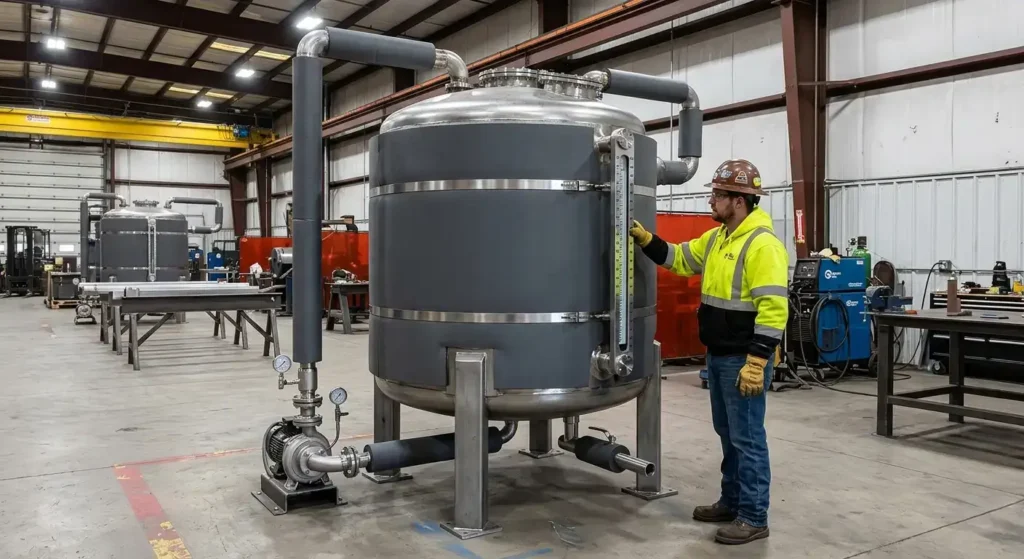
Yes. Glycol tanks reduce freezing risk by keeping the loop charged at the correct concentration and adding thermal mass that slows how fast the loop can cool toward the freeze point. The tank does not lower the freezing temperature; the glycol chemistry does that, and the tank maintains that protection reliably between service visits.
Key Takeaways
- Freeze protection glycol tank sizing must account for both the loop volume and the reserve needed between service intervals.
- A glycol feed tank replaces small losses automatically, which stops freeze protection from drifting down as plain water enters the loop between service visits.
- Thermal mass in a buffer or storage tank slows how quickly the fluid can cool toward freezing, adding margin during cold snaps and flow interruptions.
- The glycol concentration freeze point target is set from ASHRAE freeze point tables and the glycol manufacturer’s data at the lowest ambient temperature the system will see.
- A tank is one layer of freeze protection, working alongside correct glycol concentration, insulation, heat tracing, and periodic monitoring.
How Do Glycol Tanks Reduce Freezing Risk?
The tank does not lower a temperature or add antifreeze on its own. What it does is keep the loop reliably full of fluid at the right glycol concentration, which is what actually prevents a freeze. In that sense, the tank protects the protection.
How Dilution Drift Erodes Freeze Protection
A loop slowly loses fluid to minor leaks, venting, and maintenance. If plain water is used to top it off, the concentration drifts down and the freezing temperature creeps up. Over a season, a loop that started well protected can quietly become vulnerable. A feed tank holding pre-mixed fluid prevents that drift, which is the most direct way a tank lowers the chance of a freeze.
How Thermal Mass Adds a Second Layer
A larger volume of protected fluid changes temperature more slowly, so the loop has more margin before any part of it nears the freeze point. Both the concentration-maintenance and thermal mass effects depend on the tank being sized and maintained correctly. Red River’s process tank and thermal energy storage fabrication scope covers vessel types used in this role across cold-climate hydronic and industrial loops.
How Does Glycol Lower the Freezing Temperature?
Glycol lowers the freeze point of water by interfering with ice crystal formation, so the mixture stays liquid well below the freezing temperature of plain water. The more glycol in the blend, the lower the freeze point drops, up to a practical limit.
How the Glycol Concentration Freeze Point Target Is Set
Freeze point data from ASHRAE fluid tables and the glycol manufacturer’s chart sets the target concentration for the lowest temperature the system will see. The tank holds fluid at that target concentration, but the antifreeze effect comes from the chemistry of the glycol, not the vessel.
Freeze Protection vs Burst Protection
There are two levels of protection. Freeze protection keeps the fluid fully pumpable at the lowest temperature. Burst protection is a lower concentration that lets the fluid turn slushy without splitting the pipe. Loops that must keep running need freeze protection. Equipment that only needs to survive a cold idle can use burst protection. The feed tank keeps whichever concentration the system needs topped off so it does not slip over time.
How Does a Glycol Feed Tank Maintain Protection Over Time?
A feed tank maintains protection by automatically replacing the small amounts of fluid a loop loses, using pre-mixed glycol rather than plain water. This keeps the concentration steady, which keeps the freeze point where it was designed to be.
Preventing Concentration Drift Between Service Visits
Every time a loop is topped off with water instead of a glycol mixture, the concentration drops a little and the freezing temperature rises. A feed tank carrying fluid already mixed to the target ratio means every automatic top-off holds the protection steady. Red River’s pressure vessel fabrication includes glycol feed, storage, and mixing tanks specified for the actual service conditions and loop volumes they serve.
How Red River Fabricates Glycol Feed Tanks
Every glycol feed tank Red River fabricates is specified for fluid compatibility, operating pressure, and temperature range before fabrication scope is defined. Red River’s prefabrication services cover integrated skid scopes that include glycol feed tanks alongside the loop vessels they protect.
Does Thermal Mass in a Buffer Tank Reduce Freezing Risk?
Yes. A loop with more stored volume takes longer to drop in temperature, buying time during a cold snap, a power loss, or a flow interruption. When circulation stops or a heat source drops offline, a small-volume loop can cool toward freezing quickly, while a loop with substantial thermal mass cools far more slowly.
When Thermal Mass Makes the Difference
That extra margin can be the difference between a safe restart and a cracked coil. Thermal mass does not replace correct glycol concentration, but it adds a useful buffer on top of it. Red River’s fabrication capabilities include standalone buffer vessels and combined buffer configurations designed for loop protection in cold-climate service.
Where Is Freezing Risk Highest in a Hydronic Loop?
Freezing risk is highest wherever fluid sits cold and still: rooftop chillers, outdoor piping, idle equipment, and any line exposed to ambient air in a cold climate. A loop that keeps circulating is far safer than one that has stopped, because still fluid loses heat from the outside in and reaches freezing first at the coldest, most exposed point.
Why Cold-Climate Systems Need Every Layer
In a Wyoming winter, the margin that keeps a loop safe is the sum of all protective layers. The glycol holds the freezing temperature down, the feed tank keeps the concentration from slipping, thermal mass slows the cooling, and insulation reduces heat loss. A diluted charge or an uninsulated run is usually where the first freeze shows up.
What Else Is Needed Beyond a Glycol Tank?
A glycol tank is one part of freeze prevention. The correct concentration comes first, set from the lowest temperature the system will see. Insulation slows heat loss and heat tracing protects spots insulation cannot. Periodic testing of concentration, freeze point, and inhibitor level confirms protection is still in place.
Glycol Tanks Built for Cold-Weather Service
Can glycol tanks reduce freezing risk? Yes, by holding the loop at the right concentration and adding thermal mass, as long as the tank is sized and maintained as part of a complete freeze protection plan. Red River has fabricated ASME-certified glycol feed, storage, and buffer tanks from Gillette, Wyoming, since 2003. The National Board maintains registration records for all ASME-stamped vessels Red River delivers. Red River holds active ASME U Stamp and NBBI R Stamp certifications.
Ready to Size Your Glycol Tank for Cold-Climate Service?
Request a quote or call us to discuss glycol feed tank sizing, vessel specification, and freeze protection scope with Red River’s team. Design conditions are confirmed during engineering review before fabrication begins.
Frequently Asked Questions
1. Does a Glycol Tank Prevent Freezing by Itself?
Not by itself. The glycol mixture lowers the freezing temperature and prevents a freeze, while the tank keeps the loop charged at the correct concentration. The tank maintains that protection and adds thermal mass, but the antifreeze effect comes from the glycol chemistry.
2. How Does a Glycol Feed Tank Stop Protection From Dropping?
A glycol feed tank holds pre-mixed fluid at the target concentration and automatically replaces small losses. Because it tops off with a glycol mixture rather than plain water, the concentration stays steady and the freeze point holds. This prevents the slow dilution drift that erodes protection over a season.
3. Does Adding Thermal Mass Really Help Against Freezing?
Yes. A larger volume of protected fluid cools more slowly, so the loop has more margin during a cold snap, power loss, or flow interruption. A buffer or storage tank provides that thermal mass and adds useful time before any part of the loop nears freezing.
4. Is a Glycol Tank Enough on Its Own for Freeze Protection?
No. A complete plan also needs the correct concentration, insulation, sometimes heat tracing, and periodic monitoring. The tank supports the plan by holding and feeding protected fluid, but each element covers a gap the others cannot.
5. Does Red River Build Glycol Tanks for Cold Climates?
Yes. Red River fabricates ASME-certified glycol feed, storage, and buffer tanks designed for cold-weather service, with sizing and connections matched to the freeze protection plan. Design conditions are confirmed during engineering review before fabrication begins.
Related Blog Post
Which Materials Suit Make-Up Water Service?
How Big Should Make-Up Water Tanks Be?
Make-Up Water Tanks: Design, Sizing, and Fabrication
When to Spec Equalization Tanks for Industrial Systems
How Do Equalization Tanks Balance Flow?
About Author



