
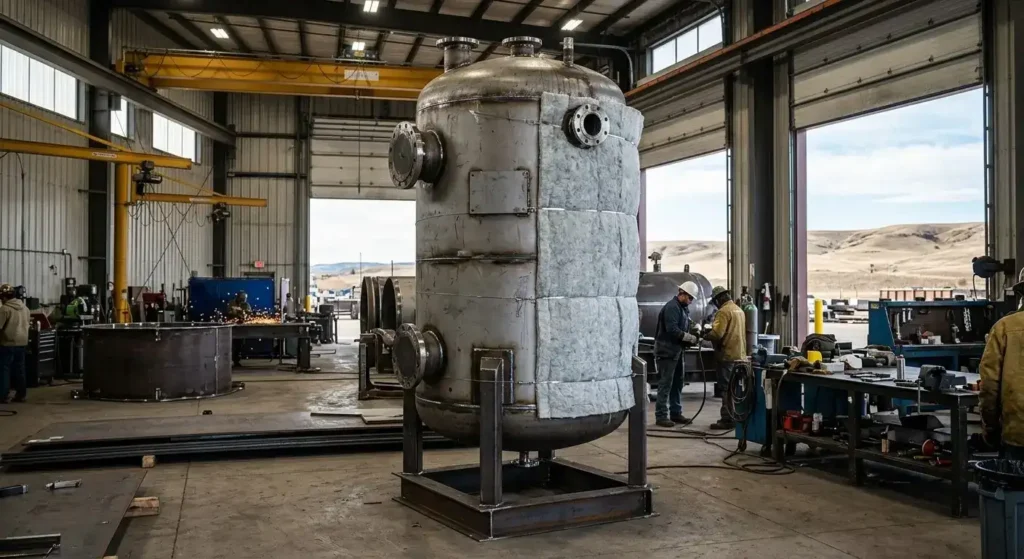
A hydronic tank is a pressure-rated vessel in a closed-loop water system that stores thermal energy, absorbs volume changes, or separates air and debris from the fluid. Any hydronic tank operating above 15 psig is an ASME Section VIII coded pressure vessel, subject to specific material, examination, and documentation requirements before it ships.
Key Takeaways
- A hydronic tank is a vessel in a closed water loop that stores energy, manages volume, or conditions the fluid, depending on its type.
- The four main types are the hydronic buffer tank, the thermal storage tank, the expansion tank, and the air and dirt separator. Each solves a different problem in the loop.
- A hydronic tank operating above 15 psig is built to ASME Section VIII as a coded pressure vessel with specific material, examination, and documentation requirements.
- The right tank keeps a hydronic system efficient by preventing short cycling, holding pressure stable, and protecting pumps, heat exchangers, and control valves from air and debris.
- Hydronic tanks are used in power generation, commercial facilities, and industrial processes and are often delivered as part of modular skid packages pre-piped and ready to connect.
What Is a Hydronic Tank and What Does It Do?
A hydronic system heats or cools a building or facility by circulating water, or a water-glycol mix, through a closed loop of boilers, chillers, pumps, and terminal units. A hydronic tank is the vessel in that loop that gives the system the stored volume and stability it needs to run efficiently.
How the Tank Function Depends on Its Type
The tank’s function depends on which problem it is solving in the loop. A thermal storage tank holds heated or chilled water for use during peak demand periods. An expansion tank gives the water room to expand safely as system temperature rises. A buffer tank or air and dirt separator conditions the fluid or adds volume so pumps and heat exchangers operate in stable, clean conditions. In every case the tank is performing a function the bare piping cannot deliver on its own.
Why Hydronic Tanks Are Engineered Pressure Vessels
Because most hydronic tanks operate under pressure and at controlled temperatures, they are engineered pressure vessels rather than simple atmospheric drums. Past a certain pressure threshold, they fall under a construction code that governs how they are designed, welded, examined, and documented. Red River’s pressure vessel fabrication scope covers all four hydronic tank types across power generation, process, and commercial applications.
What Are the Four Main Types of Hydronic Tanks?
Hydronic tanks are grouped by the job they perform in the loop. Most systems use one or more of four distinct types.
Hydronic Buffer Tanks
A hydronic buffer tank adds water volume to a loop that would otherwise be too small to run stably. It is most common on chilled water and low-mass systems where it prevents the chiller or boiler from short cycling against a small water volume. The added thermal mass allows the heat source to run in longer, more efficient cycles, reducing wear and energy consumption.
Buffer tanks are typically sized by calculating the minimum run time the heat source requires and multiplying by the maximum output rate to get the minimum loop volume needed. The buffer tank supplies the difference between the actual loop volume and that minimum. ASHRAE guidance on hydronic system design provides the underlying methodology for buffer tank sizing in both chilled water and hot water systems.
Thermal Storage Tanks
A thermal storage tank holds chilled or hot water generated at one time for use during a later peak demand period. A tank charged overnight on off-peak utility rates can carry a facility’s full cooling or heating load through the peak demand window the following day. These tanks are larger than buffer tanks and rely on internal diffuser and baffle design to maintain thermal stratification and keep stored energy at the correct temperature throughout the discharge cycle.
The thermocline, the boundary between the stored cold or hot water and the return water, must stay sharp across each charge and discharge cycle. A diffuse thermocline allows warm return water to mix with stored cold water, reducing the usable storage capacity and lowering the supply temperature available to the cooling load. See Red River’s thermal energy storage fabrication scope for how diffuser and nozzle design are confirmed before fabrication begins.
Expansion Tanks
Water expands as it heats, and a sealed loop has no place to safely absorb that extra volume without an expansion tank. An expansion tank gives the system that capacity and holds pressure within a safe operating band as temperatures cycle. Without adequate expansion tank volume, system pressure climbs beyond safe operating limits during temperature rise, risking relief valve actuation or pressure boundary damage throughout the loop.
Sizing depends on the loop volume and the full temperature range the system operates across. Most closed hydronic loops use a diaphragm or bladder expansion tank at lower pressures, while larger industrial loops use open or closed steel expansion vessels, the latter of which are ASME-coded when operating above 15 psig.
Air and Dirt Separators
Trapped air and suspended debris damage pumps, foul heat exchangers, and generate system noise. A separator slows fluid flow enough for air to rise and particles to settle, protecting downstream equipment before they accumulate in critical components. On larger systems this function is often combined with buffering in a single vessel that adds loop volume while simultaneously conditioning the fluid.
Air removal is most effective at the point of lowest air solubility in the loop, where the fluid is hottest and the pressure is lowest, typically at the heat source outlet. Dirt separation protects strainers, pump impellers, and control valve seats from particulate that enters with makeup water or forms through corrosion inside the loop. See Red River’s process tank scope for related vessel types used in closed-loop industrial applications.
When Is a Hydronic Tank an ASME Pressure Vessel?
A hydronic tank becomes a coded pressure vessel when it operates above 15 psig internal pressure. Below that threshold, simpler tank standards may apply, but most pressurized closed-loop systems operate well above it.
What ASME Section VIII Requires
Once the operating pressure crosses 15 psig, the vessel is designed and built to ASME BPVC Section VIII, Division 1. The code governs four areas of the build.
Materials and Traceability
Only ASME-specified plate and fitting grades may be used, with certified mill test reports tracing each piece from the mill through fabrication. Every pressure-retaining material in a coded hydronic tank carries an MTR that documents its chemistry and mechanical properties and stays with the vessel documentation package.
Welds and Joint Efficiency
Qualified welders following qualified procedures perform all pressure-retaining welds, with joint efficiency tied directly to the wall-thickness calculation. The joint efficiency determines how much of the base metal strength the weld is credited for, which directly affects the design thickness of the shell and heads.
Examination and Hydrostatic Testing
NDE methods are matched to the design pressure and joint efficiency class before the hydrostatic test is conducted. The hydrostatic test pressurizes the vessel to at least 1.3 times the MAWP, witnessed by an Authorized Inspector, confirming the vessel holds without leakage or permanent deformation. The test record becomes part of the documentation package.
Documentation and National Board Registration
The ASME Form U-1 Manufacturer’s Data Report, weld records, and examination results are delivered with the vessel. Every coded vessel is registered with the National Board of Boiler and Pressure Vessel Inspectors, creating a permanent record that supports in-service inspection under the National Board Inspection Code across the vessel’s full service life.
Red River’s Certification for Coded Hydronic Vessels
Red River holds active ASME U Stamp and NBBI R Stamp certifications, both verifiable directly with the issuing bodies. Every coded hydronic tank Red River fabricates ships with the ASME Form U-1, certified MTRs for all pressure-retaining materials, weld records and procedure qualifications, and the NDE examination results and hydrostatic test record. See Red River’s fabrication capabilities for how documentation and certification are managed across hydronic vessel scopes.
Why Does the Right Hydronic Tank Matter?
Selecting and sizing the correct hydronic tank is what keeps a system efficient and reliable over its service life. The wrong tank type or the wrong size produces problems that appear as wasted energy and premature equipment wear.
What Happens When Each Tank Type Is Undersized or Misspecified
Each tank type produces a distinct failure mode when undersized or misspecified. A buffer tank that is too small causes the chiller or boiler to short cycle, starting and stopping more often than designed, increasing energy consumption and shortening equipment life. A thermal storage tank that loses stratification delivers fluid at the wrong temperature and loses usable stored capacity, reducing load-shift effectiveness. An expansion tank that is too small allows system pressure to climb beyond safe operating limits during temperature rise, risking relief valve actuation or pressure boundary damage.
The Specification Is the Fix
Each of these outcomes is a sizing and design decision made before fabrication, not a field correction. Matching the tank to the system’s actual load profile, operating temperature range, and connection requirements from the start is what separates a hydronic system that runs cleanly for decades from one that requires repeated intervention. Red River works through these design inputs at the start of every project, so the vessel that leaves the shop is sized for the actual system it protects.
Where Are Hydronic Tanks Used?
Hydronic tanks appear wherever a facility moves heat or cooling through water at scale.
Power Generation and Industrial Process
Power generation and combined heat and power plants use thermal storage vessels to decouple heat production from demand, holding thermal capacity for use during peak load periods or planned maintenance windows. Industrial process facilities use buffer, expansion, and storage tanks throughout their heating and cooling loops. Biogas digester heating systems use buffer and storage vessels to maintain digester operating temperature against variable ambient conditions.
Commercial and Institutional Facilities
Commercial buildings, hospitals, campuses, and manufacturing plants use buffer, expansion, and separator tanks throughout their HVAC and process water systems. In many of these settings the vessel is integrated into a pre-tested skid assembly that reduces field installation scope and construction schedule risk.
Modular Delivery for Any Application
Many hydronic tank installations are delivered as modular skid packages that integrate the vessel with pumps, valves, instrumentation, and piping into a single pre-tested assembly. Modular delivery eliminates commissioning unknowns and compresses field installation time. Red River’s prefabrication services cover complete hydronic skid scopes that arrive ready for utility connections and process tie-ins.
What This Means When Specifying a Hydronic Tank
Understanding what a hydronic tank is comes down to knowing the job it performs in the loop and the code it is built to when operating above 15 psig. The systems that run efficiently for decades are the ones whose tank type, size, and design were confirmed before fabrication began. Changing those inputs after the vessel is built creates rework; confirming them upfront does not. Red River has fabricated ASME-certified hydronic tanks for power generation, industrial process, and commercial applications from Gillette, Wyoming, since 2003.
Discuss Your Hydronic Tank With Red River
Red River fabricates ASME-certified hydronic tanks, buffer tanks, and thermal storage vessels for power generation, industrial process, and commercial applications. Red River holds active ASME U Stamp and NBBI R Stamp certifications and is an American Welding Society (AWS) member.
Ready to Define Your Hydronic Tank Scope?
Request a quote or call 1-307-257-5332 to discuss your hydronic tank type, sizing, and fabrication scope with Red River’s team. The design review starts before fabrication scope is defined.
Frequently Asked Questions
1. What Is the Difference Between a Buffer Tank and an Expansion Tank?
A hydronic buffer tank adds water volume to stabilize a loop and prevent short cycling of the heat source. An expansion tank gives heated water room to expand and holds system pressure within a safe band as temperatures rise and fall. They solve different problems, and a system may need both.
2. Is a Hydronic Tank the Same as a Thermal Storage Tank?
Not exactly. A thermal storage tank is one specific type of hydronic tank, sized to hold chilled or hot water for use during a later peak demand period. Other hydronic tanks, including buffer, expansion, and separator vessels, each perform a different function in the loop.
3. When Does a Hydronic Tank Need to Be ASME-Coded?
A hydronic tank operating above 15 psig internal pressure is built to ASME Section VIII as a coded pressure vessel. Most pressurized closed-loop systems operate above that threshold. The design specification confirms the operating and design pressures that place the tank under the code.
4. How Do I Know What Size Hydronic Tank I Need?
Tank sizing comes from the system’s load profile, operating temperature range, and the specific function the tank performs. A buffer tank is sized from the minimum run time the heat source requires, while a thermal storage tank is sized from the load it must carry through the peak demand window. Red River works through these sizing inputs during the engineering review before fabrication scope is defined.
5. Does Red River Fabricate Custom Hydronic Tanks?
Yes. Red River fabricates custom ASME-certified hydronic tanks designed to each client’s load profile, operating range, and connection requirements. Diffuser design, insulation scope, and nozzle orientation are confirmed during the engineering review before fabrication begins.
Related Blog Post
Which Materials Suit Make-Up Water Service?
How Big Should Make-Up Water Tanks Be?
Make-Up Water Tanks: Design, Sizing, and Fabrication
When to Spec Equalization Tanks for Industrial Systems
How Do Equalization Tanks Balance Flow?
About Author



