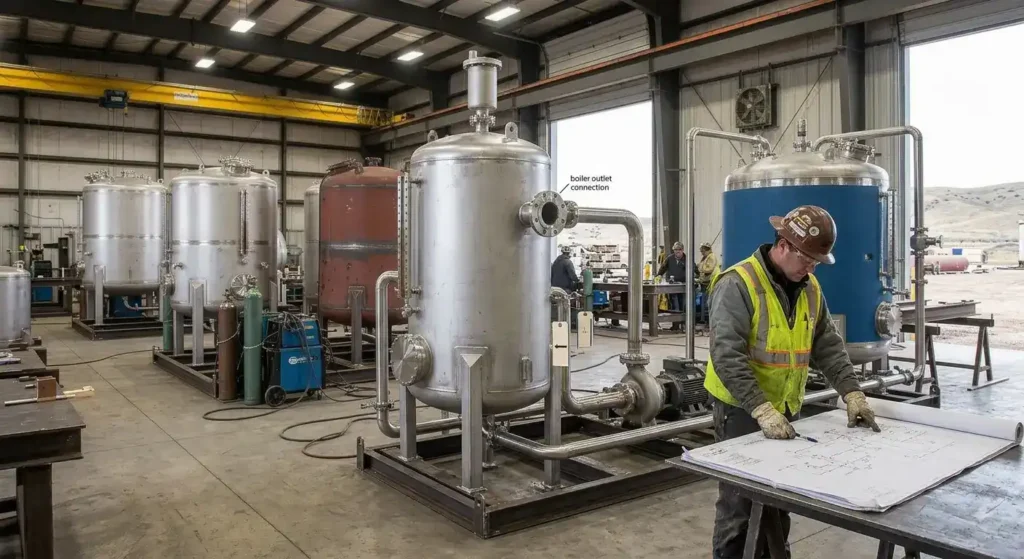
Install air separator tanks at the point of lowest air solubility, where the fluid is hottest and the pressure is lowest. In most systems that means just downstream of the boiler or chiller and on the suction side of the pump, where the separator has the most air available to capture.
Key Takeaways
- Locate air separator tanks at the point of lowest air solubility hydronic conditions produce: where the fluid is hot and the pressure is low.
- In a heating loop, that is usually at the boiler outlet and on the pump suction side. Both conditions drive air out of solution simultaneously at that location.
- The expansion tank connection sets the point of no pressure change, which guides where the air separator and pump belong relative to each other.
- Avoid cold, high-pressure spots like the return line, where most of the air stays dissolved and cannot be captured.
- Correct placement is decided during loop design and shapes the nozzle and connection layout built into the vessel.
Why Does Placement Determine How Much Air a Separator Captures?
Air does not come out of water evenly around a hydronic loop. It releases where conditions favor it, and a separator only captures the air that has actually separated from the fluid. Red River’s pressure vessel fabrication covers air separator vessels across the full range of hydronic and process loop placement conditions.
The Two Conditions That Release Air
Those conditions are high temperature and low pressure. In a typical system, both align just after the heat source and at the inlet to the pump. That is why the classic location is the boiler or chiller outlet, on the suction side of the circulator.
How Placement Shapes the Vessel Design
Because the unit holds system pressure and is sized to the flow, its placement is settled during design rather than in the field. The location shapes the nozzle layout on the pressure vessel itself, so the inlet, outlet, vent, and blowdown all line up with the surrounding piping before fabrication begins.
Why Does Air Solubility Decide the Location?
Solubility decides the location because it controls where bubbles form. Water holds more dissolved air when it is cold and under pressure, and less when it is hot and at low pressure. As conditions shift toward hot and low pressure, dissolved air comes out of solution as bubbles a separator can catch.
The Single Rule That Covers Most Systems
Find the point of lowest air solubility hydronic conditions allow and put the separator there. That is the spot where the fluid is giving up the most air and where capture is easiest. ASHRAE guidance on hydronic system design is built on this same principle, confirming that air separator placement is a design decision driven by fluid thermodynamics rather than piping convenience.
Where Is the Best Location in a Heating Loop?
In a heating loop, the best spot brings together the two conditions that drive air out of solution: fluid is hottest right after the boiler, and pressure is lowest at the pump inlet.
At the Boiler Outlet
Fluid leaving the boiler is at its hottest and holds the least dissolved air. Placing the separator on the supply side, close to the boiler outlet, catches air the moment heat drives it out of solution. On a multi-boiler plant, the separator usually sits on the common supply header so it serves the whole system at once.
On the Pump Suction Side
Pressure is lowest on the suction side of the circulator, just before it adds head to the fluid. Low pressure reinforces what the heat already started. Combining the boiler outlet and pump suction air separator placement in one location is why that spot is the standard recommendation in hydronic design.
How Does the Expansion Tank Connection Affect Air Separator Placement?
The expansion tank connection sets the point of no pressure change in the hydronic loop. Wherever it ties in, the pressure at that point stays fixed as the pump runs.
Why the Three Components Belong Together
Good practice puts the expansion tank air separator combination and the pump inlet close together near the heat source. With the expansion tank tied in on the suction side, the pump pushes pressure up around the rest of the loop rather than pulling it down, keeping pressure positive and helping the separator work in the low-pressure, air-releasing zone.
How Red River Delivers This as a Complete Package
The separator and the expansion tank do different jobs, but their placement is linked, which is why they are often mounted on a single modular skid. Red River’s prefabrication services cover air control packages, including the air separator, expansion tank, and pump arrangement, that arrive pre-tested as a complete unit. See Red River’s process tank scope for related vessel types in hydronic service.
What Locations Should You Avoid for an Air Separator?
The locations to avoid are the cold, high-pressure parts of the hydronic loop, where solubility is highest and the least air is available.
Why the Return Line Is a Poor Choice
The return line before the boiler is cooler and at higher pressure, so air solubility is high and most of the air is still dissolved. A separator there captures far less than one at the hot, low-pressure point near the heat source and pump suction.
Service Access Must Be Part of the Location Decision
A well-placed vessel still needs to be maintained. The vent must be reachable to confirm it is working, and the blowdown must be reachable to flush dirt. The chosen spot needs real clearance when someone services it, not just on the drawing. Red River’s fabrication capabilities confirm nozzle orientation and access clearance as part of the vessel scope.
Air Separator Tanks Built and Positioned for Your Loop
Knowing where to locate air separator tanks is half the job. The other half is a vessel sized to the flow, built to ASME code, and laid out so its connections match the position chosen in the loop. Red River has fabricated ASME-certified air separators and integrated air control packages from Gillette, Wyoming, since 2003. The National Board maintains registration records for all ASME-stamped vessels Red River delivers.
Ready to Configure Your Air Separator Tank?
Request a quote or call us to discuss air separator placement, vessel sizing, and fabrication scope with Red River’s team. The right location and the right vessel are both decided before fabrication begins.
Frequently Asked Questions
1. What Is the Ideal Location for an Air Separator Tank?
The ideal location is the point of lowest air solubility, where the fluid is hottest and the pressure is lowest. In most systems that is just downstream of the boiler or chiller and on the suction side of the pump. Placed there, the separator has the most air available to capture.
2. Why Does the Air Separator Go on the Pump Suction Side?
Pressure is lowest at the pump inlet, and low pressure pushes dissolved air out of the fluid. Combined with high temperature from the heat source, the suction side becomes the spot where the most air is released. That is why the air separator belongs there rather than on the higher-pressure discharge side.
3. How Is the Expansion Tank Related to Air Separator Placement?
The expansion tank connection sets the point of no pressure change in the loop. Tying it in near the pump inlet, alongside the air separator, keeps loop pressure positive and helps the separator work in the low-pressure zone. The two components do different jobs, but their placement is closely linked.
4. Can I Put an Air Separator on the Return Line?
Not ideally. The return line before the boiler is cooler and at higher pressure, so air solubility is high and most of the air is still dissolved. A separator there captures far less than one placed at the hot, low-pressure point near the heat source and pump suction.
5. Does Air Separator Placement Differ for Chilled Water Systems?
The temperatures differ, but the principle is the same. Find the point of lowest solubility for the chilled water or thermal storage loop and place the separator there. The goal is always to position the vessel where the most air leaves solution, then leave room to service the vent and blowdown.
Related Blog Post
Which Materials Suit Make-Up Water Service?
How Big Should Make-Up Water Tanks Be?
Make-Up Water Tanks: Design, Sizing, and Fabrication
When to Spec Equalization Tanks for Industrial Systems
How Do Equalization Tanks Balance Flow?
About Author