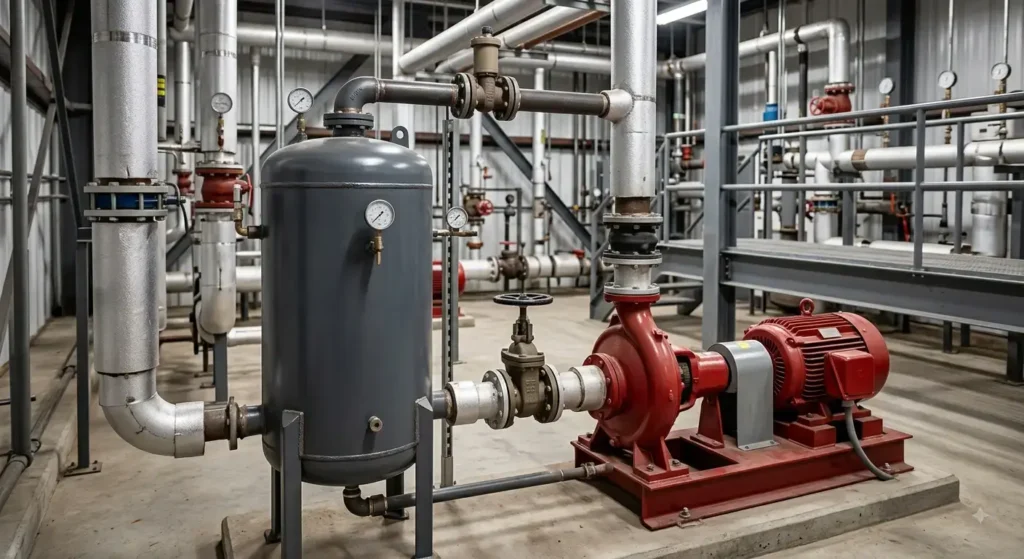
Yes. Air removal improves pump life by eliminating cavitation at the impeller, overheating of the mechanical seal, and oxygen-driven internal corrosion before any of those stressors reach the pump, through an ASME-coded air separator on the pump suction side built to Section VIII by Red River’s pressure vessel fabrication team.
Key Takeaways
- Air removal improves pump life by eliminating cavitation, protecting the mechanical seal’s cooling film, and removing the oxygen supply that drives internal corrosion.
- Bubbles reaching the pump impeller collapse violently under rising pressure, pitting and eroding the impeller surface with each pass. This damage accumulates silently until performance degrades.
- A mechanical seal depends on a thin fluid film to cool and lubricate its faces. Air pockets break that film, causing the seal to run dry, overheat, and fail ahead of schedule.
- Removing entrained air removes the dissolved oxygen that corrodes the impeller, housing, and shaft, reducing the rust and debris that accelerate wear on every moving part.
- Air removal is one layer of pump protection, working alongside correct sizing, adequate suction pressure, proper alignment, and routine maintenance.
How Does Air Damage a Pump?
Entrained air attacks a pump in three ways simultaneously, each targeting a different component. Together they create a cumulative failure pattern that shortens service life far more than any single cause would on its own.
Cavitation at the Impeller
Cavitation is the most destructive mechanism. As bubbles move from the suction side into the impeller, they enter a region of sharply rising pressure. The pressure increase causes the bubbles to collapse violently against the metal surface of the impeller. Each collapse delivers an intense localized pressure pulse that pits and erodes the impeller face. Over hundreds of thousands of operating cycles, the impeller profile changes, hydraulic efficiency drops, and eventually the impeller fails structurally. Entrained air gives these bubbles a constant supply, making cavitation persistent rather than intermittent.
Mechanical Seal Overheating
A mechanical seal maintains a pressure-tight rotating joint by holding a thin film of process fluid between its stationary and rotating faces. That fluid film provides both lubrication and cooling. When air reaches the seal faces, the fluid film breaks down. The faces contact each other or run on gas rather than a liquid film, generating significantly more heat than the seal can dissipate. The result is accelerated face wear, cracking, or complete seal failure. Seal replacement is one of the most common service events for circulators, and entrained air is a frequent underlying cause that goes unidentified when the seal is simply swapped out.
Internal Corrosion from Dissolved Oxygen
Entrained air carries dissolved oxygen into the pump and the connected loop. Oxygen reacts with carbon steel components, including the impeller, volute, and shaft, producing iron oxide corrosion. The corrosion products dislodge and circulate as particulate debris, abrasively wearing the clearances between rotating and stationary parts. Removing entrained air removes the oxygen supply that drives this corrosion cycle.
How Does Removing Air Extend Pump Life?
An air separator installed on the suction side of the pump intercepts entrained air before it reaches the impeller, eliminating the source of all three damage mechanisms simultaneously.
The Compounding Effect of Clean Fluid
With the air removed, cavitation loses its bubble supply, the mechanical seal maintains its cooling film continuously, and the oxygen that drives corrosion leaves with the air. The pump runs quieter, holds its prime without manual intervention, and operates at the temperature the seal and bearings were designed for. Each of those improvements translates directly into extended service life and compounds over years. See Red River’s process tank and fabrication capabilities for how air separation is incorporated into complete vessel and loop configurations.
Suction-Side Placement for Maximum Protection
Placing the separator on the pump suction side, just upstream of the inlet, delivers the greatest protection because the fluid is cleaned at the point it releases the most air. Many systems integrate the separator and pump on a modular skid package so the air removal protection is built into the assembly and confirmed before the skid ships.
Is Air Removal the Only Factor in Pump Life?
No. Air removal eliminates one major stressor, but a pump’s service life depends on a combination of factors.
What Else Affects Pump Life
A pump also requires correct sizing for the actual load, adequate net positive suction head to prevent low-pressure cavitation regardless of air content, proper shaft alignment, and routine bearing and seal maintenance. Skipping any of those shortens service life even if the fluid is completely air-free.
Where Air Removal Fits in the Full Picture
Air removal eliminates the constant entrained-air stressor while correct suction conditions address pressure-induced cavitation separately. The two work together rather than in place of each other. ASHRAE guidance on hydronic system design treats air control as one component in a broader approach to loop fluid quality and pump protection.
What Are the Signs Air Is Damaging Your Pump?
Several observable symptoms indicate that entrained air is shortening a pump’s service life.
Noise and Vibration
Gurgling, rattling, or intermittent vibration from the pump housing is a common first indicator that bubbles are passing through the impeller. These sounds are the acoustic signature of cavitation events in progress and indicate that impeller erosion is occurring on every operating cycle.
Recurring Seal Failures and Persistent Air Return
If a circulator cycles through mechanical seals faster than its rated replacement interval, air-starved cooling is a probable cause. If air returns to the loop quickly after manual bleeding, the system either generates air faster than passive venting can clear it or lacks continuous air removal entirely. An air separator that captures air as fast as it enters or comes out of solution eliminates both problems.
Protect Your Pumps With Red River
Can air removal improve pump life? Yes, measurably, across the service life of both the air separator and the pump it protects. Red River has fabricated ASME-certified air separators and combination air and dirt separator vessels for hydronic and process loop applications from Gillette, Wyoming, since 2003. The National Board maintains registration records for all ASME-stamped vessels Red River delivers.
Ready to Protect Your Pumps?
Request a quote or call us to discuss air separator sizing, placement, and fabrication scope with Red River’s team. Red River’s prefabrication services cover complete air control packages delivered pre-tested on a modular skid.
Frequently Asked Questions
1. How Does Air Shorten the Life of a Pump?
Entrained air shortens pump life through three mechanisms: bubbles reaching the impeller cause cavitation that pits and erodes the metal, air at the mechanical seal breaks down its cooling film and causes overheating and premature failure, and dissolved oxygen corrodes internal components and produces abrasive debris. Together, these effects wear a pump out before its rated service life.
2. Does Removing Air Really Prevent Cavitation?
It removes one major cause. Cavitation occurs when bubbles collapse against the impeller, and entrained air continuously supplies those bubbles. An air separator on the suction side removes that source. Low suction pressure can independently cause cavitation, so air removal works best when the correct net positive suction head is also maintained.
3. Why Does Air Cause Mechanical Seal Failure?
A mechanical seal depends on a thin film of process fluid between its faces to provide cooling and lubrication. When air reaches the seal, the fluid film breaks down, the faces contact each other or run on gas, and heat generated far exceeds the seal’s rated temperature. The seal faces wear, crack, or seize.
4. Is an Air Separator Enough on Its Own to Protect a Pump?
No. An air separator removes entrained air, which is one major stressor, but a pump also needs correct sizing, adequate suction pressure, proper alignment, and routine maintenance. Air removal is one layer that works alongside good system design and upkeep.
5. Where Should the Air Separator Be Installed to Protect the Pump?
On the suction side of the pump, just upstream of the inlet. At that location, the separator captures the maximum air content and delivers clean fluid directly into the impeller with no opportunity for bubbles to re-enter between the separator and the pump.
Related Blog Post
Can Condensate Storage Improve Reliability?
Where Do Condensate Tanks Fit in a Steam System?
Which Nozzles Simplify Maintenance on Pressure Vessels?
How to Vent Condensate Tanks in Steam Systems
How Do Baffle Layouts Affect Stratification in TES Tanks?
About Author