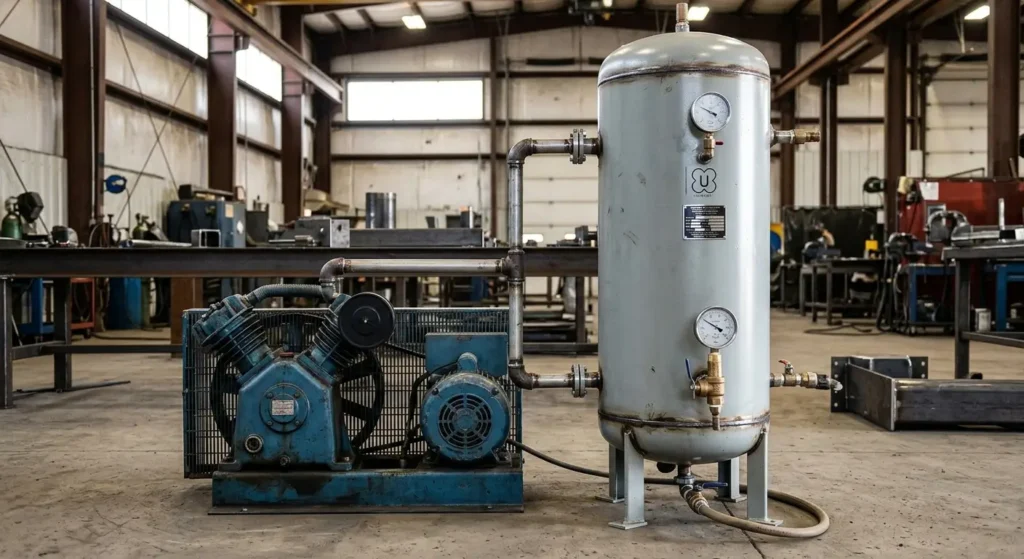
Receiver tanks affect compressor cycle time by extending the off time between starts: more compressed air storage volume means the system draws down pressure more slowly, so the compressor rests longer before restarting. The relationship between receiver volume, pressure differential, and compressor output is governed by the formula t = (V × (P1 − P2)) / (C × Pa), where a larger V directly extends t.
Key Takeaways
- Compressor cycle time is the interval between starts. A receiver tank extends that interval by storing compressed air so the compressor does not restart every time demand fluctuates above the cut-in pressure.
- Short cycling a compressor occurs when the receiver tank is undersized relative to compressor output. Each start event stresses the motor windings, heats the valves, and consumes three to five times more energy than equivalent steady-state operation.
- Doubling receiver tank volume roughly doubles the off time between compressor starts when all other system variables remain constant.
- Reciprocating compressors are rated at six to eight starts per hour maximum. Rotary screw compressors allow four to six. Exceeding those limits accelerates failure across all drive components.
- Every compressed air receiver vessel operating above 15 psig must carry the ASME U Stamp under Section VIII, Division 1.
What Is Compressor Cycle Time?
Compressor cycle time is the total elapsed time from one compressor start to the next. It has two components: run time, when the compressor builds pressure to the cut-out setpoint, and off time, when the system draws from stored compressed air while the compressor rests. Longer off times mean fewer starts per hour and less mechanical stress on every component in the drive system. Without adequate storage, pressure drops to the cut-in setpoint almost immediately after the compressor shuts off, triggering an instant restart. That pattern is short cycling compressor behavior, and it degrades equipment faster than almost any other sustained operating condition.
What Formula Governs Receiver Tank Cycle Time?
The off time between compressor starts is calculated directly from the receiver volume and system pressures:
t = (V × (P1 − P2)) / (C × Pa)
Where: t = off time in minutes, V = receiver volume in cubic feet, P1 = cut-out pressure in psig, P2 = cut-in pressure in psig, C = compressor output in CFM, Pa = atmospheric pressure in psia (14.7 at sea level).
What the Formula Shows About Receiver Tank Sizing
Tank volume scales cycle time directly. Double V and t doubles. Tighten the pressure differential (P1 − P2) and off time shortens. Increase compressor output without adding storage and cycle frequency rises. This is why receiver tank sizing must be calculated against actual system parameters rather than estimated from a rule of thumb alone.
Worked Example
A 50 CFM reciprocating compressor operates between 100 psig cut-in and 125 psig cut-out with a 200-gallon receiver (26.7 cubic feet):
t = (26.7 × 25) / (50 × 14.7) = 0.91 minutes between starts, approximately 65 starts per hour
That rate far exceeds the six to eight starts most reciprocating units are rated for. Upgrading to a 500-gallon vessel (66.8 cubic feet):
t = (66.8 × 25) / (50 × 14.7) = 2.27 minutes between starts, approximately 26 starts per hour
That result is within the acceptable operating range for most reciprocating compressors. Red River’s pressure vessel fabrication and fabrication capabilities cover receiver vessels sized against this calculation for compressed air applications.
What Does Short Cycling Cost a Compressor?
Short cycling is the most direct consequence of undersized compressed air storage. Each start draws high-amperage inrush current through the motor, generates heat in the windings, and subjects the valves and connecting rods on reciprocating units to a mechanical shock load.
Motor and Valve Wear
Motor manufacturers specify a maximum start count per hour because each start accumulates heat faster than the windings can dissipate it between cycles. Exceeding the limit shortens insulation life and leads to premature motor failure, with valve springs on reciprocating units fatiguing under repeated start loads.
Energy Cost of Short Cycling
Short cycling is widely documented as a primary source of avoidable energy waste in industrial compressed air systems. Each unnecessary start consumes approximately three to five times the energy of equivalent steady-state operation, so a compressor restarting 60 times per hour versus 12 consumes substantially more energy for the same air volume.
What Are the Maximum Allowable Starts by Compressor Type?
Manufacturer start-per-hour limits vary by compressor type and determine the receiver sizing target for any given system.
Reciprocating Compressors
Most manufacturers rate reciprocating units at six to eight starts per hour maximum, so practical receiver tank sizing targets four to six starts per hour to maintain a working margin. Red River’s process tanks and capabilities cover receiver vessels for reciprocating compressed air systems.
Rotary Screw Compressors
Rotary screw compressors generate heat on startup as oil separator and screw elements reach operating temperature. Most manufacturers rate rotary screw units at four to six starts per hour; exceeding that limit degrades compressor oil faster than normal service intervals anticipate.
Variable Speed Drive Compressors
Variable speed drive compressors modulate output to match demand and have no traditional start count limit, but still benefit from receiver storage. A correctly sized vessel allows the VSD to operate in a mid-range speed band during demand spikes rather than pegging at maximum output.
What ASME Requirements Apply to Receiver Vessels?
Every compressed air receiver vessel operating above 15 psig must carry the ASME U Stamp under ASME Section VIII, Division 1. The air receiver is subject to code-governed material selection, weld quality, pressure testing, and documentation under repeated pressure cycling.
Any vessel operated outside its original MAWP without proper re-rating is a code violation. Re-rating or modification work must be performed under the NBBI R Stamp. The National Board maintains registration records for all stamped vessels. Red River holds active ASME U Stamp and NBBI R Stamp certifications, both verifiable with the issuing bodies. Every coded receiver vessel ships with the ASME Form U-1, certified MTRs, weld records, and NDE examination reports coordinated through qualified inspection personnel. Red River’s modular skid packages and prefabrication scope cover receiver vessels integrated with compressor and control assemblies in pre-tested skid configurations.
Receiver Tanks Sized for Your Compressor
A vessel undersized by 30 percent can push a compressor past its rated start frequency and accelerate motor failure. What most systems get wrong is confirming the actual cut-in and cut-out pressures, the minimum load, and the manufacturer’s rated start limit before the vessel is specified. Red River has fabricated ASME-certified receiver tanks for compressed air, oil and gas, and industrial process applications from Gillette, Wyoming, since 2003.
Discuss Your Receiver Tank Requirements With Red River
Request a quote or call 1-307-257-5332 to discuss your cycle time requirements, receiver vessel sizing, and fabrication scope with Red River’s team.
Frequently Asked Questions
1. How Do Receiver Tanks Affect Cycle Time in a Rotary Screw Compressor?
A larger receiver extends off time between load cycles by keeping system pressure above the cut-in setpoint longer. For rotary screw compressors rated at four to six starts per hour, a correctly sized vessel keeps the unit within that range even during variable demand. Inadequate storage forces the compressor to reload too frequently, elevating separator temperatures and degrading oil faster than normal.
2. What Is the Maximum Number of Starts per Hour for a Reciprocating Compressor?
Most reciprocating manufacturers rate their units at six to eight starts per hour maximum. Operating above that limit stresses motor windings, valves, and connecting rods. Receiver tank sizing should target four to six starts per hour to maintain a working margin below the rated ceiling.
3. Can Short Cycling Be Reduced Without Replacing the Receiver Tank?
Widening the pressure differential allows the system to draw more air before restarting. If tight pressure tolerance is required and the band cannot be widened, larger or additional receiver storage is the correct solution.
4. Does Adding a Second Receiver Tank Improve Cycle Time?
Yes. Two vessels piped in parallel provide the combined volume of both, which the cycle time formula treats as a single larger tank. Each vessel must individually carry the ASME U Stamp if operating above 15 psig.
5. How Does Altitude Affect Receiver Tank Cycle Time?
At higher elevations, atmospheric pressure drops below 14.7 psia, reducing effective storage pressure differential and shortening off time for a given tank volume. A facility at 5,000 feet with Pa of approximately 12.2 psia needs a larger receiver to achieve the same cycle time as a sea-level system.
Related Blog Post
Can Condensate Storage Improve Reliability?
Where Do Condensate Tanks Fit in a Steam System?
Which Nozzles Simplify Maintenance on Pressure Vessels?
How to Vent Condensate Tanks in Steam Systems
How Do Baffle Layouts Affect Stratification in TES Tanks?
About Author