
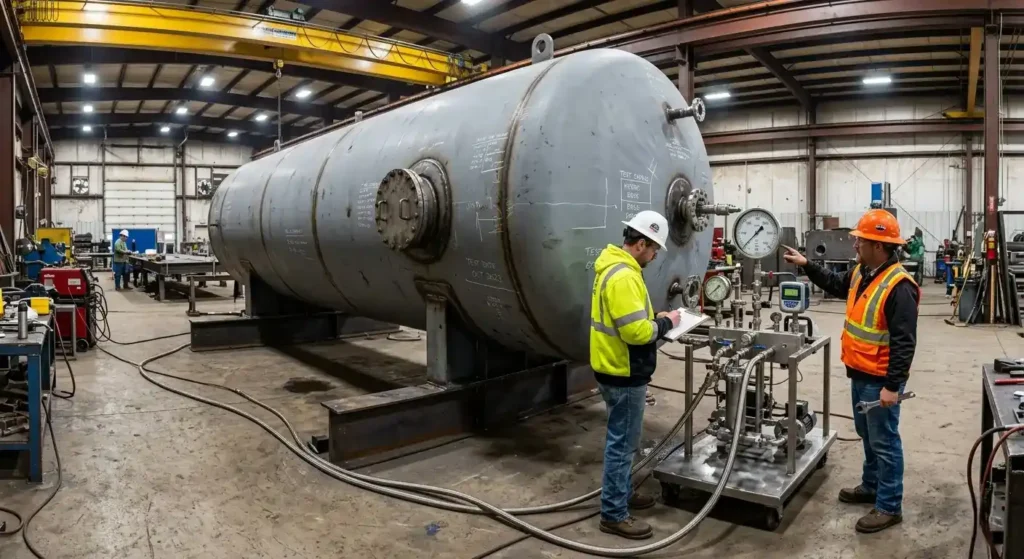
Thermal storage testing standards cover three distinct categories: code-required fabrication testing, performance testing, and in-service inspection. All three must be defined before the fabrication scope is finalized, because gaps in any category create problems that are significantly more expensive to resolve during commissioning than during the design phase.
Key Takeaways
- Thermal storage testing standards span three categories: code-required fabrication testing, performance testing that verifies stratification efficiency, and thermal storage tank inspection standards that govern evaluation across the vessel service life.
- ASME pressure vessel testing under Section VIII requires hydrostatic testing at 1.3 times MAWP, witnessed by the Authorized Inspector. The test confirms structural integrity but cannot detect subsurface weld flaws that NDE addresses.
- Full radiographic examination of all pressure-retaining welds is best practice for TES vessels in daily charge-discharge cycling service, regardless of the minimum code requirement.
- Factory acceptance testing resolves stratification performance, instrumentation, and integration issues in the fabrication shop before shipping, compressing field commissioning scope.
- The complete documentation package establishes the vessel baseline and supports the full in-service inspection lifecycle under the National Board Inspection Code.
- In-service inspection under the NBIC requires the original fabrication documentation as the reference baseline. Red River delivers complete documentation packages with every coded TES vessel.
What Do TES Vessel Testing Requirements Cover Across All Three Categories?
Most procurement specifications focus on code-required fabrication testing and treat performance and in-service testing as operational concerns to resolve later. TES vessel testing requirements that only address ASME fabrication testing leave stratification performance verification and in-service inspection baseline documentation undefined until problems surface in the field.
Why All Three Categories Must Be Set Before Fabrication Begins
The three testing categories are interdependent. NDE scope affects the vessel’s joint efficiency factor, which affects wall thickness in the design calculation. FAT scope affects instrumentation and nozzle requirements. In-service inspection documentation starts with the ASME Form U-1 and weld records generated during fabrication. None of these can be added retroactively. Red River works through the full testing scope at the start of every TES project. See Red River’s pressure vessel fabrication and thermal energy storage pages for how this applies across vessel types.
What ASME Pressure Vessel Testing Applies to TES Vessels?
ASME Section VIII Division 1 governs the fabrication testing requirements for coded pressure vessels, including thermal storage vessels. Three test methods apply depending on vessel service and configuration.
Hydrostatic Pressure Testing
Every coded TES vessel must be hydrostatically tested at a minimum of 1.3 times the MAWP before the ASME stamp is applied, conducted water-filled and witnessed by the third-party Authorized Inspector. The test confirms structural integrity but cannot detect subsurface weld flaws that may propagate under cyclic loading. NDE examination is required in addition to, not instead of, the hydrostatic test.
Pneumatic Testing as an Alternative
ASME Section VIII permits pneumatic testing at 1.1 times MAWP where water fill is not practical. Pneumatic testing stores significantly more energy than hydrostatic testing, making it more hazardous and requiring additional precautions. Red River confirms the test method during the design review.
Leak Testing for Zero-Leakage Applications
For vessels where trace leakage is not acceptable, leak testing using halogen gas, helium, or vacuum box techniques can be performed in addition to the standard pressure test. This applies to high-purity process service or where environmental regulations require zero-leakage verification.
What NDE Requirements Apply to TES Vessels in Cyclic Thermal Service?
NDE requirements for coded vessels are established by ASME Section VIII based on the vessel’s joint efficiency classification. TES vessels in daily charge-discharge service carry fatigue loading that makes NDE scope more consequential than for static-service vessels.
Radiographic and Ultrasonic Testing
Full radiographic or ultrasonic examination allows a joint efficiency of 1.0 in the ASME design calculation. Spot radiography allows 0.85. No radiography allows 0.70 but requires increased wall thickness. For TES vessels in cyclic service, full examination is best practice regardless of the minimum code requirement. A fatigue crack at a subsurface flaw is more expensive to repair in service than the incremental cost of full RT during fabrication.
Magnetic Particle and Liquid Penetrant Testing
Magnetic particle testing (MT) and liquid penetrant testing (PT) examine surface and near-surface flaws at nozzle welds, support attachment welds, and any weld subject to stress concentration in cyclic service. Red River coordinates NDE examination through qualified inspection personnel at required hold points before the vessel closes.
What Performance Testing Verifies Stratification Before Shipment?
Performance testing goes beyond ASME code requirements and verifies the vessel and integrated system deliver the stratification efficiency the design assumed before the unit ships.
Factory Acceptance Testing for Chilled Water Tank Testing
A well-defined factory acceptance test for a chilled water TES vessel or modular skid verifies diffuser flow distribution, thermocline formation and hold under simulated charge-discharge conditions, instrumentation accuracy, and pressure connection integrity. Factory acceptance testing resolves integration issues in the shop where corrections are straightforward. Red River’s modular skid packages include defined FAT scopes with witness testing available for clients requiring third-party verification before shipment.
Stratification Efficiency Measurement
Stratification efficiency quantifies the fraction of nominal tank volume that delivers usable storage at the design delta T, measured via temperature sensors at defined intervals during a controlled charge-discharge cycle. ASHRAE guidelines provide reference methods for stratification efficiency measurement across chilled water and industrial TES applications.
What Thermal Storage Tank Inspection Standards Apply In-Service?
ASME-stamped TES vessels fall under the National Board Inspection Code (NBIC) for in-service inspection, repair, and alteration after the vessel enters service. These thermal storage tank inspection standards define inspection intervals, documentation requirements, and repair procedures. Initial in-service inspection after the first year of operation is standard practice for new vessels in cyclic service. Subsequent intervals depend on corrosion rate, service conditions, and jurisdictional requirements.
An effective in-service inspection program requires the original fabrication documentation as the baseline: ASME Form U-1, certified mill test reports, weld procedure specifications, welder qualification records, NDE reports, and hydrostatic test records. Red River’s capabilities include delivering this complete documentation package as standard practice with every coded TES vessel.
How Do the Three Testing Categories Sequence Across the Fabrication Timeline?
Understanding when each testing category applies across the fabrication timeline prevents the scheduling conflicts that push testing to closeout rather than integrating it throughout the build.
Code Testing Runs Concurrent With Fabrication
NDE examination runs concurrently with fabrication at defined hold points. Nozzle welds are examined before the nozzle boss is covered by insulation or internal liners. Shell seam radiographs are taken before the next course is added on tall vertical vessels. These hold points are defined in the vessel’s inspection and test plan before the first plate is cut. Attempting to catch up on NDE after the vessel is fully assembled creates access problems and documentation gaps that delay the Authorized Inspector’s final review.
Hydrostatic testing is the final code-required step before the ASME stamp is applied. By the time hydrostatic test pressure is applied, all NDE must be complete, all documentation must be assembled, and the Authorized Inspector must be available to witness the test. Scheduling the hydrostatic test before NDE documentation is complete means one of three outcomes: the test is postponed, NDE is rushed and inadequately documented, or the stamp is applied before the documentation package is complete. None of those outcomes is acceptable on a coded vessel.
Performance Testing Requires a Completed Vessel
Factory acceptance testing for stratification efficiency and instrumentation performance requires the vessel to be fully assembled with all nozzles, diffusers, instrumentation connections, and insulation in place. FAT cannot be staged before fabrication is complete. This means the FAT schedule must be planned against the fabrication completion date, not added after the vessel is finished. For TES skid packages that integrate multiple vessels with piping, instrumentation, and controls, the FAT schedule is part of the project plan from day one.
In-Service Inspection Documentation Starts at Material Receipt
The documentation chain that supports in-service inspection under the NBIC starts at material receipt, not at vessel delivery. Certified mill test reports for all pressure-retaining materials must be tied to specific heats and lots, matched to the vessel weld map, and filed before those materials are cut and welded into the vessel. A gap in MTR traceability at this stage creates a documentation deficiency that cannot be resolved retroactively without material testing that is significantly more expensive than maintaining proper records from the start.
This is why Red River treats NDE documentation, hydrostatic test records, and MTR traceability as parallel workstreams running alongside fabrication, not sequential tasks completed at the end. See Red River’s about us page for how this documentation discipline is embedded in Red River’s fabrication quality program.
What Does a Complete TES Vessel Documentation Package Contain?
The documentation package delivered with a coded TES vessel serves two functions: it closes out the ASME fabrication requirements and it provides the baseline for the in-service inspection lifecycle. A complete package covers five document categories.
ASME Fabrication Documents
The core ASME fabrication documents are the Form U-1 Manufacturer’s Data Report, signed by both the Authorized Manufacturer and the Authorized Inspector; certified mill test reports for all pressure-retaining materials; the weld map identifying every pressure-retaining joint; weld procedure specifications and procedure qualification records; welder qualification records for every welder who worked on the vessel; and NDE reports for every examination performed, including the method, the procedure revision, the examiner, and the disposition of every indication.
Pressure Test Records
The hydrostatic test record documents the test pressure, the test medium, the hold duration, the test date, the result, and the Authorized Inspector’s signature. For vessels where pneumatic or leak testing was performed, the applicable records for those methods are included alongside the hydrostatic test record. These records create the traceable link between the test and the vessel serial number that the NBIC requires as the inspection baseline.
Performance Testing Documents
For TES vessels delivered as part of a complete modular system, the documentation package includes FAT records, stratification efficiency test results documenting the measured thermocline depth and figure of merit across the charge-discharge cycle, and instrumentation calibration records for all sensors installed on the vessel or skid. These documents establish the performance baseline that in-service inspections will reference when evaluating whether the system is performing within its design parameters.
What This Means When Defining Your TES Vessel Scope
Defining thermal storage testing requirements after the fabrication scope is set is the most common source of commissioning delays on TES vessel projects. NDE scope affects design. FAT scope affects instrumentation and nozzle requirements. Documentation for in-service inspection starts at the mill test report stage, not at delivery. Red River works through code-required testing, NDE specification, FAT scope, and in-service inspection documentation at the start of every TES project.
Discuss Thermal Storage Testing Requirements With Red River
Red River holds active ASME U Stamp and NBBI R Stamp certifications and has fabricated and tested coded thermal storage vessels for oil and gas, power generation, and biogas clients from Gillette, Wyoming, since 2003. Red River’s prefabrication services and chilled water tank testing Wyoming capabilities are available for complete TES system scopes. Request a quote or call 1-307-257-5332 to discuss your thermal storage testing standards and fabrication scope.
Frequently Asked Questions
1. What Hydrostatic Test Pressure Is Required for ASME TES Vessels?
ASME Section VIII requires hydrostatic testing at a minimum of 1.3 times MAWP, conducted water-filled and witnessed by the third-party Authorized Inspector. The signed test record becomes part of the documentation package delivered with the completed vessel.
2. What NDE Is Required for TES Vessels in Cyclic Thermal Service?
Full radiographic or ultrasonic examination of all pressure-retaining welds is best practice for TES vessels in daily charge-discharge service, even where the minimum code requirement allows spot examination. Surface NDE including MT or PT is required at nozzle welds and support attachment welds.
3. What Does a Factory Acceptance Test for a Chilled Water TES System Verify?
A FAT verifies diffuser flow distribution, thermocline formation under simulated charge-discharge conditions, instrumentation accuracy, and pressure connection integrity. It resolves integration issues in the shop before shipping rather than during field commissioning.
4. How Are Thermal Storage Testing Standards Different From Standard Pressure Vessel Testing?
Standard pressure vessel testing covers hydrostatic testing and NDE. Thermal storage testing standards add performance verification including stratification efficiency measurement and factory acceptance testing of the complete system. TES vessels in cyclic service also carry higher NDE requirements due to fatigue loading at nozzle welds and support attachments.
5. What Documentation Should Be Delivered With a Completed TES Vessel?
At minimum: ASME Form U-1, certified mill test reports, weld procedure specifications, welder qualification records, NDE reports, and a hydrostatic test record. For complete TES systems, add FAT records, stratification test results, and instrumentation calibration records. Red River delivers this complete package with every coded TES vessel as standard practice.
6. What In-Service Inspection Requirements Apply to ASME-Stamped TES Vessels?
ASME-stamped TES vessels fall under the National Board Inspection Code for in-service inspection, repair, and alteration. Initial inspection after the first year is standard for cyclic service vessels. Subsequent intervals depend on corrosion rate, service conditions, and jurisdictional requirements. The fabrication documentation package delivered at commissioning provides the baseline for all future evaluations.
Related Blog Post
Can Condensate Storage Improve Reliability?
Where Do Condensate Tanks Fit in a Steam System?
Which Nozzles Simplify Maintenance on Pressure Vessels?
How to Vent Condensate Tanks in Steam Systems
How Do Baffle Layouts Affect Stratification in TES Tanks?
- Equalization Tanks: Design, Sizing, and Fabrication
- What Hydro Tests Are Required for Pressure Vessels?
- What Are Thermal Storage Tank Design Parameters?
- What Is Thermal Energy Storage System Manufacturing?
- Thermal Storage Tanks for Industrial Use
- Thermal Energy Storage Solutions for Industrial Applications
About Author



