
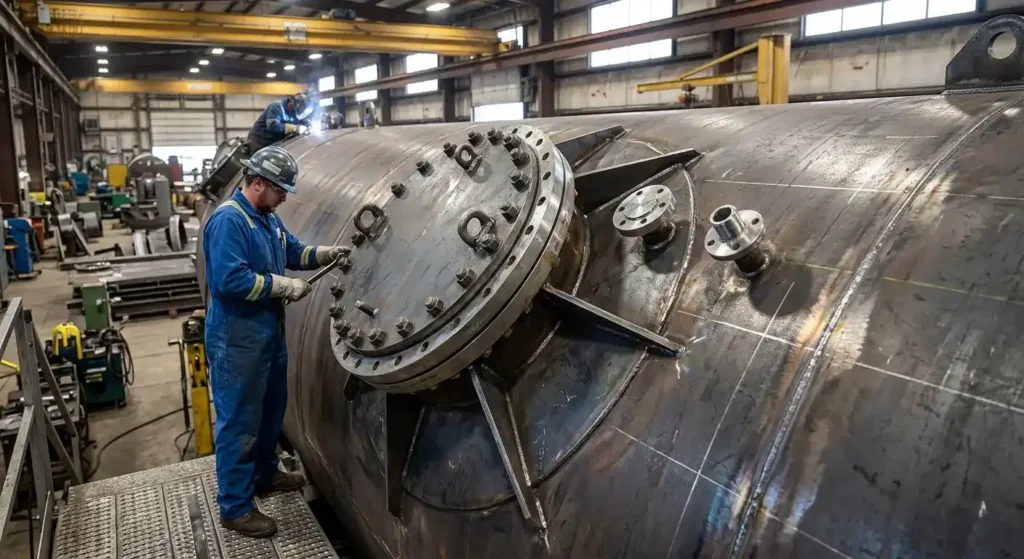
Which nozzles simplify maintenance on industrial pressure vessels? This guide is for plant engineers, inspection leads, and procurement managers who need to understand which nozzle configurations reduce inspection time and lower maintenance cost.
Key Takeaways
- Which nozzles simplify maintenance most directly are the manway, the low-point drain, and the high-point vent. These three access provisions determine how quickly a vessel can be prepared for internal inspection and returned to service.
- A 24-inch manway is the standard for confined space entry with full PPE. Placement near the bottom of vertical vessels or on the side of horizontal vessels reduces the complexity of entry and emergency retrieval.
- Full-bore drain nozzles at the geometric low point allow complete drainage. Undersized or misplaced drains leave heel liquid that extends preparation time and creates hazards for confined space entry.
- Quick-opening manways reduce access time on vessels requiring frequent internal entry. They eliminate individual bolt removal and reinstallation from the maintenance cycle on filter, strainer, and batch process vessels.
- Nozzle orientation must be coordinated with support structure and access platform design during fabrication. A correctly specified nozzle that faces an obstruction or inaccessible position provides no maintenance benefit in service.
Which Nozzles Simplify Maintenance: Why Nozzle Design Matters
Nozzle design is usually treated as a process engineering decision, connecting the vessel to the piping system at the right size, pressure class, and orientation. But nozzle configuration also determines how easily the vessel can be inspected, cleaned, and maintained throughout its service life.
A vessel with a properly sized manway, a full-bore low-point drain, and a high-point vent can be prepared for internal inspection in a fraction of the time required for vessels without these provisions. Over a 20-year service life, those differences accumulate into significant maintenance cost.
Red River’s pressure vessel fabrication scope includes working through nozzle configuration with clients during the design review phase, not just sizing connections for process flow. For more on how inspection intervals apply over a vessel service life, see how often pressure vessels need to be inspected.
Manways: The Most Important Maintenance Nozzle
Standard manway sizes and placement
A manway is the primary access point for internal inspection of a pressure vessel. ASME Section VIII requires manways on vessels above certain size thresholds, but providing manway access on smaller vessels is still best practice when internal inspection is expected during the service life.
Standard manway sizes are 18 inches, 20 inches, and 24 inches in diameter. An 18-inch manway allows a person to enter a vessel in light clothing. A 24-inch manway allows entry in full personal protective equipment including self-contained breathing apparatus, which is required for confined space entry in many industrial service conditions. For vessels where inspection requires extensive internal movement, the 24-inch manway is the standard that actually simplifies maintenance.
A manway near the bottom of a vertical vessel or on the side of a horizontal vessel allows entry without descent line work. A top-center manway on a tall vertical vessel requires the inspector to lower into the vessel, adding time and complicating rescue.
Quick-opening manways
For vessels that require frequent internal access, such as filter vessels, strainer bodies, or batch process vessels, quick-opening manways with swing bolt or davit-mounted closure designs simplify maintenance significantly compared to standard flanged manways requiring full bolt removal. Quick-opening designs allow the closure to be removed without handling individual bolts and reinstalled without torquing a full bolt circle.
Red River’s fabrication capabilities include quick-opening manway designs for vessels where frequent access is a defined operational requirement. The manway style, size, and location are confirmed during the design review before fabrication begins.
Drain Nozzles: Simplifying Vessel Preparation
Full-bore drains at the low point
A full-bore drain nozzle at the geometric low point of the vessel allows complete drainage before internal inspection or maintenance. Drain nozzles that are undersized, not at the true low point, or obstructed by internal components leave heel liquid that must be removed manually before safe entry is possible.
For water service, a 2-inch minimum full-bore drain at the vessel low point is standard. For hydrocarbon or chemical service, drain sizing must also account for fluid viscosity, hazard level, and waste disposal requirements.
Low-point drain with isolation valve
A drain nozzle fitted with an isolation valve and a blind flange or cap downstream allows the drain valve to be kept closed during normal operation and opened for controlled drainage during maintenance preparation. Specifying the isolation valve as part of the vessel fabrication scope, rather than leaving it to field installation, ensures the valve is the correct pressure class, material, and body style for the vessel service. Red River’s prefabrication capabilities cover drain valve and nozzle assembly as part of the vessel scope on modular and skid-mounted configurations.
Vent Nozzles: Safe Depressurization and Purging
A vent nozzle at the geometric high point of the vessel allows air or inert gas to enter as the vessel drains, preventing vacuum formation that can damage the vessel shell. For vessels in hazardous service, the vent nozzle also provides the connection point for purging with nitrogen or steam before entry.
A minimum one-inch full-bore vent at the high point is standard for most vessel sizes. Undersized vents create back pressure that slows drainage and can generate partial vacuum in thin-wall vessels.
Inspection Nozzles and Flush Connections
Threaded inspection ports
Threaded inspection ports in the two-inch to four-inch range provide access for borescope inspection without requiring full vessel entry. For vessels where the interior can be assessed visually without physical entry, threaded inspection ports at strategic locations reduce the frequency of full manway entry during routine inspection intervals.
Inspection port placement should provide sight lines to the critical inspection areas of the vessel interior, including shell-to-head junctions, nozzle welds, and internal component attachment points. ### Flush connections for cleaning
Flush connection nozzles allow high-pressure water or cleaning solution to be introduced into the vessel interior for cleaning without requiring manual internal access. For vessels with fouling tendencies or periodic cleaning requirements, flush nozzles at designed locations reduce cleaning time and eliminate confined space entry for routine cleaning cycles.
Nozzle Orientation and Access Clearance
Which nozzles simplify maintenance also depends on whether the nozzle orientation allows safe and practical access. A manway with no platform or access structure above it does not simplify maintenance because the inspector still cannot safely access the opening. Nozzle orientation must be coordinated with the support structure, access platform, and ladder design during the engineering phase.
Red River coordinates nozzle orientation with vessel support design and access provisions during fabrication to ensure the maintenance nozzles specified on the drawing are actually accessible in the installed position. The National Board provides guidance on in-service inspection requirements that inform where access provisions are most needed over the vessel service life. AWS welding standards also apply to nozzle weld qualification on coded pressure vessels.
Ready to Review Nozzle Configuration for Your Next Vessel Project?
Which nozzles simplify maintenance on your vessel depends on service conditions, inspection interval requirements, and access constraints at the installation site. Red River works through nozzle configuration, manway sizing and placement, drain and vent provisions, and access clearance with clients before fabrication scope is finalized.
Request a quote or call 1-307-257-5332 to discuss your vessel nozzle configuration and maintenance access requirements with Red River’s fabrication team.
Frequently Asked Questions
1. Which nozzles simplify maintenance most significantly on industrial pressure vessels?
The manway is the most important maintenance nozzle because it determines whether internal inspection is practical or requires disassembly. A properly sized and positioned manway combined with a full-bore low-point drain and a high-point vent covers the three access provisions that most directly affect inspection preparation time and long-term maintenance cost.
2. What is the minimum manway size for confined space entry with full PPE?
A 24-inch manway is the standard minimum for entry in full personal protective equipment including self-contained breathing apparatus. An 18-inch manway allows entry in light clothing but may not accommodate the equipment required for confined space entry under applicable safety regulations in industrial service conditions.
3. When should a quick-opening manway be specified instead of a standard flanged manway?
Quick-opening manways are appropriate for vessels requiring frequent internal access, such as filter vessels, strainer bodies, and batch process vessels. They allow the closure to be removed and reinstalled without handling individual bolts, reducing access time for routine maintenance cycles. The pressure class and temperature rating of the quick-opening design must match the vessel’s design conditions.
4. Why is low-point drain nozzle placement critical for maintenance?
A drain nozzle not located at the true geometric low point of the vessel leaves heel liquid that must be removed manually before safe entry. For vessels in hydrocarbon or chemical service, that residual liquid creates a confined space hazard that extends preparation time and requires additional controls before inspection can begin.
5. How does nozzle orientation affect maintenance access in practice?
A nozzle specified at the correct location on the vessel drawing is only useful for maintenance if the orientation aligns with accessible working positions. Manways that open toward obstructions, drains that face unavailable floor space, and vents that cannot be reached without scaffolding all reduce the maintenance value of the nozzle. Orientation must be coordinated with support structure and platform design during fabrication.
Related Blog Post
Can Condensate Storage Improve Reliability?
Where Do Condensate Tanks Fit in a Steam System?
How to Vent Condensate Tanks in Steam Systems

How Do Baffle Layouts Affect Stratification in TES Tanks?

What Delta T Drives Volume in Thermal Storage Tanks?
No related articles found.
About Author



