
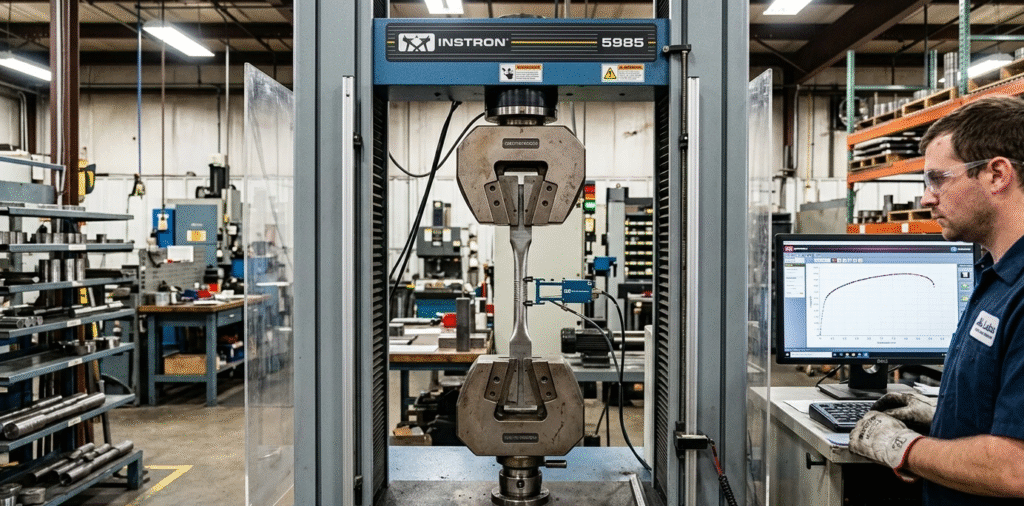
A material that fails unexpectedly during tensile testing can point to deeper problems in fabrication, design, or operating conditions. This article is for engineers, facility managers, operators, and welders who need to understand what causes tensile test failure and how those results affect equipment reliability.
You’ll learn how tensile testing of materials works, what the stress-strain curve reveals, why fracture points matter during inspections, and which hidden factors often contribute to premature material failure in industrial environments.
Why Tensile Test Failure Matters in Industrial Systems
A failed tensile test goes beyond lab results, highlighting potential weaknesses in pressure vessels, pipelines, structural supports, or rotating equipment under real-world stress. Engineers use tensile testing to ensure materials meet mechanical standards before service. Early fractures often indicate manufacturing defects, improper heat treatment, corrosion, or design-related stress concentrations. Identifying these risks early helps reduce downtime, safety issues, and costly replacements.
Red River Team frequently discusses how material reliability and testing procedures influence long-term structural performance across industrial systems.
How Tensile Testing of Materials Works
Tensile testing measures a material’s response to a controlled pulling force until fracture. Engineers record force and elongation data to create a stress-strain curve, identifying elastic deformation, yield strength, ultimate tensile strength, and fracture behavior.
Elastic and Plastic Deformation
In the elastic stage, materials return to their original shape after load removal. After the yield point, permanent plastic deformation occurs, helping engineers assess overload behavior. Ductile materials deform before breaking, while brittle ones fracture suddenly.
Understanding the Fracture Point
The fracture point marks complete specimen separation. Engineers analyze the fracture surface, as its appearance often indicates the failure mechanism. A rough, stretched surface suggests ductile failure, while flat or sharp patterns point to brittle behavior or internal defects.
What Causes Tensile Test Failure Most Often
Most tensile test failures result from multiple contributing factors rather than a single isolated issue. Material quality, fabrication processes, environmental exposure, and testing conditions all influence the outcome.
Material Defects and Internal Flaws
Voids, inclusions, laminations, and microcracks weaken the material before testing even begins. These imperfections create localized stress concentration points where cracks can initiate under load.
Even small internal flaws may significantly reduce tensile strength and elongation values during testing.
Improper Heat Treatment
Heat treatment directly affects hardness, ductility, and grain structure. If the thermal process is incorrect, the material may become too brittle or lose its intended mechanical strength.
Premature fracture during tensile testing is common when improper cooling rates or inconsistent heat exposure alter the internal structure of the metal.
Corrosion and Environmental Damage
Corrosion gradually removes material thickness and creates weak zones that accelerate crack propagation. Chemical exposure, moisture, and salt contamination increase the likelihood of failure during testing.
Stress corrosion cracking is particularly dangerous because the damage may spread internally before surface signs become visible.
Poor Specimen Preparation
Specimen geometry must follow strict testing standards. Rough machining marks, dimensional inconsistencies, or surface scratches can distort test results and trigger premature fracture.
Testing errors caused by improper preparation sometimes resemble genuine material failure, which is why engineers review fabrication records carefully during analysis.
Residual Stress From Manufacturing
Residual stress is one of the most overlooked causes of tensile test failure. Welding, machining, bending, and uneven cooling can leave hidden internal stresses trapped inside the material.
During testing, these internal stresses combine with the applied tensile load and may cause the specimen to fail earlier than expected. This issue commonly appears near weld zones and heat-affected areas in fabricated assemblies.
How Engineers Use Stress-Strain Curve Interpretation
The stress-strain curve reveals how a material behaves during testing. Engineers use this data to assess material suitability for service.
Identifying Yield Strength
The yield point marks the transition from elastic to permanent deformation, helping engineers select materials for pressure systems and load-bearing structures.
Evaluating Ultimate Tensile Strength
Ultimate tensile strength is the maximum stress a material can withstand before necking. Low values often indicate defects, improper alloy composition, or environmental degradation.
Analyzing Necking and Fracture Behavior
Necking concentrates deformation in one section before fracture. Engineers examine the fracture surface and deformation to identify causes such as overload, brittleness, fatigue, or hidden defects.
Why Fracture Mechanics Improves Failure Investigations
Fracture mechanics helps engineers understand how cracks initiate and propagate under stress. Instead of only identifying visible defects, engineers can estimate whether a crack is likely to grow during service conditions.
This approach is especially important for pressure vessels, pipelines, and structural systems operating under cyclic loading conditions.
The American Society of Mechanical Engineers provides standards widely used during pressure equipment evaluation and material testing programs.
Red River Team also highlights the importance of combining tensile test data with inspection methods that detect hidden structural damage before catastrophic failure occurs.
For facilities evaluating structural integrity, understanding non-destructive testing methods for pressure vessel safety helps support more accurate material assessments.
The Hidden Connection Between Weld Quality and Tensile Failure
Top-ranking articles often overlook how weld preparation impacts tensile failure. In industrial systems, poor weld geometry and joint preparation create stress concentration zones, leading to higher tensile loading. Cracks often form near undercut welds, incomplete penetration, or abrupt transitions.
Proper fabrication practices reduce these risks significantly. Red River Team explains how vessel welding joint preparation for optimal strength improves long-term structural reliability in pressure-containing systems.
This connection between weld preparation and tensile testing is frequently overlooked despite its importance in real-world failure analysis.
How Facilities Reduce Tensile Strength Failure Risk
Preventing tensile strength failure requires more than passing a single material test. Long-term reliability depends on fabrication quality, inspection planning, and operational monitoring.
Use Testing Standards Consistently
Testing procedures should follow recognized standards to ensure repeatable and accurate results.
Facilities handling pressure systems often reference guidelines discussed in this comprehensive guide to ASME pressure vessel testing requirements during inspection planning.
Combine Tensile Testing With Other Inspections
Tensile testing alone cannot detect every form of hidden damage. Ultrasonic inspection, magnetic particle testing, and dye penetrant testing help identify flaws before structural failure occurs.
Facilities performing routine inspections often integrate additional procedures discussed in testing the vessel to improve equipment reliability.
Monitor Operational Changes
Production increases, pressure changes, vibration exposure, and thermal cycling can alter material stress conditions significantly.
Engineers should reevaluate critical components whenever operating demands exceed original design assumptions.
For a broader context on industrial material breakdown, Red River Team also explains the common types of failure in strength of materials that affect engineered systems.
Concluding Insights into the Causes of Tensile Test Failure
Understanding what causes tensile test failure helps engineers identify risks before structural problems develop in operational equipment. Material defects, residual stress, corrosion, fabrication quality, and improper testing conditions can all influence fracture behavior during tensile testing.
When facilities combine accurate stress-strain curve interpretation with proper inspection practices, they gain a clearer understanding of material performance and long-term structural reliability.
Get Expert Engineering Support for Reliability Issues
If your facility is experiencing unexplained cracking, failed material tests, or recurring pressure-related reliability issues, Red River Team provides engineering guidance for industrial systems and structural integrity evaluations. Contact Red River now.
Frequently Asked Questions
1. How do engineers analyze tensile test failure?
Engineers analyze tensile test failure by reviewing the stress-strain curve, inspecting the fracture surface, and evaluating the material’s fabrication and operational history. Microscopic analysis may also identify brittle fracture, ductile deformation, or fatigue-related cracking.
2. Why does a tensile test fail before the expected strength is reached?
Premature failure often results from hidden material defects, residual stress, corrosion exposure, or improper thermal processing. Testing equipment calibration issues and specimen preparation errors can also affect the results.
3. What does the fracture point in tensile test results indicate?
The fracture point reveals how the material ultimately failed under tension. Engineers use fracture surface characteristics to determine whether the failure was ductile, brittle, fatigue-related, or influenced by environmental conditions.
4. Why is weld preparation important in tensile testing?
Improper weld geometry can create stress concentration zones where cracks begin under load. Proper joint preparation helps distribute stress more evenly and improves structural reliability during service.
5. What is the role of residual stress in tensile test failure?
Residual stress, which remains in a material after manufacturing processes such as welding, machining, or heat treatment, can significantly impact tensile test results. These internal stresses may cause unexpected fracture points or accelerate crack propagation, even when the material is under lower-than-expected loads. Engineers often take residual stress into account when analyzing tensile failures, as it can reduce the material’s overall strength and lead to premature failure. Proper stress-relief procedures and post-treatment practices help minimize these internal stresses and improve the material’s performance.
KEY TAKEAWAYS
- Inspect weld zones and heat-affected areas closely during tensile failure investigations
- Verify specimen dimensions and machine calibration before accepting test data
- Review stress-strain curves alongside fracture surface analysis for more accurate conclusions
- Monitor corrosive operating environments where tensile cracking risk increases over time
- Include residual stress evaluation when analyzing fabricated or welded components
Related Blog Post
Which Materials Suit Make-Up Water Service?
How Big Should Make-Up Water Tanks Be?
Make-Up Water Tanks: Design, Sizing, and Fabrication
When to Spec Equalization Tanks for Industrial Systems
How Do Equalization Tanks Balance Flow?
No related articles found.
About Author



