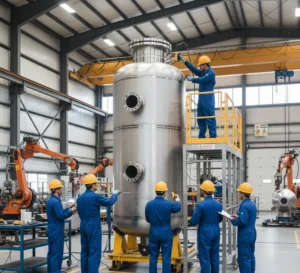
Accurate pressure vessel dimensional compliance ensures safety, proper stress distribution, and efficient operation. Systematic inspections and precise measurements at all fabrication stages prevent deviations and support regulatory compliance.
Pressure Vessel Dimensional Tolerance Standards
Pressure vessel dimensional standards form the critical backbone of numerous industrial processes, containing gases and liquids under pressure in applications ranging from refineries and chemical plants to power generation facilities. Accurate pressure vessel fabrication is fundamental for safety and operational efficiency. The dimensional specifications established during the design phase must be maintained rigorously throughout fabrication, installation, and the vessel’s service life.
Understanding Pressure Vessel Dimensional Requirements in Pressure Vessel Codes
Pressure vessel dimensional inspection involves systematic measurement and verification of physical dimensions against specified tolerances. Regulatory bodies like the ASME Boiler and Pressure Vessel Code (BPVC), particularly Section VIII, provide the most widely recognized standards. Additional guidance may come from API, ISO, or local regulations, depending on the application.
Dimensional accuracy ensures that stress distributions match design calculations, sealing surfaces function properly, and components align correctly during assembly. Even small deviations can reduce safety margins and operational efficiency.
Critical Pressure Vessel Dimensional and Tolerances for Pressure Vessel Components
Shell Roundness and Straightness Requirements
Cylindrical shell components must maintain roundness tolerances to ensure uniform stress distribution. ASME BPVC Section VIII Division 1 specifies that out-of-roundness should not exceed 1% of nominal diameter. Straightness requirements prevent buckling and uneven loading. These are verified using laser trackers, inside micrometers, or circumferential tapes.
Head Geometry and Profile Verification Standards
Pressure vessel heads, whether elliptical, hemispherical, or torispherica,l require precise geometric profiles. Critical dimensions include crown radius, knuckle radius, and straight flange length. Modern inspection employs 3D scanning technology or template checks to ensure accuracy. Deviations in head geometry can create stress concentrations.
Nozzle Alignment and Orientation Tolerances
Nozzles, the connection points for piping and instrumentation, must be precisely positioned. Standard tolerances include ±1/8 inch (3.2 mm) for location and ±2° for angular orientation. Proper nozzle alignment ensures piping connections do not induce harmful stress and internal components function properly.
Support Structure Pressure Vessel Dimensional Compliance
Supports, including saddles, legs, and lugs, require verification for proper load distribution. Measurements include center-to-center distances, levelness, and alignment with vessel centerlines. These ensure operational loads are properly transferred to foundations without creating localized stresses. Learn more about support design in industrial pressure vessels.
Essential Measurement Tools and Techniques
Laser Tracking and 3D Measurement Systems
Modern fabrication increasingly uses laser trackers with ±0.001 inch (0.025 mm) accuracy and 3D measurement systems. These systems allow rapid verification of complex geometries and generate dimensional reports comparing as-built components to designs.
Traditional Measurement Methods and Their Applications
Traditional tools like inside micrometers, calipers, depth gauges, and straightedges remain vital. These are essential for verifying critical pressure vessel dimensions in both fabrication and maintenance.
Calibration Requirements for Inspection Equipment
All measurement equipment, whether digital or traditional, requires regular calibration to maintain accuracy. ASME standards typically require calibration traceable to national standards (like NIST in the United States). Documentation of calibration status forms an essential part of quality assurance programs. Even the most sophisticated measurement system provides questionable results without proper calibration verification.
Digital Documentation of Pressure Vessel Dimensional Data
Modern Pressure Vessel dimensional inspection increasingly employs digital documentation systems that capture, organize, and analyze measurement data. These systems provide benefits including improved traceability, statistical analysis capabilities, and integration with design models. Digital records also facilitate comparison between in-service measurements and original fabrication data, supporting remaining life assessments.
Inspection Stages and Verification Points
Pre-fabrication Material Pressure Vessel Dimensional Verification
Dimensional inspection begins before fabrication. Plate materials are checked for thickness and flatness, and piping sections for nozzles require verification of diameter, wall thickness, and straightness. Early verification prevents propagation of costly errors. Reference material selection guides for best practices.
In-Process Measurements During Fabrication
Ongoing Pressure Vessel dimensional verification during fabrication provides early detection of deviations while corrections remain feasible. Critical inspection points include:
- Shell roundness after rolling
- Alignment verification before welding (5G welding)
- Dimensional checks after heat treatment
- Verification of weld reinforcement heights
These steps reduce the risk of rework and ensure quality assurance throughout fabrication.
Final Pressure Vessel Dimensional Inspection Requirements
Final dimensional verification occurs after fabrication and before testing. Often, third-party inspectors confirm compliance with design and applicable codes. The final inspection process includes checking overall dimensions, nozzle positions, and support alignments.
Documentation and Reporting Standards
Pressure Vessel Dimensional inspection generates essential documentation that forms part of the vessel’s permanent record. Reports typically include:
- Measurement results with comparison to allowable tolerances
- Identification of inspection tools and their calibration status
- Verification of inspector qualifications
- Documentation of any deviations and their resolution
These records support maintenance, modification, andservice life assessments.
Pressure Vessel Dimensional Compliance and Its Critical Role
Maintaining precise pressure vessel dimensional accuracy is essential for ensuring the safety, performance, and longevity of pressurized systems. From shell roundness and head geometry to nozzle alignment and support structures, every dimension directly influences stress distribution, sealing integrity, and operational efficiency. Adhering to established standards such as ASME BPVC, combined with systematic inspections throughout fabrication and proper calibration of measurement tools, ensures that vessels meet stringent design requirements. Comprehensive documentation of these dimensional verifications not only supports regulatory compliance but also provides a reliable reference for maintenance, modifications, and lifespan assessments. Ultimately, meticulous attention to pressure vessel dimensional specifications is the cornerstone of safe, efficient, and dependable industrial operations.
Need a reliable partner?
Red River specializes in the design and manufacturing of pressure vessels. We also fabricate related items such as prefabricated spools and skid packages.
Reach out to us today and experience the Red River difference. Where American-made products and American Values come together, we care more.
Frequently Asked Questions
1. What are the most critical dimensional tolerances for pressure vessel safety?
Critical tolerances include shell roundness, thickness, nozzle alignment, head geometry, and flange flatness, ensuring stress distribution and vessel integrity.
2. How do ASME Pressure Vessel dimensional requirements differ from other international standards?
ASME BPVC offers more specific dimensional tolerances than PED, with explicit formulas, while JIS, Chinese codes, and PED often reference ISO or allow slightly different limits.
3. What measurement equipment provides the most accurate results for pressure vessel inspection?
Laser tracking ensures ±0.001 inch accuracy for vessel dimensions, combined with ultrasonic thickness gauges and optical alignment systems for precise wall thickness, nozzle orientation, and critical features.
4. How does material thickness affect Pressure Vessel dimensional inspection requirements?
Material thickness affects inspection: thicker materials allow larger dimensional tolerances but require tighter control of variations, influencing stress distribution and necessitating ultrasonic measurements for thick-walled vessel verification.
5. What documentation is required for dimensional inspection of pressure vessels?
Documentation includes dimensional verification reports, calibration records, inspector qualifications, and deviation resolutions; ASME-certified vessels require Authorized Inspector review and permanent maintenance of all inspection records.
Key Takeaways
- Dimensional accuracy directly impacts pressure vessel safety and performance through proper stress distribution and component alignment
- Systematic inspection at multiple fabrication stages ensures compliance with design specifications and regulatory requirements
- Proper measurement tools and calibration are essential for accurate verification of critical dimensions
- Comprehensive documentation provides the foundation for vessel certification and future reference
Related Blog Post
Pressure Vessel Design & Engineering: Concept to Launch
What is Pressure Vessel Design and Engineering: Code-Ready Guide
What are the Key Factors in Pressure Vessel Engineering
How Do You Design a Pressure Vessel: A Step-By-Step Guide