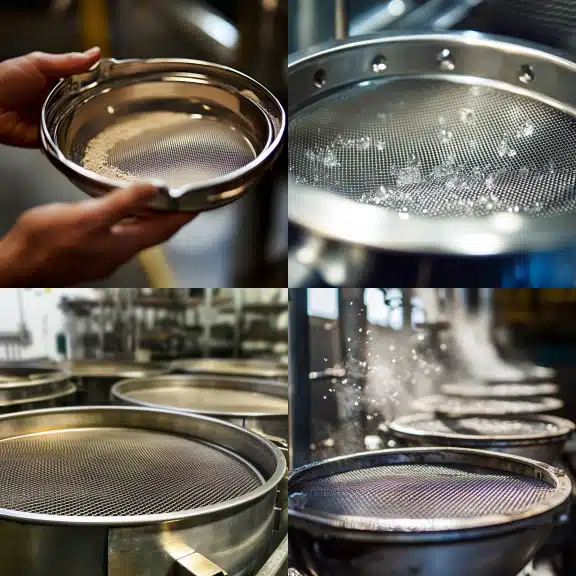
Understanding the Importance of Industrial Sieving

The Importance of Industrial Sieving
Industrial sieving plays a crucial role in ensuring product quality, consistency, and safety, making it indispensable across various industries. At Red River, we recognize that every element matters, particularly when maintaining the highest standards of satisfaction and safety in industrial practices. Also known as industrial screening or particle separation, sieving is a seemingly simple yet essential process used in oil and gas, food processing, power generation, and biogas production. Whether for mesh filtration systems or large-scale separation equipment, the significance of using a sieve cannot be overstated. But why exactly is sieving so important? Let’s dive in.
What is a Sieve?
A sieve, at its core, is a filtration device designed to separate particles based on size. It works by allowing smaller particles to pass through while larger ones are retained. This highly powerful device is common in many industrial applications, ensuring that only the simplest materials of the desired size make it to the next stage of production. However, sieving isn’t just about separation—it’s also about ensuring consistency, quality, and safety in the goods you produce.
Importance of Industrial Sieving: Common Applications in Industry
Sieving isn’t limited to kitchens; in fact, its uses in business applications are widespread and varied. For instance, in oil and fuel industries, sieves help purify materials, ensuring that only natural substances are processed. In the chemicals and materials industry, sieves classify raw substances, ensuring the best grades are used.
In food and beverage manufacturing, industrial sieving ensures consistent flour particle size, prevents contamination, and helps companies meet FDA food safety standards. In mining operations, sieves and screens separate ores by grade, following ASTM particle size specifications.
This precision not only ensures a higher-quality final product but also enhances efficiency while reducing waste. Businesses looking to minimize costs and maximize yield rely on sieving as a vital process.
The Role of Industrial Sieving in Quality Control
At Red River, quality management lies at the heart of what we do, and sieving plays a crucial part. By using a sieve, we ensure that all materials meet the specifications required for safe and efficient operations. This is particularly important in pressure vessels, where even the smallest impurity can cause issues.
For example, during a 2024 refinery project, our sieving process removed particles above 50 microns, meeting API 650 cleanliness requirements and reducing equipment downtime by 18%.
Through sieving, every material we use undergoes strict screening and testing, guaranteeing that the final product exceeds expectations and satisfies enterprise requirements.
Importance of Industrial Sieving: Why It Cannot Be Overlooked
Applications Highlighting the Importance of Sieving
A sieve separates particles based on size, ensuring that materials meet precise specifications. This process plays a critical role in industries like oil and fuel, where uniform particle size directly impacts performance and safety.
Enhancing Filtration Efficiency
Sieves remove impurities early in the process, preventing blockages and reducing pressure on complex filtration systems. This approach not only streamlines operations but also decreases costs.
Reducing Waste and Maximizing Yield
Businesses use sieving to separate usable materials from waste efficiently, ensuring that nothing goes to waste. By doing so, they reduce disposal costs and create sustainable, value-driven operations.
Improving Safety and Compliance
In industries where safety and compliance matter, businesses rely on sieving to meet strict standards. This practice minimizes risks and ensures compliance with operational regulations.
Importance of Industrial Sieving: Choosing the Right Sieve for Your Needs
Factors to Consider When Selecting an Industrial Sieve
When selecting a sieve, consider the type of material being processed, the preferred particle length, and the operational environment. Choose a mesh size that aligns with your application’s requirements to achieve optimal separation. Additionally, select a sieve material that withstands specific operational conditions, such as extreme temperatures, corrosive substances, or abrasive materials.
Types of Industrial Sieves and Their Specific Uses
Each type of sieve is designed for specific purposes. Vibratory sieves work well for fine particle separation, while centrifugal sieves handle bulkier substances more effectively. By understanding the unique capabilities of each sieve, you can select the most suitable option for efficient, green processing.
Maintenance Tips for Longevity and Performance
To keep your sieve operating efficiently for years, perform regular maintenance. After each use, clean the mesh to prevent clogging and inspect it for wear and tear. Replace or repair damaged parts immediately to avoid operational delays. Proper storage and handling also play a vital role in maintaining performance and extending the sieve’s lifespan.
Choosing the Right Sieve for Your Needs
When selecting a sieve, consider the type of material being processed, the preferred particle length, and the operational environment. Choose a mesh size that aligns with your application’s requirements to achieve optimal separation. Referencing standards such as ASTM E11 for sieve mesh sizes or ISO 3310 for test sieves can help ensure compliance and precision.
Additionally, select a sieve material that withstands specific operational conditions, such as extreme temperatures, corrosive substances, or abrasive materials.
Need a reliable partner?
Frequently Asked Questions
How do I choose the correct mesh size for my application?
The ideal mesh size depends on the desired particle size distribution, production speed, and industry standards. For example, fine powders may require mesh sizes under 100 microns, while aggregates use larger openings.
What is the difference between sieving and screening in industrial processes?
Sieving generally refers to separating particles using a mesh with defined openings, ideal for precise particle size control. Screening often involves larger-scale separation using vibrating or rotating equipment for bulk materials.
What materials are most normally processed by the use of a sieve in business packages?
Industries use sieving widely to separate substances efficiently. In the food and beverage sector, companies classify flour, sugar, and spices with sieves. In the chemical industry, businesses rely on sieves to process powders, granules, and other bulk substances with precise particle sizes. Additionally, mining and mineral industries utilize sieves to sort and classify unique grades of ores and minerals, improving extraction and processing efficiency.
How does the mesh length of a sieve affect its performance?
The mesh length of a sieve plays a key role in determining the scale of debris that passes through. Manufacturers measure mesh size in microns or by the number of openings per inch, which dictates the precision of the separation. For example, smaller mesh sizes allow finer particles to pass while blocking larger debris. In quality filtration, industries prefer sieves with smaller mesh lengths. Conversely, applications that handle coarser substances benefit from larger mesh sizes. Choosing the correct mesh size ensures effective separation and filtration.
What are the blessings of the usage of a sieve over other filtration methods?
Sieves offer distinct advantages over traditional filtration methods, especially in industrial settings. They provide efficient filtration with minimal maintenance. Unlike complex filtration systems, operators clean and maintain sieves easily, reducing downtime. Sieves also support precise particle separation, ensuring uniform material quality. Additionally, they are cost-effective, requiring fewer consumables and offering long-term operational savings. Their versatility enables businesses to handle a wide variety of materials effectively.
How frequently ought industrial sieves be inspected and maintained?
Industrial sieve inspections depend on their application and working environment. Operators inspect sieves used in harsh conditions daily for wear, damage, or deformation. Regular cleaning prevents clogging and ensures consistent operation. Additionally, technicians check for tears or weak spots in the mesh to extend the sieve’s lifespan. Proactive maintenance guarantees consistent performance over time.
Can sieves be custom-designed for specific commercial needs?
Yes, manufacturers design sieves to meet unique industrial requirements. Customization options include adjusting the mesh size, selecting materials that resist wear or corrosion, and modifying sieve shapes for specific applications. For example, industries dealing with abrasive materials often require sieves made from reinforced fabrics, while environments with extreme temperatures demand specialized coatings. Tailored sieves improve operational efficiency and ensure long-term reliability.
Related Blog Post
- What is better than silica gel?
- Are molecular sieves reusable?
- Is molecular sieve hazardous?
- What is a sieve basically used for?
- How many molecular sieves to use?
- How does a molecular sieve bed work?
- How much water can molecular sieves absorb?
- What is the difference between molecular sieve and desiccant?
Solutions
In the realm of industrial solutions, Red River emerges as a pioneer, offering a diverse range of custom-engineered products and facilities. Among our specialties is the design and production of Custom/OEM Pressure Vessels, meticulously crafted to meet individual client requirements, ensuring performance under various pressure conditions. Our expertise extends to the domain of prefabrication, where Red River leads with distinction.
The company excels in creating prefabricated facilities, modules, and packages, reinforcing its stance as a forerunner in innovation and quality. This proficiency is further mirrored in their Modular Skids offering, where they provide an array of Modular Fabricated Skid Packages and Packaged equipment. Each piece is tailored to client specifications, underlining their commitment to delivering precision and excellence in every project they undertake.


Related Blog Post
Condensate Tanks: Types, Fabrication, and ASME Code
Which Tests Validate Deaeration in Pressure Systems?
Equalization Tanks: Design, Sizing, and Fabrication
What Are Thermal Storage Testing Standards for TES Vessels?
What Hydro Tests Are Required for Pressure Vessels?
No subpillar set for this blog post.
About Author