The 3G welding position is a vertical groove weld where the joint runs vertically and the welder progresses upward along the seam. It is one of six standard positions defined by AWS and is required under ASME Section IX for welder qualification on pressure vessel fabrication.
Key Takeaways
- The 3G position is a vertical groove weld, one of six standardized positions (1G through 6G) referenced in ASME Section IX
- Qualifying in 3G certifies a welder for flat (1G) and horizontal (2G) groove welds as well
- ASME Section IX requires welders to hold a current performance qualification in every position they perform on a U Stamp vessel
- The 6G position is the most restrictive test and qualifies welders for all groove weld positions
- Without 3G-qualified welders on staff, a fabricator cannot stamp vessels with vertical longitudinal seam welds under the ASME U Stamp program
What Is the 3G Welding Position?
The 3G position is defined by the American Welding Society as a groove weld performed on a vertical plate, with the welder progressing upward or downward along the seam. Uphill 3G is the standard for pressure vessel and structural work because it produces deeper fusion and stronger mechanical properties. Downhill 3G is faster but delivers shallower penetration and is limited to thin materials outside of coded applications.
The position number identifies joint orientation, not weld type. Groove welds and fillet welds use different numbering in some contexts, but 3G consistently refers to vertical groove welds across ASME and AWS documentation.
The 1G Through 6G Position Comparison
| Position | Name | Joint Orientation | Progression | Qualification Coverage |
|---|---|---|---|---|
| 1G | Flat | Horizontal plate, weld on top | Left to right | 1G only |
| 2G | Horizontal | Vertical plate, weld horizontal | Left to right | 1G, 2G |
| 3G | Vertical | Vertical plate, weld vertical | Uphill or downhill | 1G, 2G, 3G |
| 4G | Overhead | Horizontal plate, weld underneath | Left to right | 1G, 4G |
| 5G | Horizontal fixed pipe | Pipe horizontal, welder moves around | Multiple passes | 1G, 2G, 3G, 4G, 5G |
| 6G | Inclined fixed pipe | Pipe at 45 degrees, fixed | Multiple passes | All positions |
A 3G qualification does not cover 4G, 5G, or 6G. Welders who need to perform overhead or pipe groove welds must test separately for those positions. The 5G welding position is a common next qualification for welders working on piping systems attached to pressure vessels.
Why 3G Certification Matters for ASME Pressure Vessel Welding
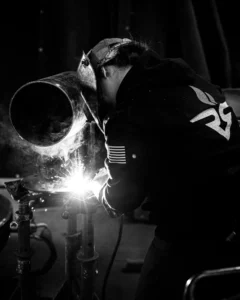
ASME Section IX is the qualification and certification code for all welding on ASME-stamped pressure vessels. Every welder performing a groove weld on a U Stamp vessel must hold a current performance qualification record (WPQR) in that position, backed by a passing test coupon examined per Section IX requirements.
For cylindrical pressure vessel shells, longitudinal seam welds run vertically when the shell course is in the upright position during fabrication. This makes 3G one of the most frequently required qualifications on a vessel fabrication floor.
The qualification test requires:
- A test coupon welded in the 3G position per the applicable Welding Procedure Specification (WPS)
- Radiographic or mechanical bend testing per ASME Section IX QW-191 and QW-160
- A passing result documented on the WPQR and kept on file by the fabricator
- Re-qualification if the welder does not use that process at least once every six months
The qualification is specific to welding process, base metal P-number, filler metal F-number, and progression. A welder qualified for uphill 3G with SMAW on carbon steel cannot perform that position using GTAW without a separate test.
For a full breakdown of what Section IX requires from fabricators, see the ASME Section IX welding qualification code explained.
What Red River Applies
Red River maintains ASME Section IX welder qualifications across all positions required for U Stamp pressure vessel fabrication. Every welder on a coded vessel holds current WPQRs verified before each project. Shell course rolling, longitudinal and circumferential seam welding, and nozzle attachment are performed by Section IX-qualified welders with documented procedures on file.
For a complete overview of how welding integrates with vessel fabrication from plate to stamp, see welding a pressure vessel: techniques and best practices.
Welding careers at Red River require ASME Section IX qualification in the positions relevant to vessel fabrication. Explore open positions at Red River.
What This Means
For anyone specifying ASME-stamped pressure vessels, 3G qualification is not a credential to verify after award. It is a requirement built into Section IX and confirmed at every ASME authorization audit. A fabricator without 3G-qualified welders cannot stamp a vessel with vertical groove welds. Confirming that the fabricator maintains current, documented WPQRs for all required positions is a standard step in any pressure vessel procurement.
Get a Quote for Your ASME Vessel Project
Red River fabricates ASME Section VIII, Division 1 pressure vessels with the U Stamp. Every vessel is built by Section IX-qualified welders with WPQRs on file for every position required. Request a quote and get your project in front of a team that is already qualified to build it.
Frequently Asked Questions
1. What does 3G mean in welding?
3G refers to a vertical groove weld where the joint runs vertically and the welder progresses uphill or downhill along the seam. It is one of six standard positions (1G through 6G) defined by the American Welding Society and used in ASME Section IX welder qualification.
2. What positions does a 3G qualification cover?
A 3G groove weld qualification covers 1G (flat), 2G (horizontal), and 3G (vertical). It does not qualify the welder for 4G (overhead), 5G (horizontal fixed pipe), or 6G (inclined fixed pipe), which require separate performance qualification tests.
3. Is 3G required for ASME pressure vessel welding?
Yes. For any vessel with vertical groove welds, welders must hold a current ASME Section IX 3G performance qualification. Longitudinal seam welds on cylindrical shells are vertical joints and are among the most common 3G applications in pressure vessel fabrication.
4. What is the difference between 3G and 6G welding?
3G is a vertical groove weld on a flat plate. 6G is a fixed-pipe weld with the pipe axis inclined at 45 degrees, requiring the welder to work in all positions as they travel around the pipe. A 6G qualification covers all groove weld positions. A 3G qualification covers only flat, horizontal, and vertical.
5. How long does a 3G welding qualification remain current?
Under ASME Section IX, a welder performance qualification remains current as long as the welder performs that process at least once every six months. If that continuity breaks, the qualification expires and the welder must retest. The fabricator’s quality control system is responsible for tracking currency on all coded work.