
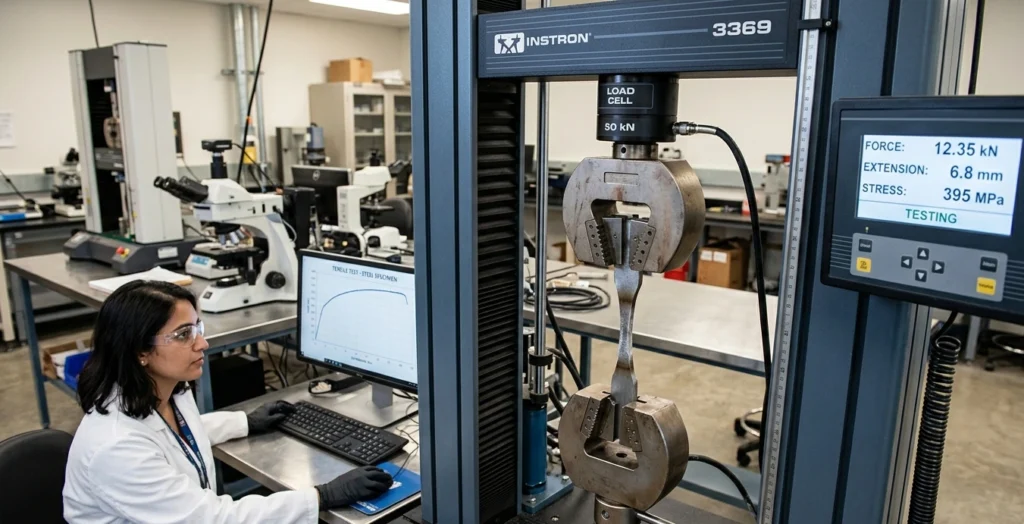
Unexpected material cracking or premature fracture during testing can signal larger structural risks in industrial equipment and fabricated components. This guide is written for engineers, facility managers, operators, and mechanics who need to understand why tensile test failure occurs and what those results mean in practical applications.
You’ll learn how tensile testing of materials works, how to interpret stress-strain behavior, what the fracture point in tensile test results indicates, and how engineers use failure analysis to identify design, manufacturing, or operational problems before they lead to equipment breakdown.
Why Tensile Testing Matters in Industrial Applications
Industrial systems depend on materials that can withstand predictable loads without permanent deformation or sudden fracture. Tensile testing helps engineers verify whether a material performs within the expected mechanical limits before it enters service.
The process measures how a specimen reacts under controlled pulling forces. Engineers analyze elongation, yield strength, ultimate tensile strength, and fracture behavior to determine whether the material is suitable for pipelines, pressure vessels, structural supports, rotating equipment, and fabricated assemblies.
A tensile test failure does not automatically mean the material is defective. In many cases, the failure provides valuable insight into how the material behaves under stress and whether hidden weaknesses exist within the component structure.
For a broader breakdown of structural failure patterns, Red River Team also explains the common types of failure in strength of materials seen across industrial environments.
How Tensile Testing of Materials Works
Tensile testing of materials follows a controlled procedure designed to measure mechanical behavior under increasing tension. The test continues until the specimen fractures completely.
A standardized specimen is mounted inside a tensile testing machine. The machine applies a gradually increasing pulling force while sensors record load and elongation data throughout the test cycle.
Elastic Deformation Stage
At the beginning of the test, the material deforms elastically. This means it returns to its original shape after the load is removed.
The elastic region is important because it defines the safe operating range for many engineering applications. Components designed within this range avoid permanent deformation during normal use.
Yield Strength and Plastic Deformation
Once the material exceeds its yield strength, permanent deformation begins. The specimen stretches beyond recovery and enters the plastic deformation phase.
This stage helps engineers understand how the material behaves under overload conditions. Ductile materials usually continue deforming before fracture, while brittle materials may fail rapidly after yielding.
Fracture Point in Tensile Test Results
The fracture point in tensile test data marks the final separation of the specimen. Engineers examine both the load data and the fracture surface to determine how the material failed.
The appearance of the fracture surface often reveals whether the failure was ductile, brittle, fatigue-related, or influenced by manufacturing defects.
What Causes Tensile Test Failure
Most tensile test failure events result from multiple contributing factors rather than a single issue. Material composition, manufacturing quality, environmental exposure, and testing conditions all affect the outcome.
Material Defects
Internal voids, inclusions, laminations, and microcracks weaken the specimen before testing begins. These flaws create stress concentration areas where cracks can initiate under load.
Even small defects may dramatically reduce elongation and ultimate tensile strength values during testing.
Improper Heat Treatment
Heat treatment controls hardness, ductility, and internal grain structure. Incorrect thermal processing can make a material excessively brittle or reduce its load-bearing capacity.
A poorly heat-treated component may fracture suddenly with minimal plastic deformation during tensile testing.
Red River Team also discusses broader material failure mechanisms that influence crack formation and premature fracture behavior.
Corrosion Damage
Corrosion gradually reduces material thickness and creates localized weak zones. In aggressive environments, corrosion pits become starting points for crack propagation during testing.
Stress corrosion cracking is especially dangerous because internal damage may not be visible from the surface.
Specimen Preparation Problems
Improper machining, rough edges, and dimensional inconsistencies can distort tensile test results. Testing standards require precise specimen geometry to ensure accurate measurements.
Surface scratches near the gauge length can also initiate premature cracking during loading.
Equipment Calibration Errors
Tensile testing machines require regular calibration to maintain accuracy. Faulty sensors or misaligned grips may produce unreliable stress and elongation readings.
Engineers often verify calibration records before accepting test results for critical applications.
How Engineers Interpret the Stress-Strain Curve
The stress-strain curve is one of the most important tools in mechanical testing. It reveals how the material behaves throughout the entire loading process.
Linear Elastic Region
The initial straight portion of the curve represents elastic behavior. Stress and strain increase proportionally during this phase.
Engineers use this region to calculate elastic modulus and predict how materials will behave under service loads.
Yield Region
The yield point marks the transition from elastic to permanent deformation. Some metals display a distinct yield plateau, while others transition gradually.
This region is important when designing systems exposed to variable or repeated loading conditions.
Ultimate Tensile Strength
The peak of the curve represents the maximum stress the material can withstand before necking begins.
After this point, the specimen weakens as the cross-sectional area decreases rapidly.
Necking and Final Fracture
Necking occurs when deformation becomes concentrated in a smaller section of the specimen. The material eventually fractures once the remaining cross-section can no longer support the load.
The shape of the fracture surface provides important clues during engineering failure analysis.
Ductile vs Brittle Tensile Test Failure
The fracture mode strongly influences how engineers interpret test results and evaluate operational risk.
Ductile Failure Characteristics
Ductile tensile test failure includes significant elongation and visible deformation before fracture. The specimen absorbs substantial energy during loading.
Fracture surfaces typically show dimples and a cup-and-cone pattern. This type of failure often provides warning signs before complete separation occurs.
Additional examples of ductile and brittle mechanical failure can also be seen in industrial pressure-containing systems and fabricated assemblies.
Brittle Failure Characteristics
Brittle fracture occurs with minimal deformation and little energy absorption. Cracks propagate rapidly once initiated.
Cold temperatures, material impurities, and high strain rates increase the risk of brittle behavior during testing.
Why the Difference Matters
Ductile materials are generally preferred in many industrial applications because they fail more gradually. Brittle failures can become catastrophic without visible warning.
Engineers use fracture behavior data to evaluate safety margins, inspection schedules, and operating limits.
The Overlooked Influence of Residual Stress on Test Results
Many discussions about tensile test failure focus only on applied load and material strength. Residual stress is often ignored even though it can significantly affect test outcomes.
Residual stress remains trapped inside a material after welding, machining, forming, or uneven cooling. These stresses may already place parts of the specimen close to critical limits before the tensile test even begins.
In welded assemblies, the heat-affected zone frequently contains tensile residual stress that accelerates crack initiation. A specimen may fail earlier than expected even when the external loading conditions appear normal.
Engineers sometimes perform stress-relief heat treatment before testing to reduce this variable. During failure investigations, fracture mechanics analysis often includes residual stress calculations to explain premature fracture behavior.
This factor is frequently missed in generalized online explanations despite its importance in industrial fabrication and pressure-containing systems.
How Tensile Test Failure Supports Failure Analysis
A failed tensile specimen provides valuable information beyond simple pass-or-fail results. Engineers use the data to identify larger reliability concerns within industrial systems.
Verifying Material Certification
Test results confirm whether the material meets specified mechanical properties. Unexpected results may reveal supplier inconsistencies or incorrect alloy composition.
This is especially important for pressure vessels, structural steel, and safety-critical components.
Investigating Equipment Failures
When industrial equipment fractures unexpectedly, engineers often compare failed components against tensile test data.
Differences in ductility, elongation, or fracture behavior can help identify the root cause of the operational failure.
Supporting Maintenance Planning
Tensile testing helps maintenance teams predict material degradation trends over time. Repeated testing may reveal strength reduction caused by corrosion, thermal cycling, or fatigue exposure.
Red River Team frequently discusses these evaluation methods when addressing material reliability and structural performance in industrial systems.
These evaluation methods are commonly used during material failure analysis procedures involving industrial equipment and structural components.
Industries That Depend on Accurate Tensile Testing
Tensile testing plays a critical role in industries where mechanical failure creates operational or safety risks.
Oil and Gas Operations
Pipelines, pressure vessels, and drilling equipment operate under constant mechanical stress. Tensile testing helps confirm that materials can withstand pressure, vibration, and environmental exposure.
Manufacturing Facilities
Heavy machinery, lifting systems, and fabricated components rely on predictable mechanical performance during continuous operation.
Material testing helps reduce unexpected downtime and structural failures.
Aerospace and Transportation
Aircraft components, rail systems, and transportation infrastructure require precise mechanical properties to maintain structural integrity under cyclic loading conditions.
Testing standards in these industries are often extremely strict because small material failures can create large-scale consequences.
How Engineers Reduce the Risk of Tensile Strength Failure
Prevention starts during material selection and continues throughout fabrication, operation, and inspection.
Select Materials for Actual Operating Conditions
Design loads alone are not enough. Engineers also evaluate temperature exposure, corrosion risk, vibration, and cyclic stress conditions before selecting materials.
Environmental compatibility plays a major role in long-term reliability.
Improve Fabrication Quality
Proper welding procedures, controlled heat treatment, and dimensional accuracy reduce the likelihood of hidden defects.
Inspection during fabrication often identifies problems before the component enters service.
Monitor High-Stress Areas
Cracks commonly initiate near welds, threaded sections, sharp corners, and geometric transitions.
Non-destructive testing methods such as ultrasonic inspection and dye penetrant testing help identify early-stage damage.
Reevaluate Systems After Operational Changes
Increased production demand, pressure adjustments, or process modifications may introduce higher stress levels than the original design anticipated.
Engineers should reassess material performance whenever operating conditions change significantly.
Why Fracture Mechanics Improves Tensile Failure Investigations
Fracture mechanics helps engineers evaluate how cracks initiate and grow under stress. Instead of only identifying visible defects, engineers can estimate whether a crack is likely to propagate during service.
This approach improves inspection planning and maintenance decisions in high-risk industries. Crack growth analysis is commonly used in pressure vessel inspections, pipeline evaluations, and structural integrity programs.
Many organizations also apply structural failure analysis methods when evaluating long-term equipment integrity.
The ASTM International and the American Society of Mechanical Engineers provide standards that guide tensile testing procedures and material evaluation methods.
RedRiver Team also emphasizes the importance of combining fracture mechanics with operational history during engineering investigations.
Tensile Test Failure Concluding Thoughts
A tensile test failure provides far more information than a simple fracture result. The stress-strain curve, fracture characteristics, and testing conditions all help engineers understand how materials behave under real operating loads.
When engineers interpret tensile testing data correctly, they can identify hidden weaknesses, improve material selection, and reduce the risk of structural failure before equipment enters critical service.
Get the Support You Need with Red River
If your team needs support evaluating material performance or investigating structural reliability concerns, Red River Team provides engineering insight for industrial systems and pressure-related applications. Contact Red River now.
FREQUENTLY ASKED QUESTIONS
1. How do engineers analyze tensile test failure?
Engineers analyze tensile test failure by reviewing the stress-strain curve, inspecting the fracture surface, and comparing the results against material standards. Microscopic examination helps identify whether the fracture was ductile, brittle, or fatigue-related. Environmental exposure and fabrication history are also considered during the investigation. Learn more about modes and mechanisms of material and structural failure.
2. Why does a tensile test fail?
Premature failure may happen because of hidden material defects, incorrect heat treatment, corrosion exposure, or residual stress from manufacturing processes. In some cases, improper specimen dimensions or testing machine calibration issues contribute to inaccurate results.
3. What does the stress-strain curve reveal during tensile testing?
The stress-strain curve shows how a material behaves throughout elastic deformation, yielding, strain hardening, necking, and final fracture. Engineers use this information to evaluate ductility, strength, and overall material performance under load.
4. What is the fracture point in tensile test results?
The fracture point marks the final separation of the tensile specimen during testing. Engineers examine the fracture surface to determine whether the failure was ductile, brittle, or influenced by environmental or manufacturing factors.
5. Why is tensile testing important for industrial equipment?
Tensile testing confirms whether materials can safely handle operational loads without excessive deformation or fracture. This helps engineers reduce structural failure risks in pipelines, pressure vessels, machinery, and support structures.
KEY TAKEAWAYS
- Review fracture surfaces closely to distinguish between ductile and brittle failure behavior
- Verify tensile testing machine calibration before accepting critical material results
- Inspect weld zones and geometric transitions where stress concentrations commonly develop
- Include residual stress evaluation when analyzing unexpected tensile specimen failure
- Compare tensile data against actual operating conditions instead of relying only on material certificates
- Reassess material performance after process changes that increase mechanical loading
Related Blog Post
Which Materials Suit Make-Up Water Service?
How Big Should Make-Up Water Tanks Be?
Make-Up Water Tanks: Design, Sizing, and Fabrication
When to Spec Equalization Tanks for Industrial Systems
How Do Equalization Tanks Balance Flow?
No related articles found.
About Author



