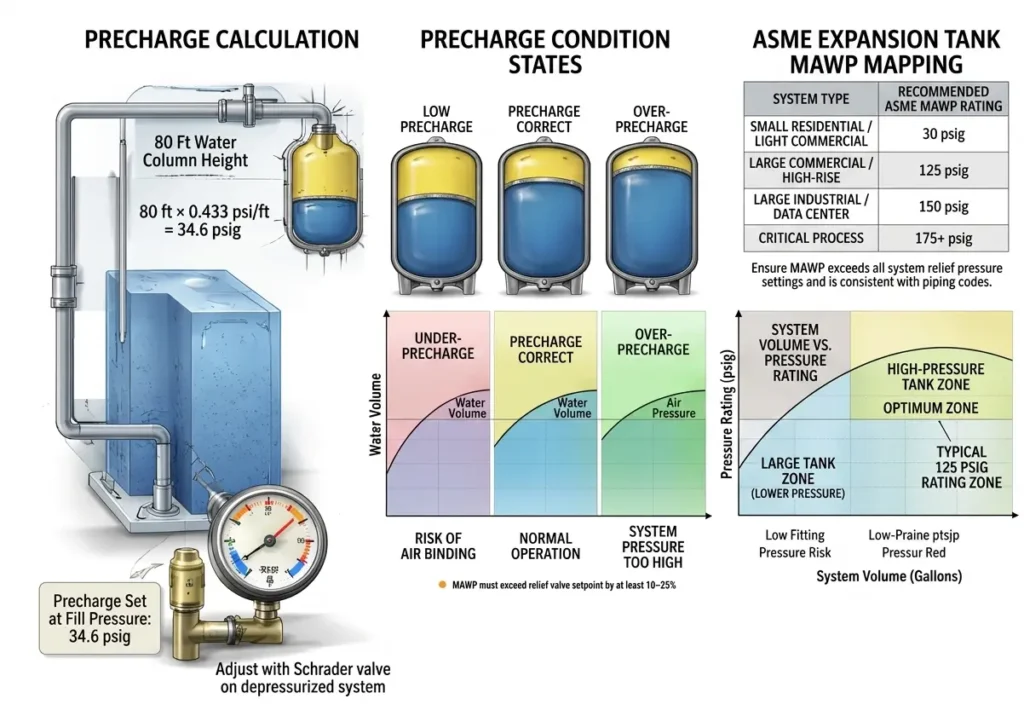
An expansion tank can have the correct size and still fail if precharge or pressure rating is wrong, leading to unstable loop pressure or unsafe operation in chilled water systems. This guide is for mechanical engineers and facility managers responsible for specifying, commissioning, and maintaining HVAC and industrial systems. You’ll learn how to calculate correct precharge and MAWP, and how to verify both to ensure stable, code-compliant operation.
What Is Expansion Tank Precharge Pressure?
Understanding what precharge and rating do expansion tanks need starts with defining precharge pressure. Precharge pressure is the gas pressure on the dry side of an expansion tank’s diaphragm or bladder before it is connected to the chilled water system and before any water enters the vessel.
This gas space is typically filled with nitrogen or dry air at the factory and must be set to the correct value during commissioning. It establishes the baseline operating condition of the tank and determines how much usable gas volume is available to absorb thermal expansion of water in the system.
Precharge must always be measured with the system fully depressurized and the tank isolated. If measured while the system is pressurized, water-side pressure compresses the gas and produces a falsely high reading, leading to incorrect settings and poor system performance.
How to Calculate the Correct Precharge Pressure
The correct precharge pressure for an expansion tank equals the static fill pressure at the expansion tank connection point, the system pressure at that specific location when the loop is filled with water at ambient temperature before pressurization.
Static fill pressure = height of water column above the expansion tank connection (in feet) × 0.433 psi/ft
For example, if the expansion tank is located in the basement mechanical room and the highest point in the chilled water loop is 80 feet above the tank connection:
Static fill pressure = 80 ft × 0.433 = 34.6 psig
The precharge pressure should be set to 34 psig rounded down to the nearest whole number to prevent the diaphragm from pre-filling with system water before the loop reaches operating conditions.
In systems with pressurization units most large data center chilled water systems use a pressurization unit (also called a make-up water unit or pressure-maintaining station) to maintain a minimum system pressure above the static fill pressure. In these systems, the precharge pressure must equal the minimum system pressure maintained by the pressurization unit, not just the static head pressure. If the pressurization unit maintains 25 psig at the expansion tank connection, precharge must be set to 25 psig regardless of the static head value.
Precharge too high:
- Gas pressure exceeds system fill pressure
- Diaphragm is pushed toward the water side before filling
- Usable water volume is reduced
- System pressure rises too quickly and may trigger relief valve early
Precharge too low:
- Water enters the tank at initial fill
- Gas cushion is partially compressed from the start
- Reduced capacity for thermal expansion
- Premature relief valve operation at normal operating temperatures
Correct pre charge:
- Diaphragm sits in neutral position at system fill
- Full gas volume is available for expansion
- System pressure follows the intended design curve across all operating conditions
What Pressure Rating Does an Expansion Tank Need?
The pressure rating of an expansion tank at its maximum allowable working pressure (MAWP) must exceed the maximum pressure the system will experience under any operating or test condition.
MAWP must be greater than the system’s pressure relief valve setting. If the relief valve is set at 125 psig, the expansion tank MAWP must exceed 125 psig. A common practice is to specify MAWP at least 10–15% above the relief valve setting providing margin between normal operating pressure and the vessel’s rated limit.
MAWP must account for hydrostatic test pressure. ASME Section VIII Division 1 requires hydrostatic testing at 1.3 times the MAWP before commissioning. An expansion tank with a 125 psig MAWP will be hydrostatically tested at 163 psig. The vessel design must accommodate this test pressure without permanent deformation.
Typical MAWP values for data center chilled water systems:
| System Type | Typical Operating Pressure | Recommended MAWP |
| Small data center (< 500 tons) | 50 to 75 psig | 125 psig |
| Medium data center (500 to 2,000 tons) | 75 to 100 psig | 150 psig |
| Large data center (2,000+ tons) | 100 to 125 psig | 175–200 psig |
| High-rise building cooling | 125 to 175 psig | 200–250 psig |
These values assume standard closed-loop chilled water systems. Systems with tall buildings, pressurized injection loops, or high-head pump configurations may require higher MAWP ratings. Always confirm MAWP against the system’s actual pressure relief valve setting and maximum pump shutoff pressure.
For ASME code stamped pressure vessels with confirmed MAWP ratings and full certification documentation, Red River fabricates expansion tanks to each project’s specific pressure requirements.
ASME Pressure Rating Requirements
Expansion tanks above 15 psig are ASME Section VIII Division 1 pressure vessels, and their MAWP is calculated, not assumed, based on design rules and verified by hydrostatic testing at 1.3× MAWP.
- Shell thickness: Calculated using ASME formula t=PR÷(SE−0.6P)t = PR ÷ (SE − 0.6P)t=PR÷(SE−0.6P) based on pressure, geometry, and material strength
- Material allowable stress: Defined in ASME Section II Part D and varies by material and temperature
- Weld joint efficiency: Depends on NDE level (1.0 full RT, 0.85 spot RT, 0.70 no RT) and directly affects required thickness
- Hydrostatic test: Required at 1.3× MAWP before U-stamp and Form U-1 approval confirms structural integrity
For which materials suit chilled water service in expansion tank fabrication, Red River evaluates each project’s fluid chemistry and pressure requirements before specifying shell material and thickness.
Precharge Verification Procedures
Precharge must be checked throughout the expansion tank’s lifecycle to maintain correct system performance.
At commissioning:
- Verify with system fully depressurized and tank isolated
- Measure via Schrader valve using calibrated gauge
- Adjust using nitrogen only (never compressed air)
After system changes:
- Required after pump, piping, or pressure setpoint modifications
- Depressurize system and reset precharge to updated static conditions
Annual maintenance:
- Check for gradual gas loss (typically 1–3 psig/year)
- Re-verify to prevent reduced acceptance volume and unstable system pressure
Regular verification ensures the tank maintains its designed operating range and prevents premature relief valve operation.
The National Board of Boiler and Pressure Vessel Inspectors provides guidance on in-service inspection requirements for ASME-certified pressure vessels including expansion tanks in pressurized chilled water systems.
What Precharge and Rating Do Expansion Tanks Need
When an expansion tank is specified with the correct MAWP and commissioned with the correct precharge, it will maintain stable loop pressure for 15–25 years with only routine verification and occasional diaphragm or bladder replacement.
Undersized MAWP creates a code and safety issue, while incorrect precharge leads to unstable system pressure that is often misdiagnosed as pump or valve problems, driving unnecessary maintenance and system changes.
Need a Reliable Partner?
Red River fabricates ASME U-stamp certified expansion tanks with MAWP rated to each project’s system pressure requirements and precharge set to the calculated static fill pressure at commissioning.
Contact our team to discuss expansion tank precharge and pressure rating requirements for your chilled water system.
Frequently Asked Questions
1. How do expansion tanks control loop pressure?
Expansion tanks contain a pre-charged gas cushion separated from system water by a diaphragm or bladder. As water temperature rises and volume increases, the water compresses the gas cushion absorbing the volume change and preventing pressure from rising beyond the system’s operating range.
2. When to choose bladder vs diaphragm tanks?
Choose a bladder tank when the vessel is large and bladder replacement is more cost-effective than full vessel replacement over the service life. Choose a diaphragm tank for smaller systems where the compact, lower-cost design is sufficient and full tank replacement at end of diaphragm life is acceptable.
3. What is the correct precharge pressure for an expansion tank?
Precharge pressure must equal the static fill pressure at the tank connection point the pressure exerted by the water column above the tank at ambient temperature with the system empty.
4. How is precharge pressure measured correctly?
Precharge is measured with the system completely depressurized and the tank isolated from the loop. A calibrated gauge is attached to the Schrader valve on the gas side.
5.What MAWP does an expansion tank need for a data center chilled water system?
MAWP must exceed the system’s pressure relief valve setting typically by 10 to 15%. Most data center chilled water systems with relief valves set at 100 to 125 psig specify expansion tanks with 150 to 175 psig MAWP.
Key Takeaways
- Precharge must equal static fill pressure at the tank connection (0.433 psi/ft of water head) or minimum system pressure in pressurized systems.
- Always set and verify precharge with the system fully depressurized to avoid false readings from diaphragm compression.
- MAWP should exceed relief valve setpoint by 10 to 15% to ensure safe operating margin in chilled water systems.
- Use nitrogen only, compressed air introduces moisture that damages diaphragms and internal components.
- Check precharge annually due to natural gas loss (about 1 to 3 psig per year).
Related Blog Post
Which Materials Suit Make-Up Water Service?

How Big Should Make-Up Water Tanks Be?
Make-Up Water Tanks: Design, Sizing, and Fabrication
When to Spec Equalization Tanks for Industrial Systems
How Do Equalization Tanks Balance Flow?
About Author