
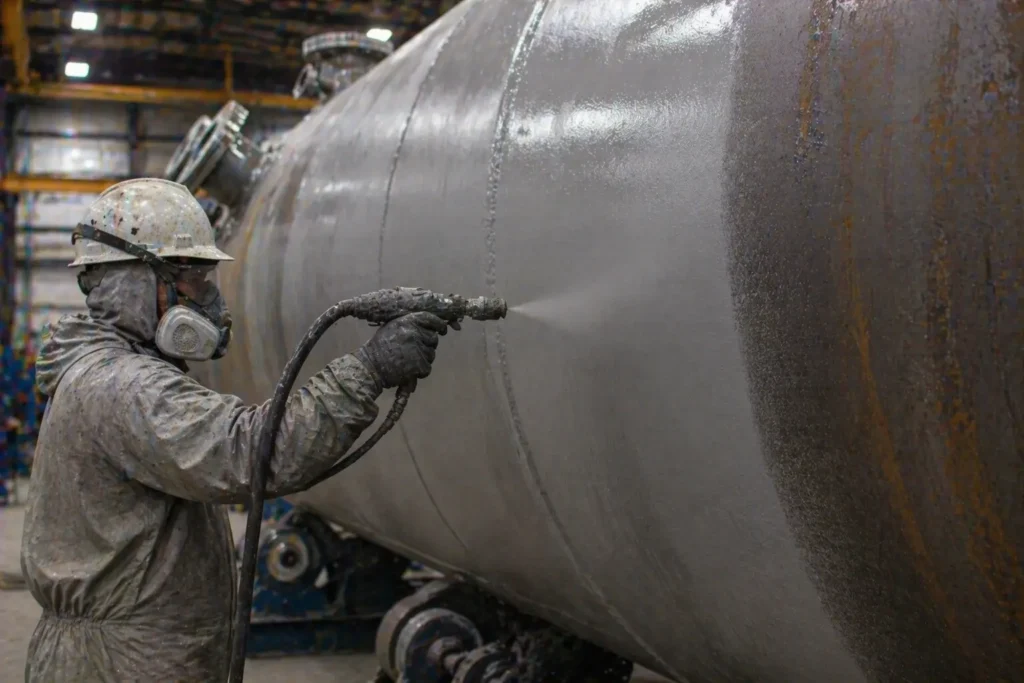
Choosing the right coating matters. This guide shows which coatings pair best with carbon steel, compares carbon steel coating systems, and highlights pressure vessel coatings for industrial applications. Proper surface preparation is just as critical as chemistry in ensuring long‑term performance.
Why Carbon Steel and Coating Selection Cannot Be Separated
Carbon steel’s strength, availability, and weldability make it the default material for pressure vessels, storage tanks, structural steel, and pipe fabrication across oil and gas, power generation, biogas, and industrial applications. Its weakness is straightforward: unprotected carbon steel corrodes in virtually every service environment.
The coating system is a design decision, not an afterthought. Service environment, operating temperature, fluid contact, and external exposure conditions all determine which system is appropriate. A coating selected without that context is a guess. Red River’s coating capability is integrated into the fabrication process so coating selection happens at the design phase, applied under controlled shop conditions before anything reaches the field.
The Coatings That Pair Best With Carbon Steel
What Coatings Pair Best With Carbon Steel: Epoxy Systems
Epoxy is the workhorse of carbon steel protection. Two-component epoxy systems form a hard, dense film that resists moisture, chemicals, and mechanical abrasion. They bond strongly to properly prepared carbon steel surfaces and perform reliably across a wide temperature range in dry or intermittently wet service.
Epoxy is the right choice for the interior of produced water tanks, chemical storage vessels, and process tanks where the coating contacts aqueous fluids, mild acids, or hydrocarbons. Standard epoxy systems begin to degrade above approximately 120 degrees Celsius in continuous service. For elevated temperature applications, a different chemistry is required. Red River’s fabrication capabilities include epoxy coating specification and application as part of the standard shop production process.
Zinc-Rich Primers
Inorganic zinc silicate: Used extensively on structural steel and external surfaces of pressure vessels in atmospheric exposure. Provides galvanic protection where the zinc sacrifices itself to protect the steel substrate if the coating film is breached.
Organic zinc-rich epoxy primers: Perform similarly in less aggressive environments and are easier to apply and recoat. Both are used as the first coat in a multi-coat system, with an intermediate coat and topcoat applied over them.
Zinc-rich systems are not suitable for immersion service where the coating will be in continuous contact with water or process fluids. The zinc dissolves rapidly in that environment and protection fails. For immersion service, epoxy or novolac systems are the correct choice.
Polyurethane Topcoats
Polyurethane coatings are applied as topcoats over epoxy or zinc primer systems on external surfaces. They provide UV resistance, color retention, and a harder, more abrasion-resistant finish than epoxy topcoats. For pressure vessels and structural steel exposed to sunlight and weather, polyurethane extends the service life of the full coating system by protecting the layers beneath. Polyurethane is not used in direct contact with process fluids or in immersion service.
Novolac Epoxy and High-Build Epoxy Systems
For service environments involving concentrated chemicals, solvents, or elevated temperatures beyond the range of standard epoxy, novolac epoxy systems provide a higher-density cross-linked film with significantly better chemical resistance. Used in chemical processing vessels, solvent storage tanks, and applications where the process fluid attacks standard epoxy films.
High-build epoxy systems apply in thicker film builds per coat, providing greater barrier protection in a single application cycle. Common in the interior lining of large storage tanks where coverage efficiency matters and the service environment demands a robust barrier. Red River’s custom pressure vessel fabrication process includes coating system specification as part of the design review for every project.
How Operating Environment Drives Coating Selection
Temperature: The first filter. Standard epoxy systems handle moderate temperatures reliably. Above that threshold, high-temperature coatings or ceramic-filled systems are required. Operating temperature must be confirmed for both the process side and the external environment before a coating is specified.
Chemical exposure: Determines whether a standard epoxy, a novolac system, or a specialty lining is required. The specific fluid, its concentration, operating pH, and whether the coating will be in continuous or intermittent contact all affect which chemistry holds up in service.
External atmospheric exposure: In corrosive environments including coastal locations and chemical plant atmospheres, the coating system must match the site’s corrosivity category. The ISO 12944 standard classifies atmospheric corrosivity from C1 (very low) through C5 (very high). For oil and gas applications in modular skid packages, the combination of produced fluid exposure and external atmospheric conditions requires careful system selection across both interior and exterior surfaces.
Surface Preparation: The Factor That Determines Whether Any Coating Lasts
The best coating system will fail prematurely on a poorly prepared surface. For carbon steel, the standard preparation method for high-performance industrial coatings is abrasive blasting to a defined cleanliness and profile standard. SSPC and NACE jointly publish the surface preparation standards most industrial vessel coating specifications reference. SSPC-SP 10 Near-White Blast is required for immersion service and aggressive environments. Less demanding environments may accept SSPC-SP 6 Commercial Blast as the minimum.
The anchor profile created by blasting must match the coating system’s requirements. Too smooth and the coating does not bond adequately. Too rough and the peaks exceed the coating film thickness, leaving unprotected high points that corrode first.
Shop application under controlled conditions consistently produces better results than field application. Red River’s prefabrication services include abrasive blasting and coating application in the fabrication facility, which means the steel surface never has time to re-oxidize between blasting and coating application.
Specify the Right Coating Before Fabrication Begins
Specifying the coating system after the vessel is built creates constraints that did not need to exist. Internal coating access, nozzle configuration, and surface preparation logistics are all easier to plan when coating is part of the design from the start. Red River works through coating system selection as part of the design coordination process for all custom vessel and skid projects so the specified system matches the actual service conditions.
Ready to Confirm Which Coatings Pair Best With Carbon Steel for Your Project?
Request a quote or call 1-307-257-5332 to discuss coating system selection with Red River’s fabrication team.
Frequently Asked Questions
1. What is the most common coating failure mode on carbon steel vessels?
Inadequate surface preparation is the leading cause. When the steel surface is not blasted to the specified cleanliness and anchor profile, adhesion is compromised from day one. Moisture trapped under the coating film, mill scale left on the surface, and contamination from oil or salts all accelerate delamination and underfilm corrosion. The coating chemistry rarely fails first. The surface preparation underneath it does.
2. Can carbon steel vessels be coated internally and externally with different systems?
Yes, and this is standard practice on most industrial vessels. The interior coating is selected for process fluid contact conditions: chemical resistance, temperature, and immersion service requirements. The exterior coating is selected for atmospheric exposure, UV resistance, and the corrosivity category of the installation environment. Specifying a single system for both surfaces almost always underserves one or both service environments.
3. How does operating temperature affect carbon steel coating selection?
Standard epoxy systems begin to degrade above approximately 120 degrees Celsius in continuous service. Between 120 and 230 degrees Celsius, high-temperature epoxy or phenolic systems are typically used. Above 230 degrees Celsius, inorganic coatings, ceramic-filled systems, or thermal spray aluminum are the appropriate choices. Operating temperature must be confirmed for both the process side and the external environment before specifying.
4. What is the ISO 12944 standard and why does it matter?
ISO 12944 classifies atmospheric corrosivity into categories from C1 (very low) through C5 (very high, industrial and coastal environments with high humidity and aggressive atmospheres). Specifying a coating system to the appropriate ISO 12944 corrosivity category ensures the system is engineered for the actual exposure conditions at the installation site, not a generic assumption.
5. Does Red River apply coatings in the shop or in the field?
Red River applies coatings in the fabrication facility as part of the controlled production process. Shop application allows surface preparation and coating to be completed under controlled temperature and humidity conditions, which consistently produces better adhesion and film quality than field application. For projects requiring field touch-up or field-applied topcoats after installation, Red River coordinates the specification so the field-applied portion is compatible with the shop-applied system.
Key Takeaways
- Epoxy coatings are the standard for immersion service and chemical exposure on carbon steel. They bond strongly to prepared surfaces and resist moisture, mild chemicals, and mechanical abrasion across a wide temperature range.
- Zinc-rich primers provide galvanic protection and are the correct base coat for external atmospheric exposure. Not suitable for immersion service.
- Polyurethane topcoats extend system life on external surfaces by providing UV resistance and abrasion protection over the primer and intermediate coats beneath.
- Novolac epoxy and high-build systems are required for aggressive chemical service environments where standard epoxy chemistry is insufficient.
- Surface preparation to the correct SSPC standard is as important as coating selection. A coating system applied to an inadequately prepared surface will fail regardless of its chemistry.
- Coating selection should happen during the design phase, before fabrication begins, not as an afterthought at the end of the project.
Related Blog Post
Can Condensate Storage Improve Reliability?
Where Do Condensate Tanks Fit in a Steam System?
Which Nozzles Simplify Maintenance on Pressure Vessels?
How to Vent Condensate Tanks in Steam Systems
How Do Baffle Layouts Affect Stratification in TES Tanks?
About Author



