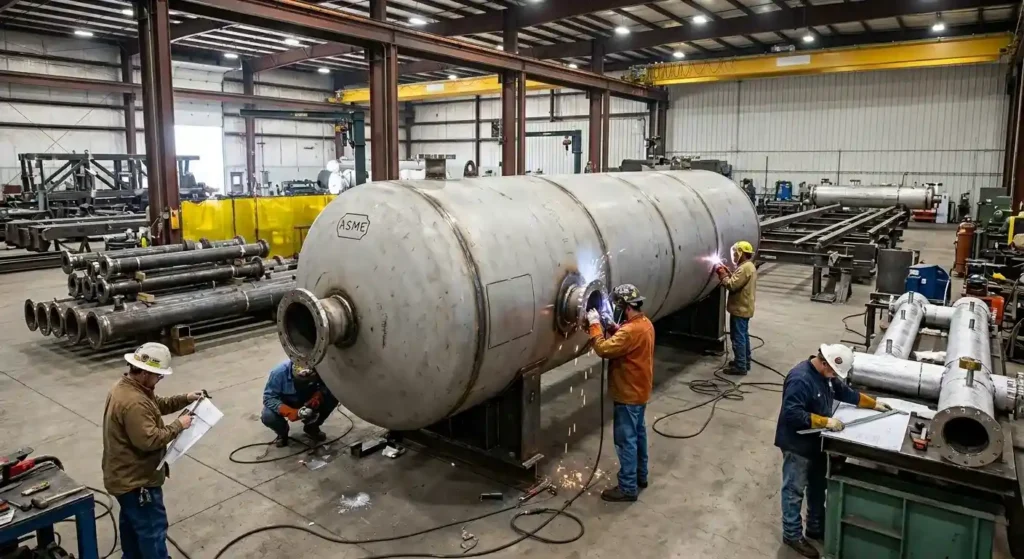
Industrial specifications meet data center needs for the core engineering requirements. ASME Section VIII governs chilled water pressure vessels in data center cooling loops the same way it governs oilfield separators and biogas vessels. Where data center projects diverge is in continuous cycling duty, space constraints, and documentation expectations, not in the applicable fabrication standards.
Key Takeaways
- For ASME pressure vessel code compliance, material selection, and insulation system design, existing industrial standards apply directly to data center thermal storage vessels.
- Any chilled water vessel operating above 15 psig in a data center cooling loop requires ASME Section VIII compliance and fabrication by a U Stamp-certified shop. The code does not distinguish between industries.
- Data center applications differ from standard industrial practice in continuous cycling duty, space and access constraints, and documentation expectations. These differences affect design inputs and procurement requirements, not the applicable fabrication standards.
- Modular skid packages pre-assembled and pre-tested at the fabrication facility address tight mechanical-room space constraints and reduce on-site commissioning scope.
- Complete documentation, including ASME Form U-1 data reports, certified mill test reports, weld records, NDE reports, and hydrostatic test records, supports data center commissioning and is standard Red River delivery practice on coded vessels.
Why Do Data Center Engineers Ask Whether Industrial Specs Apply?
Industrial pressure vessel and storage tank specifications have governed high-stakes applications in oil and gas, power generation, and chemical processing for more than a century. The frameworks those industries rely on, including ASME Section VIII for pressure vessels and ASHRAE standards for chilled water system design, were not written specifically for data centers. They cover the core engineering requirements that data center thermal storage vessels face, but the question of how they apply is a fair one.
Data center engineers evaluating pressure vessel requirements for cooling systems often encounter fabricators experienced in one industry but not the other. Understanding where industrial standards apply, and where data center operating conditions add design inputs, resolves that friction before the specification is written.
Where Do Industrial Specs Align With Data Center Pressure Vessel Requirements?
Industrial specifications align with data center requirements across code compliance, material selection, and insulation design. The three areas below carry over directly, with no industry-specific exception.
ASME Section VIII Code Compliance
Any chilled water storage vessel operating above 15 psig in a data center cooling loop falls under ASME Section VIII, the same code that governs pressure vessels in oil and gas, power generation, and biogas applications. The ASME U Stamp certification required for these vessels does not distinguish between industries. A fabricator with an active ASME U Stamp builds a data center vessel to the same code as an oilfield separator.
Red River holds active ASME U Stamp and NBBI R Stamp certifications. A coded vessel built for a data center cooling application would go through the same third-party authorized inspection, documentation, and hydrostatic testing as any other ASME-stamped vessel Red River produces. See Red River’s pressure vessel fabrication for how that code compliance carries across industries.
Material Selection Standards
Carbon steel and stainless steel specifications for chilled water service are well established in industrial fabrication. ASTM A516 Grade 70 for carbon steel plate, Type 304 and 316L stainless steel, and the chemical treatment programs that protect closed-loop carbon steel systems are all covered by existing standards that apply equally to a chilled water cooling vessel.
Water chemistry compatibility, chloride exposure, and system cleanliness map onto the same selection logic used for process-industry chilled water applications. Red River applies the same material standards to a chilled water vessel regardless of the end-use environment, across its process tanks and thermal storage scopes.
Insulation and Vapor Barrier Systems
Industrial insulation standards for cold service vessels apply directly to data center chilled water tanks. A vessel operating at 40 degrees Fahrenheit in a mechanical room faces the same condensation, moisture ingress, and thermal loss risks as any cold service industrial vessel.
Vapor barrier selection, jacketing material, and insulation thickness calculations follow the same engineering principles used in chemical and food processing plants, consistent with ASHRAE thermal performance guidance. The insulation system must be designed into the fabrication scope from the start, not added as a field modification after installation. Red River coordinates insulation provisions, support ring locations, and access opening layouts during design so the vessel arrives ready for insulation without field rework.
Where Do Data Center Requirements Diverge From Standard Industrial Practice?
Data center requirements diverge in operating profile and procurement expectations, not in fabrication standards. Continuous cycling duty, constrained mechanical-room access, and documentation depth are the three differences that change design inputs.
Continuous Cycling Duty
Most industrial vessels operate with defined process cycles that include periods of low load or standby. Data center thermal storage applications operate at high load nearly continuously, often close to 8,760 hours per year with minimal variation. Thermal storage tanks in these applications charge and discharge daily, accumulating thermal fatigue cycles faster than vessels in intermittent industrial service.
This does not require a different fabrication standard, but it does require the vessel design to account for cyclic loading from the start, including nozzle reinforcement, support attachment design, and insulation provisions that hold up over years of continuous service.
Space and Access Constraints
Industrial facilities typically have more flexibility in vessel placement and maintenance clearances than data center mechanical rooms. A chilled water tank in a basement or rooftop plant room operates in a far more constrained environment than the same tank in an outdoor industrial yard.
Modular skid packages pre-assembled and pre-tested at the fabrication facility address this directly. Red River’s prefabrication approach can cover complete modular thermal storage skid scopes, reducing field work in constrained mechanical rooms to final connections rather than on-site construction.
Documentation and Commissioning Requirements
Data center operators and their colocation clients typically require more detailed commissioning documentation than standard industrial practice. Factory acceptance testing, operations and maintenance manuals, and as-built documentation that traces every component to its material certification are common data center procurement requirements.
Red River delivers a complete documentation package with every coded vessel: ASME Form U-1 manufacturer’s data report, certified mill test reports for all major materials, weld records, NDE reports, and hydrostatic test records. That package maps to data center commissioning requirements without additional effort. For modular skid scopes, Red River also delivers as-built drawings and an operations and maintenance manual.
What Should a Data Center Thermal Storage Spec Confirm Before Fabrication?
A data center thermal storage spec should confirm the operating profile and the procurement expectations, because those are where data center work differs. Code compliance, material selection, insulation systems, and fabrication quality carry over from industrial practice without change.
The friction points data center procurement teams report most often are unfamiliar documentation formats, resistance to factory acceptance testing, and commissioning packages that do not match the format the owner’s engineer expects. Red River’s modular skid packages and coded vessels ship with the documentation and testing records that data center commissioning requires as standard practice.
Industrial Standards Carry Data Center Cooling Further Than Most Specs Assume
For code compliance, material selection, insulation design, and fabrication quality, a data center chilled water vessel and an industrial one are built to the same standards. The design inputs that change are the operating profile and the documentation format, and both are known quantities that a fabricator experienced in coded vessel work builds in from the start. Getting those inputs confirmed before the specification is written is what keeps a data center thermal storage project on schedule.
Confirm Your Thermal Storage Spec With Red River Before Fabrication Begins
Red River holds the ASME U Stamp and NBBI R Stamp certifications and has fabricated ASME-coded pressure vessels and modular skid packages for oil and gas, power generation, and biogas clients from our Gillette, Wyoming, facility since 2003. The same code compliance, material standards, and documentation that industrial fabrication delivers are what a data center thermal storage vessel specification calls for. Request a quote or call 1-307-257-5332 to discuss your thermal storage vessel scope with Red River’s fabrication team.
Frequently Asked Questions
1. What ASME Certifications Apply to Data Center Thermal Storage Vessels?
Pressurized vessels operating above 15 psig in data center chilled water loops fall under ASME Section VIII and require fabrication by a U Stamp-certified shop. Atmospheric tanks typically follow API 650 or AWWA D100 depending on construction method. Red River holds active ASME U Stamp and NBBI R Stamp certifications covering both pressure vessel fabrication and code repair work.
2. Do Data Center Chilled Water Vessels Require Different Materials Than Industrial Vessels?
No. The carbon steel with epoxy lining and the stainless steel grades used in industrial chilled water service apply directly to data center applications. The selection logic follows the same criteria: water chemistry, chloride exposure, system cleanliness requirements, and service life expectations. The National Board maintains registration records for ASME-stamped vessels regardless of application.
3. How Does Continuous Cycling Duty Affect Thermal Storage Vessel Design for Data Centers?
Daily charge and discharge cycling accumulates thermal fatigue cycles faster than intermittent industrial service. Vessel design for data center thermal storage should account for cyclic loading in the mechanical design, including nozzle reinforcement, support attachment design, and insulation system provisions that maintain performance over years of continuous service.
4. Can a Modular Skid Approach Work for Data Center Thermal Storage Installations?
Yes, and it is often the preferred approach. Modular thermal storage skids pre-assembled and pre-tested at the fabrication facility reduce field work in constrained mechanical rooms to connections rather than construction. Pre-testing in the shop resolves commissioning issues before the unit ships, which compresses the on-site timeline. See Red River’s modular skid packages for how this applies to thermal storage scopes.
5. What Documentation Should a Data Center Operator Require From the Vessel Fabricator?
At minimum: ASME Form U-1 manufacturer’s data report, certified mill test reports for all major material components, weld records documenting procedures and welder qualifications, NDE reports, hydrostatic test records, and an as-built drawing package. For modular skid scopes, factory acceptance test records and an operations and maintenance manual should also be included.
Schema Recommendation: Apply FAQPage schema to all five FAQ entries. Apply Article schema to the full post with dateModified and author fields populated once the client confirms the byline.
Industrial specifications meet data center needs for the core engineering requirements. ASME Section VIII governs chilled water pressure vessels in data center cooling loops the same way it governs oilfield separators and biogas vessels. Where data center projects diverge is in continuous cycling duty, space constraints, and documentation expectations, not in the applicable fabrication standards.
Key Takeaways
- For ASME pressure vessel code compliance, material selection, and insulation system design, existing industrial standards apply directly to data center thermal storage vessels.
- Any chilled water vessel operating above 15 psig in a data center cooling loop requires ASME Section VIII compliance and fabrication by a U Stamp-certified shop. The code does not distinguish between industries.
- Data center applications differ from standard industrial practice in continuous cycling duty, space and access constraints, and documentation expectations. These differences affect design inputs and procurement requirements, not the applicable fabrication standards.
- Modular skid packages pre-assembled and pre-tested at the fabrication facility address tight mechanical-room space constraints and reduce on-site commissioning scope.
- Complete documentation, including ASME Form U-1 data reports, certified mill test reports, weld records, NDE reports, and hydrostatic test records, supports data center commissioning and is standard Red River delivery practice on coded vessels.
Why Do Data Center Engineers Ask Whether Industrial Specs Apply?
Industrial pressure vessel and storage tank specifications have governed high-stakes applications in oil and gas, power generation, and chemical processing for more than a century. The frameworks those industries rely on, including ASME Section VIII for pressure vessels and ASHRAE standards for chilled water system design, were not written specifically for data centers. They cover the core engineering requirements that data center thermal storage vessels face, but the question of how they apply is a fair one.
Data center engineers evaluating pressure vessel requirements for cooling systems often encounter fabricators experienced in one industry but not the other. Understanding where industrial standards apply, and where data center operating conditions add design inputs, resolves that friction before the specification is written.
Where Do Industrial Specs Align With Data Center Pressure Vessel Requirements?
Industrial specifications align with data center requirements across code compliance, material selection, and insulation design. The three areas below carry over directly, with no industry-specific exception.
ASME Section VIII Code Compliance
Any chilled water storage vessel operating above 15 psig in a data center cooling loop falls under ASME Section VIII, the same code that governs pressure vessels in oil and gas, power generation, and biogas applications. The ASME U Stamp certification required for these vessels does not distinguish between industries. A fabricator with an active ASME U Stamp builds a data center vessel to the same code as an oilfield separator.
Red River holds active ASME U Stamp and NBBI R Stamp certifications. A coded vessel built for a data center cooling application would go through the same third-party authorized inspection, documentation, and hydrostatic testing as any other ASME-stamped vessel Red River produces. See Red River’s pressure vessel fabrication for how that code compliance carries across industries.
Material Selection Standards
Carbon steel and stainless steel specifications for chilled water service are well established in industrial fabrication. ASTM A516 Grade 70 for carbon steel plate, Type 304 and 316L stainless steel, and the chemical treatment programs that protect closed-loop carbon steel systems are all covered by existing standards that apply equally to a chilled water cooling vessel.
Water chemistry compatibility, chloride exposure, and system cleanliness map onto the same selection logic used for process-industry chilled water applications. Red River applies the same material standards to a chilled water vessel regardless of the end-use environment, across its process tanks and thermal storage scopes.
Insulation and Vapor Barrier Systems
Industrial insulation standards for cold service vessels apply directly to data center chilled water tanks. A vessel operating at 40 degrees Fahrenheit in a mechanical room faces the same condensation, moisture ingress, and thermal loss risks as any cold service industrial vessel.
Vapor barrier selection, jacketing material, and insulation thickness calculations follow the same engineering principles used in chemical and food processing plants, consistent with ASHRAE thermal performance guidance. The insulation system must be designed into the fabrication scope from the start, not added as a field modification after installation. Red River coordinates insulation provisions, support ring locations, and access opening layouts during design so the vessel arrives ready for insulation without field rework.
Where Do Data Center Requirements Diverge From Standard Industrial Practice?
Data center requirements diverge in operating profile and procurement expectations, not in fabrication standards. Continuous cycling duty, constrained mechanical-room access, and documentation depth are the three differences that change design inputs.
Continuous Cycling Duty
Most industrial vessels operate with defined process cycles that include periods of low load or standby. Data center thermal storage applications operate at high load nearly continuously, often close to 8,760 hours per year with minimal variation. Thermal storage tanks in these applications charge and discharge daily, accumulating thermal fatigue cycles faster than vessels in intermittent industrial service.
This does not require a different fabrication standard, but it does require the vessel design to account for cyclic loading from the start, including nozzle reinforcement, support attachment design, and insulation provisions that hold up over years of continuous service.
Space and Access Constraints
Industrial facilities typically have more flexibility in vessel placement and maintenance clearances than data center mechanical rooms. A chilled water tank in a basement or rooftop plant room operates in a far more constrained environment than the same tank in an outdoor industrial yard.
Modular skid packages pre-assembled and pre-tested at the fabrication facility address this directly. Red River’s prefabrication approach can cover complete modular thermal storage skid scopes, reducing field work in constrained mechanical rooms to final connections rather than on-site construction.
Documentation and Commissioning Requirements
Data center operators and their colocation clients typically require more detailed commissioning documentation than standard industrial practice. Factory acceptance testing, operations and maintenance manuals, and as-built documentation that traces every component to its material certification are common data center procurement requirements.
Red River delivers a complete documentation package with every coded vessel: ASME Form U-1 manufacturer’s data report, certified mill test reports for all major materials, weld records, NDE reports, and hydrostatic test records. That package maps to data center commissioning requirements without additional effort. For modular skid scopes, Red River also delivers as-built drawings and an operations and maintenance manual.
What Should a Data Center Thermal Storage Spec Confirm Before Fabrication?
A data center thermal storage spec should confirm the operating profile and the procurement expectations, because those are where data center work differs. Code compliance, material selection, insulation systems, and fabrication quality carry over from industrial practice without change.
The friction points data center procurement teams report most often are unfamiliar documentation formats, resistance to factory acceptance testing, and commissioning packages that do not match the format the owner’s engineer expects. Red River’s modular skid packages and coded vessels ship with the documentation and testing records that data center commissioning requires as standard practice.
Industrial Standards Carry Data Center Cooling Further Than Most Specs Assume
For code compliance, material selection, insulation design, and fabrication quality, a data center chilled water vessel and an industrial one are built to the same standards. The design inputs that change are the operating profile and the documentation format, and both are known quantities that a fabricator experienced in coded vessel work builds in from the start. Getting those inputs confirmed before the specification is written is what keeps a data center thermal storage project on schedule.
Confirm Your Thermal Storage Spec With Red River Before Fabrication Begins
Red River holds the ASME U Stamp and NBBI R Stamp certifications and has fabricated ASME-coded pressure vessels and modular skid packages for oil and gas, power generation, and biogas clients from our Gillette, Wyoming, facility since 2003. The same code compliance, material standards, and documentation that industrial fabrication delivers are what a data center thermal storage vessel specification calls for. Request a quote or call 1-307-257-5332 to discuss your thermal storage vessel scope with Red River’s fabrication team.
Frequently Asked Questions
1. What ASME Certifications Apply to Data Center Thermal Storage Vessels?
Pressurized vessels operating above 15 psig in data center chilled water loops fall under ASME Section VIII and require fabrication by a U Stamp-certified shop. Atmospheric tanks typically follow API 650 or AWWA D100 depending on construction method. Red River holds active ASME U Stamp and NBBI R Stamp certifications covering both pressure vessel fabrication and code repair work.
2. Do Data Center Chilled Water Vessels Require Different Materials Than Industrial Vessels?
No. The carbon steel with epoxy lining and the stainless steel grades used in industrial chilled water service apply directly to data center applications. The selection logic follows the same criteria: water chemistry, chloride exposure, system cleanliness requirements, and service life expectations. The National Board maintains registration records for ASME-stamped vessels regardless of application.
3. How Does Continuous Cycling Duty Affect Thermal Storage Vessel Design for Data Centers?
Daily charge and discharge cycling accumulates thermal fatigue cycles faster than intermittent industrial service. Vessel design for data center thermal storage should account for cyclic loading in the mechanical design, including nozzle reinforcement, support attachment design, and insulation system provisions that maintain performance over years of continuous service.
4. Can a Modular Skid Approach Work for Data Center Thermal Storage Installations?
Yes, and it is often the preferred approach. Modular thermal storage skids pre-assembled and pre-tested at the fabrication facility reduce field work in constrained mechanical rooms to connections rather than construction. Pre-testing in the shop resolves commissioning issues before the unit ships, which compresses the on-site timeline. See Red River’s modular skid packages for how this applies to thermal storage scopes.
5. What Documentation Should a Data Center Operator Require From the Vessel Fabricator?
At minimum: ASME Form U-1 manufacturer’s data report, certified mill test reports for all major material components, weld records documenting procedures and welder qualifications, NDE reports, hydrostatic test records, and an as-built drawing package. For modular skid scopes, factory acceptance test records and an operations and maintenance manual should also be included.
Related Blog Post
Condensate Tanks: Types, Fabrication, and ASME Code
Which Tests Validate Deaeration in Pressure Systems?
Equalization Tanks: Design, Sizing, and Fabrication
What Are Thermal Storage Testing Standards for TES Vessels?
What Hydro Tests Are Required for Pressure Vessels?
About Author