
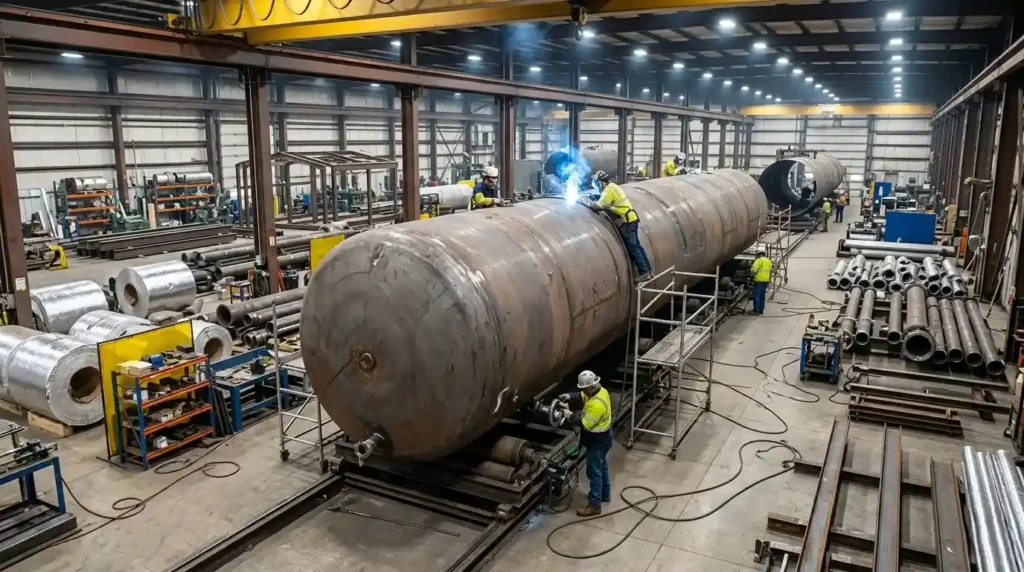
Thermal energy storage system manufacturing is the fabrication of pressure vessels, tanks, and integrated systems that store thermal energy for later use in power generation, oil and gas, biogas, and industrial cooling applications. What separates TES fabrication from standard tank work is the combination of cyclic thermal loading, insulation system integration, precise nozzle and diffuser design, and ASME-coded construction documentation required to meet a 20-plus-year service life under continuous charge-discharge cycling.
Key Takeaways
- TES manufacturing requires ASME Section VIII compliance for pressurized vessels operating above 15 psig. Division 2 is appropriate for fatigue-sensitive cycling applications. Atmospheric tanks are confirmed to the applicable construction standard during design review.
- Daily charge-discharge cycling accumulates thermal fatigue faster than intermittent industrial service. Nozzle reinforcement, support attachment design, and post-weld heat treatment (PWHT) must all account for cyclic loading from the start of the design process.
- Material selection follows operating temperature, water chemistry, chloride exposure, and design service life. Carbon steel with epoxy lining covers standard chilled and hot water service; stainless and chrome-moly alloys cover higher-temperature and more aggressive applications.
- Diffuser design directly affects usable storage capacity. Well-designed diffusers deliver 85 to 95 percent usable volume; poorly designed ones drop to 60 to 70 percent through thermocline mixing.
- Modular skid integration resolves piping flexibility, insulation support, and nozzle load coordination in the shop under a single quality system, reducing field installation to connections rather than construction.
- Complete documentation, including the ASME Form U-1, certified mill test reports, weld records, NDE reports, and hydrostatic test records, is required for TES system commissioning and is standard Red River delivery practice.
What Does TES System Fabrication Actually Involve?
TES manufacturing covers the full scope of fabricating vessels, tanks, and integrated systems that store thermal energy for later use. The storage medium can be chilled water, hot water, phase-change material, or process fluid. Operating conditions range from near-freezing chilled water in cooling applications to high-temperature process heat storage in power generation and industrial settings.
How Red River Defines TES Fabrication Scope
Red River fabricates thermal storage vessels for power generation, oil and gas, and biogas applications from Gillette, Wyoming, since 2003, with fabrication capabilities that extend to industrial chilled water storage. Every project starts with the same foundation: understanding actual operating conditions before the fabrication scope is defined. Red River’s pressure vessel capabilities and thermal energy storage services cover the full range of TES vessel types, from single coded vessels through complete modular skid packages.
What ASME Code Requirements Apply to TES Vessels?
Pressurized TES vessels operating above 15 psig fall under ASME Section VIII, which governs design, fabrication, inspection, and documentation requirements. The applicable standard is confirmed during design review based on operating pressure, temperature, and service conditions.
What Does ASME Section VIII Cover?
ASME Section VIII Division 1 covers standard pressurized TES applications. Division 2 covers higher-pressure or fatigue-sensitive designs where detailed stress analysis and explicit fatigue evaluation are required. Any vessel operating above 15 psig requires fabrication by a U Stamp-certified shop, third-party authorized inspection at required hold points, and delivery with a complete ASME Form U-1 manufacturer’s data report.
How Does Daily Cycling Affect Vessel Design Requirements?
TES vessels cycle through charge and discharge sequences daily, accumulating thermal fatigue significantly faster than vessels in intermittent industrial service. Division 2 introduces explicit fatigue analysis at nozzle welds, support attachments, and shell-to-head junctions. Even for Division 1 vessels, cyclic loading, stress concentration factors, and post-weld heat treatment (PWHT) requirements must be addressed in the mechanical design from the start, not discovered after years of operation.
What Inspection and Documentation Does a Coded TES Vessel Require?
Red River holds active ASME U Stamp and NBBI R Stamp certifications covering TES vessel manufacturing and repair. Every coded vessel is built with a third-party authorized inspector on-site at required hold points. The National Board maintains registration records for all ASME-stamped vessels.
The complete documentation package includes the ASME Form U-1, certified mill test reports, weld procedure specifications, welder performance qualification records, NDE reports, and a hydrostatic test record.
How Does Material Selection Work in TES Manufacturing?
Material selection follows operating temperature, water chemistry, chloride exposure, and design service life. Carbon steel with an epoxy lining covers standard chilled and hot water service, while stainless and chrome-moly alloys address higher-temperature and more aggressive applications.
When Is Carbon Steel the Right Choice?
Carbon steel plate to ASTM A516 Grade 70 is the standard material for chilled water storage and hot water TES vessels within normal temperature ranges. For chilled water service, a two-part epoxy interior coating provides long-term corrosion protection in closed-loop systems. For hot water service up to approximately 650 degrees Fahrenheit, carbon steel maintains adequate allowable stress values under ASME Section VIII. See Red River’s process tanks and storage vessel scope for related fabrication applications.
When Are Stainless Steel or Alloy Materials Required?
Stainless steel grades, primarily Type 304 and 316L, are specified for TES vessels with aggressive water chemistry, higher chloride exposure, or design service life requirements above 30 years. Chrome-moly alloy steels, including P11, P22, and P91 grades, are used for high-temperature applications in power generation and process heating where carbon steel allowable stress values are insufficient.
Clad or lined vessel construction combines a carbon steel shell with a stainless or nickel alloy interior surface, providing structural performance of the base metal with the corrosion resistance of the liner at lower cost than full stainless construction.
What Insulation System Requirements Apply During Fabrication?
Insulation system design is integral to TES fabrication, not a field add-on. Vapor barrier selection, jacketing material, insulation thickness, and support ring spacing must all be coordinated during fabrication. OSHA personnel protection requirements limit accessible external surface temperatures, which drives minimum insulation thickness calculations that must be completed before the vessel leaves the shop.
Why Does Nozzle and Diffuser Design Matter?
Nozzle and diffuser design directly affects vessel reliability and usable storage capacity. Nozzles are the highest-stress locations under cyclic loading; diffusers control the thermocline that determines how much stored capacity is actually usable.
How Does Nozzle Design Affect Long-Term Reliability?
Nozzles connect a shell that expands and contracts with temperature to attached piping with its own thermal expansion behavior. Differential expansion imposes loads on nozzle welds with every thermal cycle. Nozzle reinforcement design, weld geometry, and fit-up provisions at field weld joints all affect the stress concentration factor at the connection. Getting these details right during TES fabrication prevents fatigue cracking at locations that are difficult to access and expensive to repair in service.
How Does Diffuser Design Affect Usable Storage Capacity?
Chilled water TES vessels rely on thermocline stratification to separate cold supply water from warm return water. The diffuser at the supply and return nozzle locations controls flow velocity and distribution. A poorly designed diffuser destroys the thermocline and reduces usable capacity to 60 to 70 percent of nominal volume. A well-designed diffuser maintains the thermocline and delivers 85 to 95 percent usable capacity. Red River works through diffuser geometry, perforation sizing, and inlet velocity requirements with clients before fabrication begins.
How Does Modular Skid Integration Apply to TES Systems?
Modular skid integration moves piping, insulation support, and nozzle load coordination into the shop under a single quality system, reducing field installation to connections rather than construction. A modular thermal storage skid arrives at the project site with the vessel, piping, insulation support structure, instrumentation connections, and access provisions already assembled and tested as a complete unit. The U.S. Department of Energy has identified modular prefabrication as a strategy for reducing construction cost and schedule on industrial and energy projects. Verify the specific claim against a current DOE source before publishing.
What Does a Modular TES Skid Resolve Before Leaving the Shop?
This approach resolves piping flexibility analysis, insulation support design, and nozzle load coordination in the shop, where access is unrestricted and corrections are straightforward. Red River’s modular skid packages and prefabrication services cover complete TES skid assembly for power generation, oil and gas, and biogas applications.
What Are the Primary Applications of TES Fabrication?
The primary applications are industrial chilled water storage, power generation and CHP heat buffering, and oil and gas and biogas process temperature management. Each places different demands on material selection, fatigue management, and stratification design.
Industrial Chilled Water Storage
Industrial chilled water TES systems store chilled water during off-peak periods and discharge cooling capacity during peak demand. These vessels must handle continuous daily charge-discharge cycling, precise stratification, and long-term chemical water treatment compatibility.
Power Generation and Combined Heat and Power
Power generation and combined heat and power (CHP) applications use thermal storage to buffer heat recovery from turbine or engine exhaust, enabling thermal energy supply independently of generation equipment operating cycles. Vessel design must account for elevated temperature service and cycling duty imposed by equipment start-stop sequences.
Oil and Gas and Biogas
Oil and gas and biogas applications use thermal storage for fuel gas conditioning, process temperature stabilization, and heat recovery from compression and upgrading equipment. Material selection and fatigue management are critical due to corrosive process fluids and the cycling demands of continuous operations.
TES Manufacturing Built Around Your Operating Conditions
TES system fabrication requires a fabricator who understands the engineering behind the build, not just the welding and plate work. Red River works through operating conditions, code applicability, material selection, insulation system requirements, and documentation scope before the fabrication program is defined. Red River has served oil and gas, power generation, and biogas clients from Gillette, Wyoming, since 2003, with capabilities that scale from single coded vessels to complete modular thermal storage skid packages. See Red River’s full fabrication capabilities for how TES manufacturing fits within the broader project scope.
Ready to Define Your TES Manufacturing Scope?
Every project at Red River starts with a review of your actual application and service life requirements, so the vessel that leaves our facility is designed for your operating conditions, not adapted from a standard catalogue design. Request a quote or call 1-307-257-5332 to discuss your thermal energy storage system manufacturing scope with Red River’s fabrication team. The earlier the conversation starts, the more options remain available for schedule and budget.
Frequently Asked Questions
1. What ASME Certifications Apply to TES System Manufacturing?
Pressurized TES vessels operating above 15 psig require fabrication by an ASME U Stamp-certified shop under Section VIII. Atmospheric tanks are confirmed to the applicable construction standard during design review. Red River holds active ASME U Stamp and NBBI R Stamp certifications covering new vessel fabrication and repair work on all coded thermal storage systems.
2. How Does Daily Charge-Discharge Cycling Affect TES Vessel Design?
Daily cycling accumulates thermal fatigue significantly faster than intermittent industrial service. Vessel design must account for cyclic loading at nozzle welds, support attachments, and shell-to-head junctions from the start. Fatigue-managed design details, PWHT where required, and appropriate inspection intervals over the vessel service life all address this requirement.
3. What Is the Typical Lead Time for TES System Manufacturing?
Lead time depends on vessel size, code division, and scope, and is confirmed during the initial design review. Larger vessels, ASME Division 2 designs, and modular skid packages with integrated piping and instrumentation require more time than standard configurations. Projects with specialty materials or extended NDE requirements may require additional schedule.
4. What Documentation Is Delivered With a Completed TES Vessel?
Every ASME-coded TES vessel is delivered with an ASME Form U-1 manufacturer’s data report, certified mill test reports for all major material components, weld procedure specifications, welder qualification records, NDE reports, and a hydrostatic test record. Modular skid scopes also include as-built drawings and an operations and maintenance manual.
5. Can Red River Fabricate TES Systems for Both Atmospheric and Pressurized Service?
Yes. Red River fabricates pressurized TES vessels to ASME Section VIII Division 1 and Division 2, and atmospheric thermal storage tanks to applicable construction standards confirmed during design review. Red River recommends specifying a U Stamp-certified fabricator even for atmospheric tanks, since pressurized system upgrades are common over facility service life.
6. What Insulation System Considerations Apply to TES Vessel Manufacturing?
Insulation system design must be coordinated during fabrication, not added as a field modification. Vapor barrier selection, jacketing material, insulation thickness, and support ring locations all need to be confirmed before the vessel leaves the shop. For chilled water vessels, OSHA personnel protection requirements drive minimum insulation thickness calculations that must be completed during the design phase.
Related Blog Post
Condensate Tanks: Types, Fabrication, and ASME Code
Which Tests Validate Deaeration in Pressure Systems?
Equalization Tanks: Design, Sizing, and Fabrication
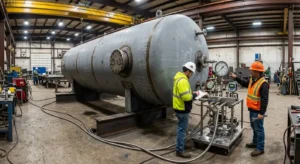
What Are Thermal Storage Testing Standards for TES Vessels?
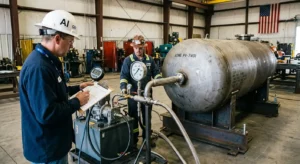
What Hydro Tests Are Required for Pressure Vessels?
- Equalization Tanks: Design, Sizing, and Fabrication
- What Are Thermal Storage Testing Standards for TES Vessels?
- What Hydro Tests Are Required for Pressure Vessels?
- What Are Thermal Storage Tank Design Parameters?
- Thermal Storage Tanks for Industrial Use
- Thermal Energy Storage Solutions for Industrial Applications
About Author



