
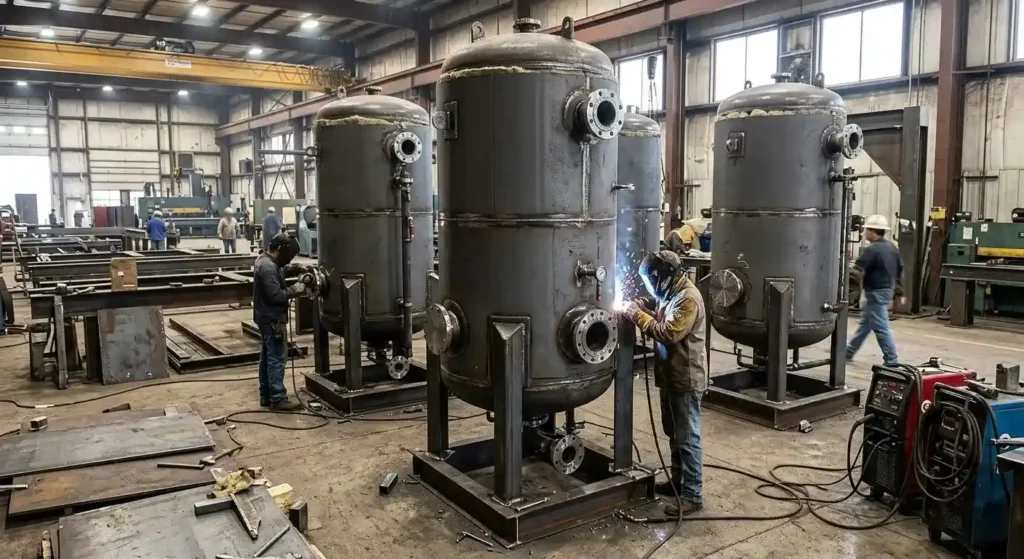
Hydronic tanks are pressure-rated vessels used in water-based heating and cooling systems to store thermal energy, stabilize loop volume, and remove air and debris from the fluid circuit. Any hydronic tank operating above 15 psig must be built to ASME Section VIII as a coded pressure vessel.
Key Takeaways
- Hydronic tanks are defined by their role in the loop. Buffer tanks, thermal energy storage tanks, expansion tanks, and separators each solve a different system problem.
- The 15 psig threshold triggers ASME Section VIII. Any hydronic tank operating above that pressure is a coded pressure vessel.
- Correct buffer volume prevents short cycling. An undersized hydronic buffer tank forces chillers and boilers to cycle too frequently, wearing equipment and wasting energy.
- Chilled water storage tanks depend on stratification. Diffuser and nozzle design that maintains cold and warm layer separation is what makes stored capacity usable.
- Hydronic tanks integrated into modular skid packages arrive pre-piped and pre-tested, reducing field installation time and schedule risk.
What Are Hydronic Tanks and How Do They Work?
A hydronic system moves heat by circulating water or a water-glycol mix through a closed loop of boilers, chillers, pumps, and terminal units. Hydronic tanks are the vessels in that loop that store energy, absorb volume changes, and condition the fluid so the system runs stably and efficiently.
The Core Function: Buffering
A loop with too little volume reacts sharply to load changes. Depending on the tank’s role, buffering means holding heated or chilled water for later use, giving fluid room to expand as it warms, or allowing entrained air and dirt to separate before they reach pumps and valves.
Why Hydronic Tanks Are Engineered Vessels
Once operating pressure exceeds 15 psig, the tank falls under ASME Section VIII and becomes a coded pressure vessel. That classification governs materials, weld procedures, examination, documentation, and the stamping that makes the vessel verifiable and insurable.
What Are the Main Types of Hydronic Tanks?
Hydronic tanks are grouped by the job they perform in the loop. Most systems use one or more of four types.
Buffer Tanks
A hydronic buffer tank adds volume to a loop that would otherwise be too small to operate stably. It prevents the chiller or boiler from short cycling against a small water volume, giving the heat source enough water to run in longer, more efficient cycles.
Thermal Energy Storage Tanks
A thermal energy storage tank holds chilled or hot water generated at one time for use at another. A chilled water storage tank charged overnight on off-peak utility rates can carry a facility’s cooling load through the peak-rate window the following day. These tanks depend heavily on internal stratification design to deliver their rated capacity.
Expansion Tanks
Water expands as it heats, and a closed loop has no relief path without an expansion tank. Expansion tanks hold pressure within a safe operating band as temperatures swing, sized to total loop volume and the system’s design temperature range.
Hydronic Separators
Entrained air and suspended debris damage pumps, foul heat exchangers, and create dead spots in the loop. A hydronic separator slows flow enough for air to rise out and particulate to settle. On larger systems, separation is frequently combined with buffering in a single vessel.
When Is a Hydronic Tank an ASME Pressure Vessel?
A hydronic tank is classified as an ASME pressure vessel when it operates above 15 psig. Most pressurized closed-loop systems run well above that threshold.
What ASME Section VIII Requires
Once the tank crosses the 15 psig line, ASME Section VIII, Division 1 governs: allowable materials and traceability, weld procedures and welder qualifications, NDE methods and acceptance criteria, pressure testing requirements, and the U-1 data report with National Board registration. The finished vessel carries the ASME U Stamp. Red River holds both the ASME U Stamp and the National Board R Stamp, verifiable directly with the issuing bodies. Hydronic system design guidance is published by ASHRAE through its technical resources.
How Are Hydronic Tanks Sized?
Sizing determines whether a hydronic tank solves the problem it was specified to solve. The calculation differs by tank type.
Buffer Tank Sizing
A hydronic buffer tank is sized from the minimum run time the heat source requires and the smallest load the system will see. Correct buffer tank sizing gives the heat source enough thermal mass to run in stable cycles at minimum load. Loop volume and the supply-to-return temperature differential are the primary inputs.
Thermal Storage Sizing
A thermal energy storage tank is sized from the load it must carry during the peak demand window and the usable temperature difference between supply and return. A chilled water storage tank that allows layer mixing loses usable capacity regardless of physical size. Diffuser and nozzle geometry are confirmed during specification. See Red River’s thermal energy storage and process tanks pages for how these vessels are fabricated.
What Materials and Fabrication Apply?
Material selection, welding, examination, and testing are matched to the fluid chemistry, operating pressure, and temperature range.
Carbon Steel vs. Stainless Steel
Carbon steel suits most closed-loop hydronic service where water chemistry is treated and controlled. Stainless steel is specified when the fluid is more aggressive, purity requirements are elevated, or the tank sees frequent thermal cycling.
NDE, Pressure Testing, and Documentation
Welds are examined by nondestructive methods matched to the design code. The finished vessel is hydrostatic tested at 1.3 times the MAWP. Every coded tank ships with the ASME Form U-1, mill test reports, weld records, and NDE examination results. See Red River’s pressure vessel fabrication and capabilities pages for the full fabrication scope.
What This Means When Specifying a Hydronic Tank
Hydronic tanks perform well only when their volume, internal design, and code compliance are settled before fabrication begins. Buffer volume that is too small causes short cycling. A chilled water storage tank without stratification loses usable capacity regardless of size. ASME documentation that is incomplete creates project and insurance risk. The systems that operate efficiently for decades are the ones where those decisions were made correctly at the start.
Work With Red River on Your Hydronic Tank
Red River fabricates ASME-certified hydronic tanks, hydronic buffer tanks, and thermal energy storage vessels for power generation, biogas, and industrial process applications from Gillette, Wyoming, since 2003. Red River holds active ASME U Stamp and NBBI R Stamp certifications and is an American Welding Society (AWS) member. Request a quote or call 1-307-257-5332 to discuss tank type, sizing, and fabrication scope.
Frequently Asked Questions
1. What Is the Difference Between a Buffer Tank and a Thermal Storage Tank?
A hydronic buffer tank adds a modest volume to stabilize a loop and prevent short cycling. A thermal energy storage tank is significantly larger and holds chilled or hot water generated at one time for use at another, often to shift load off peak utility rates. Buffer tanks solve a stability problem. Thermal storage tanks solve a timing and cost problem.
2. When Does a Hydronic Tank Need to Be ASME-Coded?
A hydronic tank operating above 15 psig is built to ASME Section VIII as a coded pressure vessel. Most pressurized closed-loop systems run above that threshold. The design specification confirms the operating and design pressures that determine whether the tank falls under the code.
3. How Is Buffer Tank Sizing Determined?
Buffer tank sizing is calculated from the minimum run time the heat source requires and the smallest load the system will see. The goal is sufficient thermal mass for the chiller or boiler to run in stable cycles. Loop volume and the supply-to-return temperature differential are the key inputs.
4. Can Hydronic Tanks Be Delivered as a Modular Skid Package?
Yes. A modular skid package integrates the tank with piping, insulation, instrumentation, and structural support into a single pre-tested assembly. All components are tested and documented together before the skid ships, reducing field installation time and schedule risk.
5. Why Does Stratification Matter in a Chilled Water Storage Tank?
Stratification keeps cold water at the bottom and warm water at the top, which is what makes stored capacity usable. A tank that allows layer mixing delivers warmer-than-specified water and loses effective capacity. Diffuser and nozzle design that preserves stratification is confirmed during specification, not adjusted in the field.
6. Does Red River Fabricate Custom Hydronic Tanks?
Yes. Red River fabricates custom ASME-certified hydronic tanks designed to each system’s load profile, operating range, and connection requirements, including diffuser geometry and insulation specification. Requirements are confirmed during engineering review before fabrication begins.
Related Blog Post
Which Materials Suit Make-Up Water Service?
How Big Should Make-Up Water Tanks Be?
Make-Up Water Tanks: Design, Sizing, and Fabrication
When to Spec Equalization Tanks for Industrial Systems
How Do Equalization Tanks Balance Flow?
About Author



