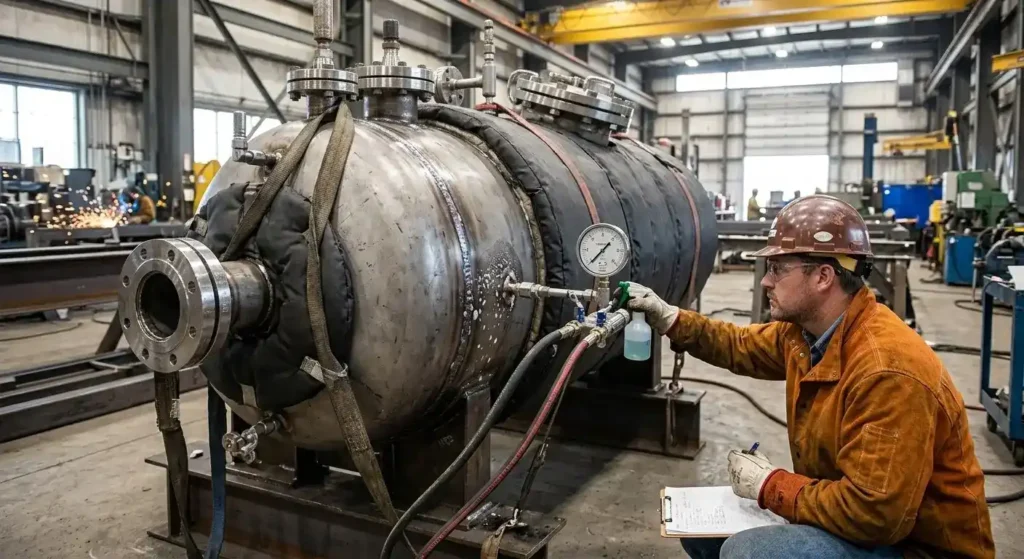
Leak tests are mandated whenever the construction code, the service conditions, or the owner’s specification call for verified leak-tightness, most often for hazardous fluids, vacuum service, certain process piping, and post-repair work. Understanding when leak tests are mandated starts with the governing code and the design basis, not the shop floor.
Key Takeaways
- The construction code sets the baseline. ASME Section VIII, Division 1 and Section V, Article 10 define when and how a pressure vessel is leak tested.
- Hazardous and lethal service raises the bar. Vessels in lethal service under UW-2 require verified leak-tightness, and facilities covered by OSHA Process Safety Management often add leak-test requirements of their own.
- A hydrostatic strength test does not always satisfy the leak test requirement. Vacuum service, jacketed vessels, and some heat exchangers need a dedicated leak test that a strength test cannot provide.
- Process piping has its own triggers. ASME B31.3 mandates a sensitive leak test for Category M, the highly hazardous fluid service category.
- Repairs and alterations reset the obligation. The National Board Inspection Code can require a new leak or pressure test after R Stamp work, documented to the same standard as new construction.
When Does ASME Code Mandate a Leak Test?
An ASME leak test is mandated when the construction code or the design specification calls for verified leak-tightness beyond the standard pressure test. For vessels built to ASME Section VIII, Division 1, the rules in Section V, Article 10 govern how pressure vessel leak testing is performed once the design requires it.
How the Trigger Is Established
The trigger is rarely arbitrary. It comes from the service conditions, the joint configuration, or a referencing code that names leak testing as a condition of acceptance. Because the requirement flows from the design basis, it belongs in the specification before the first plate is cut. Red River’s pressure vessel fabrication process establishes the test plan before fabrication scope is defined, not at closeout.
Which Services Always Require Leak Testing?
Certain services effectively guarantee a leak test, because a leak becomes a safety or environmental event rather than a nuisance. Three service conditions drive a mandatory leak test more often than any others.
Lethal and Toxic Service
Lethal service, defined under UW-2 of ASME Section VIII, Division 1, carries the strictest construction and examination requirements, and leak-tightness verification is part of protecting against the release of a lethal substance. Toxic and high-purity process fluids carry similar requirements written into the owner’s specification or, for covered sites, the OSHA Process Safety Management program.
Vacuum Service
A vessel under vacuum must hold against inward leakage, which a standard internal pressure test does not confirm. Vacuum and jacketed designs need a dedicated leak test to verify the pressure boundary holds in the direction the service actually loads it.
Owner’s Specification Requirements
Beyond the code minimum, an owner’s specification can mandate a leak test for flammable, odorous, or environmentally regulated fluids even when the base code would not. These leak test requirements are set by the buyer and confirmed before fabrication begins.
How Does a Leak Test Differ From a Hydrostatic or Pneumatic Test?
A leak test verifies tightness, while a hydrostatic or pneumatic test verifies strength. They answer different questions and are not interchangeable, and many vessels receive both.
Hydrostatic Testing Verifies Strength
A hydrostatic test under UG-99 fills the vessel with water and pressurizes it, commonly to 1.3 times the maximum allowable working pressure, to confirm the structure withstands pressure. Gross leaks may appear during the hold, but the test is built to prove strength, not tightness.
Pneumatic Testing Where Water Is Impractical
A pneumatic test under UG-100 uses gas where water cannot be used or fully drained, with added safety precautions because of the stored energy in compressed gas. Some modular skid packages and jacketed vessels fall into this category, so the test sequence is planned during the engineering review phase.
Leak Testing Verifies Tightness
A leak test looks for the escape of a test medium at a sensitivity the pressure test cannot reach. Where the service cannot tolerate even a small leak, the leak test is the acceptance step that matters, regardless of how the strength test went.
When Are Leak Tests Required for Process Piping?
For process piping built to ASME B31.3, a leak test is mandatory before the system is placed in service, and the type depends on the fluid handled.
Default Hydrostatic and Pneumatic Leak Tests
The default is a hydrostatic leak test. A pneumatic leak test is allowed where hydro is impractical, again with added precautions for the stored energy in gas. These tests verify the assembled system holds before startup.
Sensitive Leak Test for Category M Fluid Service
For Category M fluid service, which covers highly hazardous fluids where a single exposure can cause serious harm, B31.3 requires a sensitive leak test such as a gas-and-bubble or pressure-change method. The fluid service category is assigned during design and decides which test applies, so it must be settled before fabrication begins. Piping integrated into prefabricated skid packages is tested to the same requirement before the assembly ships.
Do Repairs and Alterations Trigger a New Leak Test?
Yes. Repairs and alterations to a coded vessel are governed by the National Board Inspection Code (NBIC), which can require a pressure or leak test appropriate to the work before the vessel returns to service.
National Board Inspection Code Requirements
A weld repair that breaches the pressure boundary does not simply restore the original condition. It creates a new condition that has to be re-verified. The NBIC sets the testing expectation based on the nature and extent of the repair or alteration. The National Board maintains registration records for all ASME-stamped vessels and governs R Stamp repair documentation.
How Red River Documents R Stamp Repair Work
Red River holds the ASME U Stamp and National Board R Stamp, so repair work and the leak or pressure testing that follows is documented to the same standard as new construction. Red River’s fabrication capabilities cover both new vessel fabrication and R Stamp repair and alteration scopes.
Which Leak Test Method Does the Code Require?
The code does not force a single method. It requires the method to match the needed sensitivity and the service, and Section V, Article 10 recognizes several techniques.
Common Methods From Bubble to Helium Mass Spectrometer
Common methods include the bubble test for visible gross leaks, the pressure change or pressure decay test for sealed systems, the halogen diode method, and the helium mass spectrometer test for the highest sensitivity. Each detects a different size of leak.
Matching Method to Service Sensitivity
The right choice depends on how small a leak the service can tolerate. Matching method to service sensitivity is part of every leak test plan Red River builds into the fabrication scope before the first arc is struck.
Leak Test Requirements Built Into Fabrication, Not Bolted On at Closeout
Knowing when leak tests are mandated is about reading the service conditions and governing codes early, so the test plan is built into fabrication rather than added after the fact. The vessels that clear inspection without delays are the ones whose test requirements were settled in the specification. Red River has fabricated coded vessels from Gillette, Wyoming, since 2003, with active ASME U Stamp and NBBI R Stamp certifications covering new fabrication and repair work across oil and gas, power generation, and biogas applications.
Ready to Confirm Your Vessel’s Leak Test Requirements?
Request a quote or call 1-307-257-5332 to discuss your vessel’s service conditions, applicable leak test requirements, and fabrication scope with Red River’s team. The test plan belongs in the specification before fabrication begins, and Red River works through it at the start of every project.
Frequently Asked Questions
1. What Is the Difference Between a Leak Test and a Pressure Test?
A leak test confirms that a vessel holds its contents without escape past welds, joints, or seals. A pressure test confirms the vessel withstands its design pressure without structural failure. A vessel may need both, since tightness and strength are separate properties verified by different tests.
2. Is a Hydrostatic Test the Same as a Leak Test?
Not exactly. A hydrostatic test primarily verifies strength by pressurizing the vessel with water, though gross leaks may show during the hold. A dedicated leak test detects much smaller leaks at a sensitivity a hydrostatic test is not designed to reach, which is why hazardous services often require a separate leak test.
3. What Is a Sensitive Leak Test Under ASME B31.3?
A sensitive leak test is a high-sensitivity examination required by ASME B31.3 for Category M fluid service, which covers highly hazardous fluids. It uses methods such as a gas-and-bubble test or a pressure-change test to find very small leaks. The requirement is driven by the fluid service category assigned during design.
4. Does Every Pressure Vessel Need a Leak Test?
No. Whether a leak test is required depends on the construction code, the service conditions, the fluid handled, and the owner’s specification. Many vessels are accepted on a hydrostatic strength test alone, while hazardous, vacuum, or high-purity services add a leak test on top.
5. Who Decides Which Leak Test Method Is Used?
The governing code and the design specification decide. The code sets the minimum, the fluid service or vessel design can raise it, and the owner’s specification can add requirements beyond the code. The fabricator confirms the applicable method and sensitivity before testing begins.
Related Blog Post
Can Condensate Storage Improve Reliability?
Where Do Condensate Tanks Fit in a Steam System?
Which Nozzles Simplify Maintenance on Pressure Vessels?
How to Vent Condensate Tanks in Steam Systems
How Do Baffle Layouts Affect Stratification in TES Tanks?
About Author