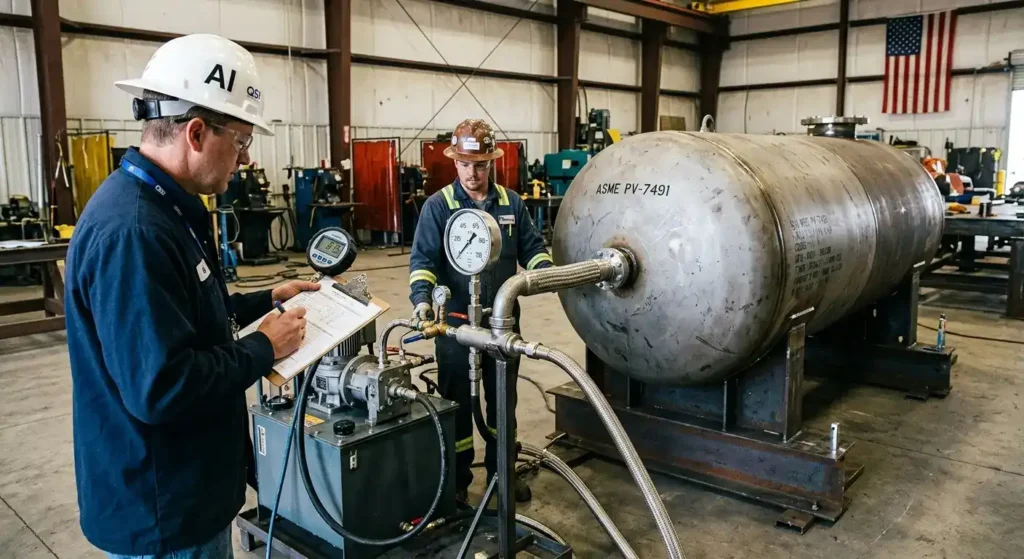
The primary hydro test required for ASME Section VIII pressure vessels is a hydrostatic pressure test at 1.3 times the maximum allowable working pressure (MAWP), conducted with the vessel fully water-filled and witnessed by a third-party Authorized Inspector. The test must be completed before the ASME U Stamp is applied and before the vessel is released for shipment.
Key Takeaways
- ASME hydrostatic test requirements under Section VIII call for 1.3 times MAWP, water-filled, witnessed by the Authorized Inspector, held long enough to permit visual inspection of all joints.
- Pneumatic testing at 1.1 times MAWP is permitted when hydrostatic testing is not practical, but requires additional safety precautions due to the higher energy stored in compressed gas at equivalent pressure.
- The acceptance criteria are no visible leakage and no permanent deformation. A leak at any location constitutes failure regardless of size or location.
- NDE must be completed before the hydrostatic test. The hydrostatic test does not substitute for NDE because it cannot detect subsurface weld flaws that may propagate under cyclic loading.
- Hydrostatic test documentation must be signed by the Authorized Inspector and filed with the ASME Form U-1 before the vessel can be registered with the National Board or released for service.
What Are the ASME Hydrostatic Test Requirements Under Section VIII?
ASME Section VIII requires a hydrostatic pressure test at 1.3 times MAWP for vessels fabricated under Division 1, completed before the U Stamp is applied, before shipment, and in the presence of a third-party Authorized Inspector.
Division 1 vs. Division 2 Test Pressure
Division 2 vessels may carry different test pressure requirements based on allowable stress values used in the design. Where design temperature approaches material limits, the calculation uses allowable stress at test temperature, which may differ from allowable stress at design temperature. Pneumatic testing at 1.1 times MAWP is permitted when water fill is not practical. Red River confirms the correct test pressure calculation with the Authorized Inspector before fabrication begins. See Red River’s pressure vessel fabrication and capabilities for how this applies across vessel types.
How Is Pressure Vessel Hydro Test Pressure Calculated?
The standard hydrostatic test pressure formula under ASME Section VIII is:
Test Pressure = 1.3 x MAWP x (Allowable Stress at Test Temperature / Allowable Stress at Design Temperature)
For a vessel with a 150 psig MAWP where allowable stresses at test and design temperature are equal:
Test Pressure = 1.3 x 150 psig = 195 psig
Minimum Test Pressure at the Top of the Vessel
The calculated test pressure must be achieved at the highest point of the vessel. For tall vertical vessels, the hydrostatic head of the water column adds pressure at the bottom during testing. The test setup must ensure the minimum pressure is achieved at the top without exceeding safe limits at the bottom.
What Hold Time and Acceptance Criteria Apply?
ASME Section VIII requires the test pressure to be held long enough to permit visual inspection of all joints. In practice, this is typically a minimum of 30 minutes for vessels requiring full external visual inspection, with actual duration determined by the Authorized Inspector based on vessel size.
Acceptance Criteria and Failure Conditions
The acceptance criteria are no visible leakage and no permanent deformation. A vessel that leaks at any location has failed regardless of whether the leak is at a weld, nozzle connection, or temporary test closure. Permanent deformation at test pressure indicates the vessel was loaded beyond its yield strength. OSHA requirements for hydrostatic testing in occupied facilities include exclusion zones and pressure relief provisions that Red River incorporates into every test procedure.
When Does Pneumatic Testing Apply?
Pneumatic testing at 1.1 times MAWP is permitted when water fill is not practical. Common reasons include structural support limitations for the water-filled weight, contamination sensitivity of the vessel service, and operating conditions that would be adversely affected by water introduction.
Pneumatic Test Procedure Requirements
Pneumatic testing stores significantly more energy than hydrostatic testing at equivalent pressure. ASME Section VIII requires a preliminary test at 10 psig to check for major leaks and a hold at 50 percent of test pressure before proceeding to full pressure. Red River’s prefabrication services include confirming the applicable test method with the Authorized Inspector before the scope is finalized.
What Hydrostatic Test Documentation Is Required Before Release?
Hydrostatic test documentation is part of the vessel package required before National Board registration and release for service. The test record documents the test pressure, test medium, hold duration, test date, result, and the Authorized Inspector’s signature. It references the vessel serial number and the ASME Form U-1, creating a traceable link between the test and the vessel.
Pre-Test NDE Requirements
NDE examination of pressure-retaining welds must be completed before the hydrostatic test. A vessel with unexamined welds cannot receive the ASME stamp even if it passes the test. Red River sequences NDE and hydrostatic testing so all required NDE is complete before test pressure is applied. See how this sequencing applies across complete vessel scopes in Red River’s modular skid packages.
What This Means for Your Vessel’s Test Scope
What hydro tests are required on a specific vessel depends on the applicable code division, MAWP, material temperature limits, and whether hydrostatic or pneumatic testing is practical. These decisions interact with NDE scope, hydrostatic test documentation requirements, and National Board registration, all of which must be defined before fabrication begins. Red River works through the full test scope at the start of every project.
Discuss Hydrostatic Test Requirements With Red River
Red River holds active ASME U Stamp and NBBI R Stamp certifications, is an American Welding Society (AWS) member, and has fabricated and tested coded pressure vessels for oil and gas, power generation, and biogas clients from Gillette, Wyoming, since 2003. Request a quote or call 1-307-257-5332 to discuss your vessel hydrostatic test requirements and fabrication scope.
Frequently Asked Questions
1. What Hydro Tests Are Required for an ASME Section VIII Pressure Vessel?
ASME Section VIII requires a hydrostatic test at 1.3 times MAWP, conducted with the vessel fully water-filled and witnessed by a third-party Authorized Inspector. The test must be held long enough to permit visual inspection of all joints. The signed test record becomes part of the vessel documentation package filed with the ASME Form U-1.
2. What Is the Difference Between Hydrostatic and Pneumatic Testing?
Hydrostatic testing uses water at 1.3 times MAWP and is the standard ASME method. Pneumatic testing uses compressed gas at 1.1 times MAWP and is permitted when water fill is not practical. Pneumatic testing stores more energy at equivalent pressure, making it more hazardous and requiring a preliminary leak check at 10 psig and a hold at 50 percent of test pressure before proceeding.
3. What Happens If a Vessel Leaks During the Hydrostatic Test?
The vessel fails regardless of leak location or severity. It must be depressurized, the leak identified and repaired, and the test repeated. Repairs to pressure-retaining welds require qualified weld procedures and may require additional NDE before the test is repeated.
4. Does the Hydrostatic Test Replace NDE Inspection?
No. NDE detects subsurface weld flaws that may not cause visible leakage at test pressure but can propagate under cyclic service loading. The hydrostatic test verifies overall structural integrity under pressure. Both are required for coded vessels, with NDE completed before the hydrostatic test.
5. What Documentation Is Required for the Hydrostatic Test Record?
The hydrostatic test record must document test pressure, test medium, hold duration, test date, result, and the Authorized Inspector’s signature. It references the vessel serial number and ASME Form U-1 to create a traceable record. Red River delivers the complete test record as part of the vessel documentation package with every coded pressure vessel.
Related Blog Post
Can Condensate Storage Improve Reliability?
Where Do Condensate Tanks Fit in a Steam System?
Which Nozzles Simplify Maintenance on Pressure Vessels?
How to Vent Condensate Tanks in Steam Systems
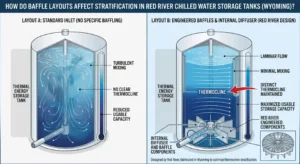
How Do Baffle Layouts Affect Stratification in TES Tanks?
- Equalization Tanks: Design, Sizing, and Fabrication
- What Are Thermal Storage Testing Standards for TES Vessels?
- What Are Thermal Storage Tank Design Parameters?
- What Is Thermal Energy Storage System Manufacturing?
- Thermal Storage Tanks for Industrial Use
- Thermal Energy Storage Solutions for Industrial Applications
About Author