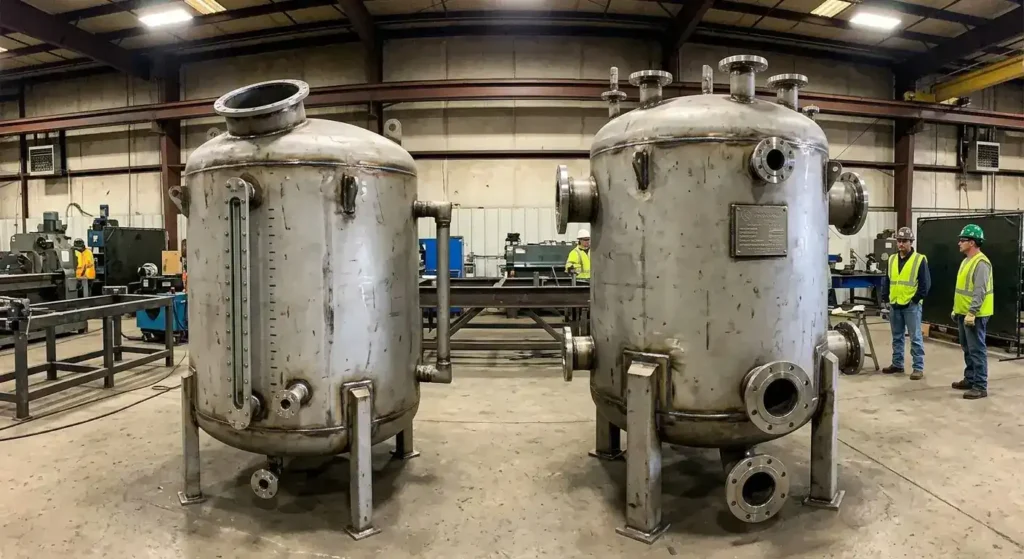
Condensate tanks collect the liquid water that forms after steam releases its latent heat to a process or heat exchange application, hold it at controlled pressure and temperature, and return it to the boiler feedwater system. The type required, the applicable construction standard, and the fabrication certification needed all depend on whether the tank operates at atmospheric pressure or above 15 psig.
Key Takeaways
- Condensate tanks fall into two categories: atmospheric vented tanks that hold condensate at near-ambient pressure, and pressurized receivers that hold condensate in a closed system above 15 psig.
- Atmospheric condensate tanks are built to applicable fabrication standards but are not subject to ASME BPVC Section VIII unless they also exceed six inches in inside diameter and operate above 15 psig. OSHA 29 CFR 1910.106 applies to atmospheric tanks in certain process environments.
- Pressurized condensate receiver tanks operating above 15 psig with an inside diameter greater than six inches are governed by ASME BPVC Section VIII Division 1 and must carry the U Stamp.
- Material selection for condensate service must account for carbonic acid corrosion from dissolved CO₂ in the condensate. Carbon steel with a calculated corrosion allowance covers most applications; stainless steel is used in high-purity or aggressive chemistry service.
- Sizing a condensate tank requires the maximum condensate return rate, the operating pressure, the required storage time between pump cycles, and the pump NPSH requirement.
What Are Condensate Tanks and How Do They Work?
Condensate tanks are pressure vessels or atmospheric vessels that collect steam condensate returning from a steam distribution system and hold it before it is pumped back to the boiler. Hot condensate carries recoverable heat, is already chemically treated, and does not need to be heated from ambient temperature before re-entering the boiler. Recovering and returning condensate reduces fuel consumption, chemical treatment costs, and boiler blowdown frequency.
Why the Tank Sits Between the Return Line and the Boiler Feed Pump
A condensate tank sits between the return line and the boiler feed pump because hot condensate arriving from the system may still be close to its saturation temperature. If that fluid hits the pump suction directly, it can flash to steam inside the pump, causing cavitation that damages the impeller and disrupts flow. The tank provides a low-pressure zone where flash steam can separate and vent, and where condensate can stabilize before entering the pump. The tank also provides storage volume that buffers swings in condensate return rate against the steady demand of the boiler feed pump.
Common Names for Condensate Tanks
Condensate tanks are also called condensate receiver tanks, condensate return tanks, condensate storage tanks, or hot well tanks depending on the application and industry. In large industrial steam systems, the hot well tank is the primary condensate collection point feeding the deaerator and boiler feedwater system. Red River’s pressure vessel fabrication and process tank scope covers both atmospheric and pressurized condensate tank types.
What Are the Main Types of Condensate Tanks?
Condensate tanks fall into two primary categories based on operating pressure and venting configuration, and the category determines the applicable construction standard and fabrication requirements.
Atmospheric Vented Condensate Tanks
Atmospheric vented condensate tanks operate at or near atmospheric pressure with an open vent that allows flash steam and dissolved gases to escape. These tanks are used in low-pressure steam systems and smaller commercial or industrial heating applications. Because they operate at atmospheric pressure, they are not subject to ASME BPVC Section VIII pressure vessel requirements as long as they remain below the code’s applicability thresholds.
However, atmospheric condensate tanks must still be constructed from materials compatible with hot condensate and designed to handle thermal expansion and the corrosive environment created by dissolved oxygen and carbonic acid. In process environments, OSHA regulations and jurisdictional requirements may impose additional material and construction obligations on atmospheric tanks.
Pressurized Condensate Receiver Tanks
Pressurized condensate receiver tanks operate above atmospheric pressure in a closed system. These tanks are used in high-pressure steam systems, combined heat and power applications, and process steam systems where flash steam recovery or pressurized condensate return is required. When operating above 15 psig and measuring more than six inches in inside diameter, these vessels fall under ASME BPVC Section VIII Division 1 and must be fabricated by a U Stamp-certified shop, inspected by a third-party authorized inspector, and registered with the National Board.
Flash Steam Recovery Vessels
When high-pressure condensate drops to lower receiver pressure, a fraction flashes back to steam. A flash steam recovery vessel captures that steam for a low-pressure header or heat exchanger rather than venting it, and is subject to the same ASME Section VIII requirements as any pressurized condensate tank.
What Standards Govern Condensate Tank Fabrication?
The governing standard for a pressurized condensate return tank ASME BPVC Section VIII Division 1 applies is established based on operating pressure and vessel diameter. For atmospheric tanks, applicable standards vary by service environment and jurisdiction.
ASME BPVC Section VIII Division 1 Requirements
ASME Section VIII Division 1 requires design calculations based on maximum allowable working pressure (MAWP), temperature, and applicable joint efficiency. Every pressure-retaining material component must be documented by a material test report (MTR) confirming chemical composition and mechanical properties. Welds are examined by qualified personnel using methods matched to the joint category and design assumptions.
Hydrostatic pressure testing at a minimum of 1.3 times the MAWP must be completed before the vessel leaves the fabrication facility. The ASME Manufacturer’s Data Report (Form U-1) is completed and signed by a third-party authorized inspector. Red River coordinates and manages NDE examination through qualified inspection personnel on all coded condensate tanks. Every vessel ships with a complete documentation package: ASME Form U-1, certified MTRs, weld records, NDE reports, and the hydrostatic test record.
Standards for Atmospheric Condensate Tanks
Atmospheric condensate tanks not subject to ASME Section VIII must still meet applicable state boiler and pressure vessel codes, insurance underwriter requirements, and in process environments, OSHA material handling regulations. These tanks are built to applicable construction standards that address the corrosive nature of hot condensate service, and they still require a documented quality program and traceable material certification. Red River’s fabrication capabilities cover both pressurized and atmospheric condensate tank types.
National Board Registration and R Stamp Work
The National Board of Boiler and Pressure Vessel Inspectors maintains permanent records for all ASME-stamped vessels. Red River holds the ASME U Stamp and NBBI R Stamp covering repair and alteration of coded condensate tanks. Correct initial fabrication documentation enables R Stamp repair work years later without reconstructing the vessel’s history.
What Are the Material Requirements for Condensate Service?
Material selection for condensate tanks must account for the corrosive service environment created by dissolved oxygen and carbon dioxide in the condensate stream.
Carbonic Acid Corrosion in Carbon Steel Condensate Tanks
Carbon dioxide dissolved in boiler feedwater is released as steam travels through the distribution system. When it condenses back with the steam condensate, it forms carbonic acid that corrodes carbon steel at a rate proportional to CO₂ concentration, temperature, and flow velocity. Carbon steel is still the standard material for most condensate tank applications, but the vessel design must include a corrosion allowance in the wall thickness calculation to account for this attack over the design service life.
When Stainless Steel Is Required
Stainless steel grades 304 and 316L are specified for condensate tanks where the service environment is aggressive, where purity requirements preclude carbon steel contact with the condensate, or where pharmaceutical or food-grade standards apply. Stainless steel eliminates the corrosion allowance calculation but increases material cost. The 316L grade is preferred where chloride exposure is a concern.
Lining Systems for Carbon Steel Condensate Tanks
Epoxy-based lining systems provide additional corrosion protection in atmospheric and lower-temperature pressurized condensate tanks. Higher-temperature pressurized service requires a lining material compatible with the operating temperature and the condensate chemistry, confirmed during design.
How Are Condensate Tanks Sized?
Sizing a condensate tank requires confirming four inputs: the maximum condensate return rate, the operating pressure, the required storage time between pump cycles, and the pump NPSH requirement.
Condensate Return Rate and Operating Pressure
The required flow capacity of the condensate tank matches the maximum return rate from the steam distribution system, including makeup water contributions. Operating pressure for a pressurized condensate tank is set at a level that allows flash steam to separate from liquid without excessive pressure drop in the return line. For systems returning condensate under line pressure, the tank design pressure must exceed the highest pressure the return line carries.
Storage Volume and Pump Cycle Time
Standard sizing practice is to provide three to five minutes of condensate storage at the maximum return rate. Facilities with variable condensate return rates or batch process steam loads size for the upper end of that range to reduce pump cycling frequency. The storage volume determines the physical vessel size.
NPSH and the Pump Interface
Available NPSH at the pump suction depends on the tank operating pressure, condensate temperature, and elevation difference between tank and pump. Hot condensate near saturation temperature leaves very little NPSH margin, so tank sizing and pump selection must be coordinated together.
Which Industries Use Condensate Tanks?
Condensate tanks are used in any facility that generates and distributes steam: power generation, oil and gas, biogas processing, chemical manufacturing, food processing, pharmaceutical manufacturing, and institutional HVAC systems.
Power Generation and Industrial Steam
Power generation facilities recover condensate from turbine extraction steam and feed heating applications as part of the Rankine cycle. Industrial process steam systems use condensate tanks at heat exchanger and process heating discharge points.
Oil and Gas and Biogas
Oil and gas facilities use condensate tanks in steam flooding, fuel gas conditioning, and process heating applications. Biogas processing facilities that use steam for gas conditioning and temperature control require condensate return systems sized for their steam heating loads. In both sectors, condensate tanks are frequently integrated into modular skid packages that arrive at the site pre-tested and ready to connect. Red River’s prefabrication services cover complete condensate return skid assemblies for these applications.
Condensate Tanks Built for Your Steam System
Condensate tanks protect the boiler feedwater system, recover latent heat, and reduce operating cost when they are correctly specified, fabricated to the right code, and sized for the actual condensate return conditions. Red River fabricates ASME-certified pressurized condensate receiver tanks and atmospheric condensate tanks for power generation, oil and gas, biogas, and industrial process applications from Gillette, Wyoming, since 2003. Every vessel is built to the actual service conditions, tested to code, and delivered with full National Board documentation.
Ready to Specify Your Condensate Tank?
Request a quote or call 1-307-257-5332 to discuss condensate tank type, sizing, material selection, ASME certification scope, and fabrication schedule with Red River’s team. The specification review starts before any plate is cut.
Frequently Asked Questions
1. What Is a Condensate Tank and Why Is It Needed?
A condensate tank collects the liquid water left after steam releases its latent heat to a process or heating application, holds it at controlled pressure, and feeds it back to the boiler feed pump. It protects the pump from cavitation caused by hot condensate flashing at the inlet, provides storage volume to buffer fluctuations in condensate return rate, and enables the recovery of heat and chemical treatment already invested in the condensate.
2. Does a Condensate Tank Need to Be ASME Certified?
A condensate tank that operates above 15 psig and has an inside diameter greater than six inches is governed by ASME BPVC Section VIII Division 1 and must carry the ASME U Stamp. Atmospheric condensate tanks operating at near-ambient pressure may be exempt from ASME pressure vessel requirements, but they must still meet applicable state codes, OSHA regulations, and insurance requirements.
3. What Is the Difference Between Atmospheric and Pressurized Condensate Tanks?
An atmospheric condensate tank vents flash steam to atmosphere and operates at near-ambient pressure. A pressurized condensate receiver holds condensate in a closed system above atmospheric pressure, allowing flash steam recovery and pressurized return to the boiler feedwater system. Pressurized tanks above 15 psig and six inches in diameter require ASME U Stamp fabrication. Atmospheric tanks do not, though they must still be constructed to handle hot, corrosive condensate service.
4. What Causes Corrosion in Condensate Tanks?
The primary corrosion mechanism in condensate tanks is carbonic acid formation when dissolved carbon dioxide in the condensate contacts the carbon steel vessel wall. The acid attacks the steel at a rate that depends on CO₂ concentration, temperature, and flow velocity. Carbon steel condensate tanks must include a corrosion allowance in the wall thickness design. Chemical treatment of the boiler feedwater to reduce CO₂ concentration also reduces the corrosion rate in the condensate system.
5. Can Condensate Tanks Be Integrated Into Modular Skid Packages?
Yes. Condensate tank skid packages that integrate the vessel with the boiler feed pump set, level controls, flash steam vent connection, makeup water inlet, and instrumentation into a pre-tested assembly are widely used in oil and gas, biogas, and industrial process applications. Factory assembly eliminates field errors in the pump-vessel interface and reduces commissioning time, making modular condensate packages well-suited to remote sites and compressed construction schedules.
Related Blog Post
Can Condensate Storage Improve Reliability?
Where Do Condensate Tanks Fit in a Steam System?
Which Nozzles Simplify Maintenance on Pressure Vessels?
How to Vent Condensate Tanks in Steam Systems
How Do Baffle Layouts Affect Stratification in TES Tanks?
About Author