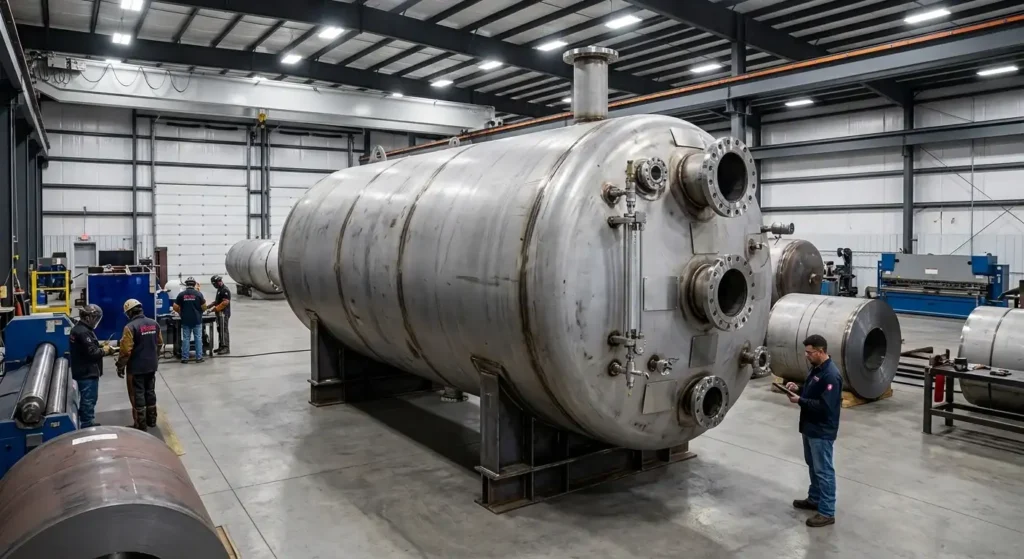
Equalization tanks balance flow by accepting incoming process fluid at variable rates and releasing it at a controlled, steady rate determined by the downstream system’s design capacity. The vessel holds the excess volume that accumulates during peak flow periods and depletes it during low-flow periods, smoothing the hydraulic load seen by downstream treatment or processing equipment.
Key Takeaways
- The flow equalization mechanism works by decoupling the upstream variable flow rate from the downstream constant design flow rate through a buffer volume held in the vessel.
- Equalization tank hydraulics are governed by the difference between the incoming flow rate and the outgoing controlled rate. When inflow exceeds outflow, the level rises. When inflow drops below outflow, the level falls.
- Peak flow buffering capacity is calculated from the peak-to-average flow ratio and the duration of the peak flow event. A higher ratio and a longer peak duration require a larger vessel.
- The outlet flow rate from a flow equalization tank is typically controlled by a pump or control valve set to the downstream system’s design flow rate, not by gravity alone.
- Every pressurized equalization vessel operating above 15 psig must carry the ASME U Stamp under Section VIII, Division 1.
- Red River fabricates flow equalization vessels in carbon steel and stainless steel sized to the actual upstream flow profile and downstream system capacity.
What Is the Flow Equalization Mechanism?
The flow equalization mechanism is straightforward: the vessel acts as a reservoir absorbing the difference between the variable inflow rate and the constant outflow rate at any moment in time.
Inflow vs. Outflow
When inflow exceeds the outlet rate, the excess accumulates and the level rises. When inflow falls below the outlet rate, the stored volume is drawn down to maintain the steady outlet flow. The level oscillates between a minimum at the end of the low-flow period and a maximum at the end of the peak-flow period. The active volume between those two levels must be correctly sized for the upstream flow profile.
Why the Flow Equalization Mechanism Requires Active Control
A tank without controlled outflow does not achieve true equalization. Gravity discharge through a fixed orifice produces a flow rate that varies with tank level, which passes some of the upstream variability downstream rather than absorbing it. The flow equalization mechanism only fully decouples inflow from outflow when a pump or control valve at the outlet holds the downstream flow rate steady regardless of tank level.
How Do Equalization Tank Hydraulics Work?
Understanding equalization tank hydraulics requires tracking three variables across the operating cycle: inflow rate, outflow rate, and tank level. The relationship between them determines whether the downstream equipment receives a consistent flow rate.
The Mass Balance at Any Moment
At any point in time, the rate of change of the tank level is proportional to the difference between inflow and outflow. If inflow is 500 gpm and outflow is 300 gpm, the tank fills at 200 gpm. If inflow drops to 150 gpm while outflow holds at 300 gpm, the tank empties at 150 gpm. The downstream system sees a steady 300 gpm throughout.
Controlling the Outflow
The outflow from an equalization tank is controlled by a pump or control valve at the outlet. A level controller monitors the tank and adjusts the outlet pump or valve to maintain the steady downstream flow rate even when inflow varies significantly. Red River’s process tank and pressure vessel fabrication scope covers equalization vessels from atmospheric atmospheric tanks to fully ASME-coded pressurized designs.
What Happens at the Operating Limits
When the tank level reaches its maximum, inflow must be reduced or diverted to prevent overflow. When the level reaches its minimum, the outlet pump may need to throttle to prevent cavitation. Both limits are design constraints that define the operating range the equalization vessel must support. Correctly sizing the active volume between those limits is the central task in equalization tank design.
How Is Peak Flow Buffering Capacity Calculated?
Peak flow buffering capacity calculation starts with characterizing the upstream flow profile across the design operating cycle, typically a 24-hour period for most industrial and wastewater applications.
Step 1: Plot Cumulative Inflow and Outflow
The hydraulic equalization vessel sizing method plots cumulative inflow volume against time across the operating cycle. A straight line through the same plot represents the cumulative outflow at the constant design rate. The maximum vertical distance between the two curves is the required equalization volume.
Step 2: Apply the Peak-to-Average Ratio
For systems without a detailed time-series profile, the equalization volume is estimated from the peak-to-average flow ratio:
Required Volume = Average Flow Rate × Retention Time × (Peak/Average Ratio − 1)
A system with an average flow of 200 gpm, a peak-to-average ratio of 3:1, and a two-hour retention time needs:
200 × 120 minutes × (3 − 1) = 48,000 gallons of equalization volume.
Step 3: Add Working Margins
The theoretical minimum volume is adjusted upward for practical margins: the dead volume below the pump suction, the freeboard above the overflow point, and any additional volume required to maintain minimum hydraulic retention time for concentration equalization. Red River works through these sizing inputs before the fabrication scope is defined, so the vessel is sized for actual operating conditions. See Red River’s fabrication capabilities for how equalization vessel sizing integrates into the design review.
What Factors Affect Flow Equalization Performance?
Several design and operational factors affect how well an equalization tank delivers the steady flow its sizing promises.
Mixing and Settled Solids
Without mixing, suspended solids settle and reduce the effective equalization volume over time. Mixing systems, whether mechanical agitators, aeration grids, or recirculation pumps, keep solids in suspension and ensure the outlet concentration reflects the mixed tank contents rather than a settled layer. The mixing energy must be sufficient to keep solids suspended without creating turbulence that interferes with any subsequent gravity settling.
Inlet Configuration and Short-Circuiting
A high-velocity inlet jet directed toward the outlet creates a short-circuit path that bypasses most of the tank volume, reducing effective hydraulic retention time. Baffles or diffusers at the inlet distribute flow across the tank cross-section and prevent short-circuiting, ensuring the full equalization volume is available to absorb the upstream flow variation.
Level Control Accuracy
The level control system governing the outlet pump determines how steady the outflow rate is in practice. An inaccurate or slow controller allows the outflow to drift with tank level, passing upstream variability downstream. Accurate, responsive level control closes the gap between the equalization performance the vessel was sized for and what is achieved in service.
When Does a Flow Equalization Tank Need to Be ASME-Coded?
Any equalization vessel operating above 15 psig must be fabricated to ASME BPVC Section VIII, Division 1, by a U Stamp-certified fabricator and registered with the National Board of Boiler and Pressure Vessel Inspectors. Most atmospheric flow equalization tanks fall below the ASME pressure threshold and may be fabricated to API 650 or other applicable standards.
What ASME Certification Covers
ASME code governs the vessel design calculation, material traceability through certified MTRs, weld joint classification and examination, hydrostatic testing at 1.3 times the MAWP, and the documentation package required for National Board registration. Red River holds active ASME U Stamp and NBBI R Stamp certifications. Every coded equalization vessel ships with the ASME Form U-1, certified MTRs, weld records, and NDE documentation coordinated through qualified inspection personnel.
Hazardous Fluid Requirements
Tanks handling hazardous fluids may carry additional EPA or OSHA requirements regardless of operating pressure, including secondary containment, designed vent systems, and material compatibility confirmation. The applicable requirements are confirmed during the design review before the fabrication scope is set.
Flow Equalization Vessels Built for Your Process
How equalization tanks balance flow comes down to vessel sizing and outlet control working together. A correctly sized vessel with poorly configured outlet control passes upstream variability through. A correctly sized vessel with accurate level control and correct inlet distribution delivers the steady downstream flow the system requires. Red River has fabricated coded equalization vessels for oil and gas, biogas, and industrial process applications from Gillette, Wyoming, since 2003. Red River’s modular skid packages cover equalization vessels integrated with pumps, level controls, and instrumentation into a single pre-tested assembly.
Ready to Size Your Flow Equalization Vessel?
Request a quote or call 1-307-257-5332 to discuss your equalization vessel sizing, inlet configuration, and fabrication scope with Red River’s team. The sizing review starts before fabrication scope is defined.
Frequently Asked Questions
1. How Do Equalization Tanks Balance Flow?
Equalization tanks balance flow by accepting incoming fluid at a variable rate and releasing it at a controlled, steady rate. When inflow exceeds the outlet rate, the tank level rises and stores the excess. When inflow drops below the outlet rate, the stored volume is drawn down to maintain the steady outlet flow. The downstream system sees a constant flow rate regardless of upstream variability.
2. What Determines the Size of a Flow Equalization Tank?
Tank size is determined by the peak equalization volume required: the maximum excess volume that accumulates during the peak flow period. This is calculated from the peak-to-average flow ratio, the downstream design flow rate, and the required working margins above the theoretical minimum. A worked example: 200 gpm average, 3:1 peak-to-average ratio, two-hour retention time requires 48,000 gallons.
3. Does an Equalization Tank Need a Pump at the Outlet?
In most industrial applications, yes. Gravity outflow produces a flow rate that varies with tank level, which does not achieve a constant downstream flow rate. A pump or control valve at the outlet, governed by a level instrument, maintains the steady outflow rate that makes equalization work.
4. Why Does Inlet Distribution Matter in an Equalization Tank?
A high-velocity inlet jet directed toward the outlet creates a short-circuit path that bypasses most of the tank volume, reducing the effective hydraulic retention time and passing more of the upstream variability downstream. Inlet baffles or diffusers distribute the incoming flow across the tank cross-section and prevent short-circuiting, ensuring the full equalization volume is used.
5. Does a Flow Equalization Tank Need to Be ASME-Coded?
Any flow equalization vessel operating above 15 psig must be fabricated to ASME BPVC Section VIII by a U Stamp-certified fabricator. Most wastewater equalization tanks are atmospheric and fall below this threshold. Closed or pressurized process equalization vessels may exceed it and require full ASME certification and National Board registration.
Related Blog Post
Which Materials Suit Make-Up Water Service?
How Big Should Make-Up Water Tanks Be?
Make-Up Water Tanks: Design, Sizing, and Fabrication
When to Spec Equalization Tanks for Industrial Systems
What Is an Equalization Tank?
About Author