hydronic tanks ASME buffer tank fabrication Red River Wyoming

Hydronic Tanks?

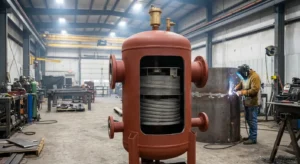
Hydronic tanks are pressure-rated vessels used in water-based heating and cooling systems to store thermal energy, stabilize loop volume, and remove air and debris from the fluid circuit. Any hydronic tank operating above 15 psig must be built to ASME Section VIII as a coded pressure vessel. Key Takeaways Hydronic tanks are defined by their role in the loop. Buffer tanks, thermal energy storage tanks, expansion tanks, and separators each solve a different system problem. The 15 psig threshold triggers
Read More »
What is a hydronic tank ASME buffer tank fabrication Red River Wyoming

What Is a Hydronic Tank?

A hydronic tank is a pressure-rated vessel in a closed-loop water system that stores thermal energy, absorbs volume changes, or separates air and debris from the fluid. Any hydronic tank operating above 15 psig is an ASME Section VIII coded pressure vessel, subject to specific material, examination, and documentation requirements before it ships. Key Takeaways A hydronic tank is a vessel in a closed water loop that stores energy, manages volume, or conditions the fluid, depending on its type. The

Read More »
Can glycol tanks reduce freezing risk glycol feed tank freeze protection Red River Wyoming

Can Glycol Tanks Reduce Freezing Risk?

Yes. Glycol tanks reduce freezing risk by keeping the loop charged at the correct concentration and adding thermal mass that slows how fast the loop can cool toward the freeze point. The tank does not lower the freezing temperature; the glycol chemistry does that, and the tank maintains that protection reliably between service visits. Key Takeaways Freeze protection glycol tank sizing must account for both the loop volume and the reserve needed between service intervals. A glycol feed tank replaces

Read More »
air separator tanks coalescing media automatic air vent hydronic loop Red River Wyoming

What Are Air Separator Tanks?

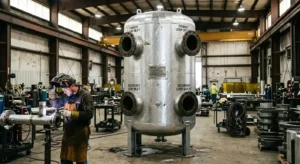
Air separator tanks are vessels installed in a hydronic loop to remove air from the circulating fluid by creating a low-velocity zone where trapped air gathers, rises, and escapes through a vent. They protect the system from corrosion, noise, poor heat transfer, and pump damage, and larger units are built as ASME-coded pressure vessels. Key Takeaways Air separator tanks pull air out of a hydronic loop so it cannot collect in high points and disrupt flow. Trapped air causes corrosion,

Read More »
Which materials suit glycol service stainless and carbon steel tank Red River Wyoming

Which Materials Suit Glycol Service?

Stainless steel and inhibited carbon steel are the two materials that suit glycol service reliably, with stainless preferred where purity and corrosion resistance are priorities and inhibited carbon steel the cost-effective choice for industrial loops with consistent fluid maintenance. Galvanized steel and bare aluminum must be kept out of glycol systems entirely, because both react with glycol and its inhibitors in ways that foul the loop. Key Takeaways Stainless steel offers the best corrosion resistance and purity for glycol service,

Read More »
How do hydronic tanks stabilize flow buffer tank hydraulic separation Red River Wyoming

How Do Hydronic Tanks Stabilize Flow?

Hydronic tanks stabilize flow by hydraulically separating the heat source from the distribution system and adding thermal mass to the loop, so pumps and the boiler or chiller operate on steady, independent flow instead of competing against one another. The result is fewer pressure swings, less short cycling, and protection for every pump and valve downstream. Key Takeaways Hydronic tanks stabilize flow mainly through hydraulic separation, which lets the source and the distribution loop run on independent flow rates without

Read More »