how much glycol volume is needed glycol concentration system volume Red River Wyoming

How Much Glycol Volume Is Needed?

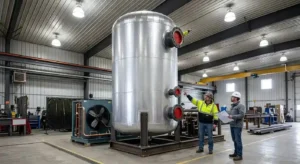
Glycol volume equals total system fluid volume multiplied by the target glycol concentration, so a 1,000-gallon loop at 30 percent needs about 300 gallons of concentrate. The concentration is set by the lowest temperature the system must survive, using the glycol manufacturer’s freeze point chart. Key Takeaways Glycol volume equals total system volume multiplied by the target concentration. Both numbers must be known before ordering fluid. Set the glycol concentration from the lowest expected temperature, using the glycol manufacturer’s chart
Read More »
When to use hydronic tanks buffer tank thermal storage Red River Wyoming

When to Use Hydronic Tanks

Use a hydronic tank whenever a water-based heating or cooling loop needs more volume, hydraulic separation, load shifting, or fluid conditioning than the bare piping can provide. The decision comes down to four triggers: short cycling calls for a buffer tank, variable flow calls for hydraulic separation, peak demand cost calls for thermal storage, and air or dirt in the loop calls for a separator. Key Takeaways Use a buffer tank when the loop volume is too low for the

Read More »
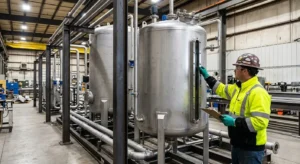
Glycol tanks ASME glycol feed and storage tank fabrication Red River Wyoming

Glycol Tanks: Types, Uses and ASME Requirements

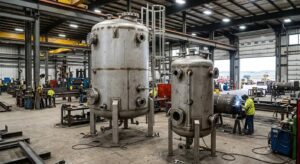
Glycol tanks are vessels that store, blend, or feed glycol-water mixtures used as heat transfer and freeze protection fluid in heating, cooling, and process systems. When they operate above 15 psig, glycol tanks are ASME-coded pressure vessels, and the tank type, material, and glycol compatibility determine whether the system runs trouble-free across its full service life. Key Takeaways Glycol tanks hold the antifreeze fluid that protects a system from freezing and maintains heat transfer performance in cold operating conditions. The

Read More »
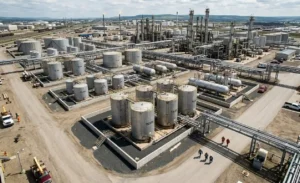
where should industrial tanks be located industrial facility Red River Wyoming

Where Should Industrial Tanks Be Located?

Industrial tanks should be sited based on six factors: safety separation distances, prevailing wind direction, process flow efficiency, secondary containment geometry, maintenance access, and future expansion provisions. Tank location is a foundational design decision, not a siting afterthought, because getting it wrong forces costly compromises on every downstream system. Key Takeaways Safety separation distances from property lines, buildings, and ignition sources are the first and most constraining siting factor. NFPA 30 is the primary reference for above-ground storage tanks; ASME

Read More »
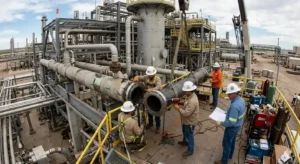
How do tie-ins impact downtime, industrial fabrication, Red River Wyoming

How Do Tie-Ins Impact Downtime

The answer comes down to three variables: how much field work is required at the connection point, how thoroughly that work was planned before the outage window opened, and whether fabricated components match actual field conditions. Each variable compounds the others. A field fit-up problem on an inadequately planned tie-in, using components that do not match field geometry, can double or triple the outage duration against the original schedule. Key Takeaways Tie-ins impact downtime through four primary variables: field fit-up

Read More »
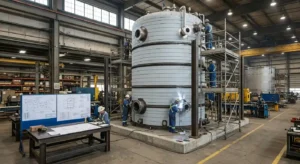
thermal storage tank design parameters ASME fabrication Red River Wyoming

What Are Thermal Storage Tank Design Parameters?

Thermal storage tank design parameters define the full operating envelope of a TES vessel: operating pressure and code basis, temperature range and cyclic loading profile, storage volume, material specification, insulation system requirements, and nozzle configuration. All parameters must be confirmed before fabrication scope is defined, because a vessel that cycles daily accumulates fatigue loads, stratification demands, and thermal expansion forces that standard vessel specifications do not address. Key Takeaways TES design parameters extend beyond standard vessel inputs to include cyclic

Read More »