
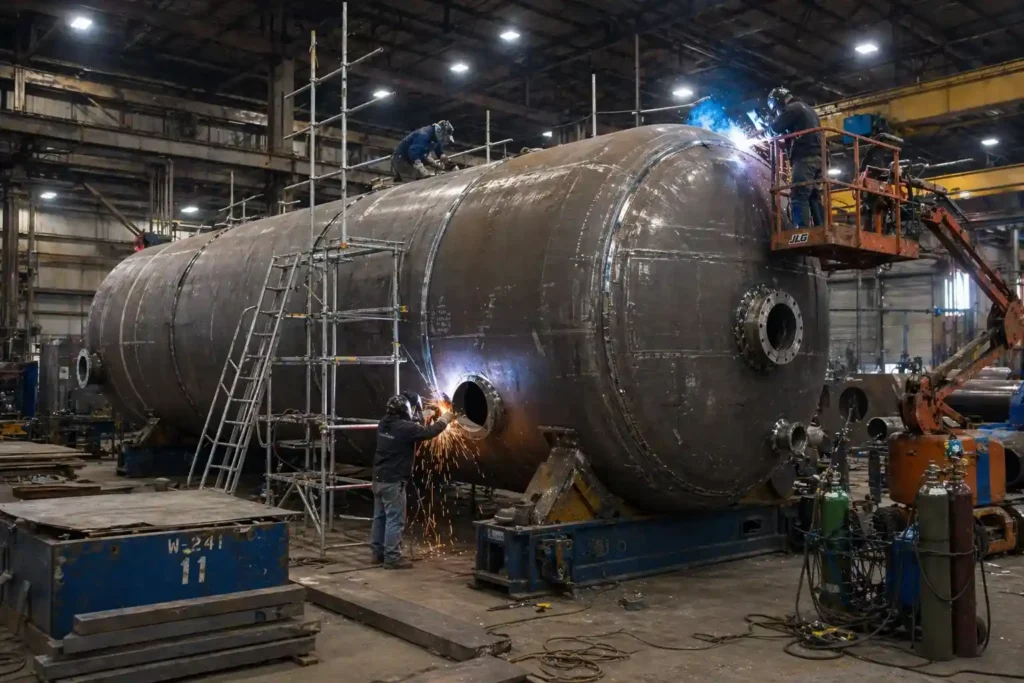
Energy storage tank construction is one of the most technically demanding processes in industrial fabrication. Get the design right, but cut corners on materials, welding, or inspection, and the vessel becomes a liability the moment it enters service. This guide covers the full construction sequence, from initial engineering decisions through code-compliant fabrication, inspection, and delivery, so procurement managers, project engineers, and facility operators know exactly what a properly built tank requires and how to verify it.
Key Takeaways
- Energy storage tank construction is a code-governed process from engineering through delivery. ASME Section VIII compliance is a legal requirement for vessels operating above 15 PSI in most commercial and industrial applications.
- Material selection is driven by operating conditions, not defaults. The wrong material grade creates premature failure or unnecessary cost. CMTRs are required for all pressure-containing components in ASME code construction.
- Hydrostatic pressure testing at 1.3 times MAWP, witnessed by the Authorized Inspector, is the code-required proof test before any vessel enters service. No compliant vessel ships without it.
- The documentation package, including the Form U-1, CMTRs, weld records, NDE reports, PWHT records, and pressure test records, is the vessel’s permanent legal record. Gaps create long-term liability.
- Modular skid integration reduces field installation time, improves quality control, and delivers a pre-commissioned unit ready for connection, with single-source accountability across the entire system.
Why Energy Storage Tank Construction Is Not a Commodity Process
Most industrial buyers treat tank procurement as a sourcing exercise. Send out specifications, collect quotes, award to the lowest qualified bidder. That approach works for standard off-the-shelf equipment. It does not work for custom energy storage tanks, and the distinction matters because a vessel that fails in service creates costs that dwarf any savings captured at procurement.
Energy storage tanks hold pressurized fluids, gases, or thermal media under operating conditions that vary by application, site, and process design. The vessel that stores produced water in an oil field operates under completely different pressure, temperature, and corrosion conditions than a chilled water storage tank in a data center or a steam accumulator in a power plant. Construction decisions made early in the engineering process, including material grade, weld joint classification, and inspection level, determine whether the vessel performs reliably for 20 to 30 years or fails prematurely.
A fabrication shop that builds structural steel cannot simply pivot to ASME code vessels. The quality management systems, certified welding procedures, third-party inspection requirements, and documentation obligations are fundamentally different. Understanding what separates a capable energy storage tank fabricator from a general metalworker is the first step in sourcing the right partner.
The Role of ASME Code in Energy Storage Tank Construction
The American Society of Mechanical Engineers (ASME) Boiler and Pressure Vessel Code (BPVC) is the foundational standard for energy storage tank construction across the United States and most international markets. Section VIII of the BPVC covers the design, fabrication, inspection, testing, and documentation requirements for pressure vessels operating above 15 PSI.
Any energy storage tank operating above that threshold must be designed and fabricated to ASME Section VIII requirements and must carry the U Stamp applied by a certified manufacturer. The U Stamp is not a self-certification. It requires an Authorized Inspection Agency (AIA) to audit the fabricator’s quality system, review design calculations, and provide a commissioned inspector on-site during fabrication and testing. The stamp on the nameplate is the record that those requirements were met.
For buyers, this creates a clear verification path. ASME maintains a public database of certified manufacturers at asme.org where any shop’s active certification status can be confirmed before a purchase order is issued. An expired or absent certification is a disqualifying condition, regardless of how competitive the quote is.
Red River holds an active ASME U Stamp certification and an NBBI R Stamp certification for repair and alteration work. Both are actively maintained through regular third-party audits, not legacy credentials from a prior era of the business.
Phase 1: Engineering and Design
Every energy storage tank construction project starts with engineering, and the quality of those initial layout calculations determines every downstream fabrication decision. Skipping or shortcutting this phase is the most common root cause of tanks that fail to perform as expected.
Design Pressure and Temperature
The design pressure is the maximum internal pressure the vessel is designed to contain, including a safety margin above the maximum operating pressure. Design temperature accounts for the highest and lowest temperatures the vessel will experience, including upset conditions. Both parameters drive material selection, wall thickness calculations, and weld joint efficiency requirements.
Applicable Code and Division
ASME Section VIII has two primary divisions. Division 1 covers most standard energy storage vessels and uses design-by-rule methodology. Division 2 uses design-by-analysis and allows thinner walls at higher stress levels, which can reduce material costs on large, high-pressure vessels. The choice between divisions depends on design pressure, vessel size, and the owner’s risk tolerance.
Nozzle and Connection Layout
Every penetration through the vessel shell is a potential weak point. Nozzle sizing, reinforcement requirements, and orientation all require engineering review. Nozzle placement that seems straightforward on a drawing can create welding access problems during fabrication or inspection access problems during in-service inspection. Good engineering anticipates both.
Corrosion Allowance
The corrosion allowance is additional wall thickness added to the minimum required thickness to account for material loss over the vessel’s service life. For aggressive fluid service, including produced water, biogas, or chemical process fluids, the corrosion allowance is a critical design parameter. Undersizing it shortens service life. Oversizing it adds unnecessary material cost.
Phase 2: Material Selection and Procurement
Material selection is the exact phase where energy storage tank construction either earns its long-term cost profile or creates severe field maintenance issues down the road. The right material for a chilled water thermal storage tank is not the right material for a produced water separator or a high-pressure steam accumulator, and specifying the wrong grade creates either premature failure or unnecessary cost.
Carbon Steel
SA-516 Grade 70 is the most commonly used plate material for standard pressure vessel applications. It offers good strength, weldability, and toughness at moderate temperatures. It is the baseline material for most oil and gas, water treatment, and moderate-service energy storage applications. Material availability for standard grades like SA-516-70 is generally predictable, but fabrication lead times depend on vessel complexity, shop loading, and whether specialty materials or PWHT are required.
Low-Temperature Carbon Steel
For applications where the vessel will experience temperatures below minus 20 degrees Fahrenheit, standard carbon steel loses impact toughness and becomes brittle. SA-516 Grade 70 with normalized heat treatment, or low-alloy steels such as SA-537, are required. Cryogenic applications require austenitic stainless steels or nickel alloy materials.
Stainless Steel
Type 304 and 316 stainless steels are used where corrosion resistance is the primary design driver. Biogas service, chemical process fluids, and food and beverage applications commonly require stainless construction. The cost premium over carbon steel is substantial, so material selection should be driven by actual corrosion requirements, not a conservative default.
Chrome-Moly Alloys
For high-temperature service above approximately 750 degrees Fahrenheit, carbon steel loses strength. Chrome-moly alloys such as P11 and P22 are used in power generation and high-temperature process applications where operating temperatures exceed the carbon steel design range.
Every material plate and fitting used in ASME code construction must arrive with a Certified Mill Test Report (CMTR) confirming the heat chemistry and mechanical properties. Material without CMTRs cannot be used in a code vessel. Fabricators who are vague about material traceability are a procurement risk.
Red River’s pressure vessel fabrication process maintains full material traceability from receiving through final documentation. Every plate is logged, identified, and traceable to its mill certificate throughout the construction sequence.
Phase 3: Energy Storage Tank Construction, Fabrication, and Welding
Fabrication is where the engineering becomes steel. For energy storage tank construction, this phase is governed by ASME code requirements at every step, from how plate is cut and formed through how welds are made, examined, and documented.
Plate Cutting and Forming
Shell sections are cut from plate using plasma, laser, or oxy-fuel cutting processes, then rolled or pressed to the required cylindrical geometry. Fit-up tolerances between shell sections and head components must meet ASME requirements before any welding begins. Gaps or misalignment that exceed code tolerances require correction before the weld can proceed.
Welding Procedure Specifications
Every weld on an ASME code vessel must be made using a qualified Welding Procedure Specification (WPS). The WPS defines the base materials, filler materials, preheat requirements, interpass temperature limits, and post-weld heat treatment requirements for each weld joint type. Welders must be qualified to the specific WPS they are using through a performance qualification test documented in a Welder Performance Qualification Record (WPQR).
Shops that cannot produce WPS and WPQR documentation for a project’s weld joints are not operating a code-compliant quality system, regardless of what their marketing says. Adhering to these strict quality protocols is what separates true ASME pressure vessel fabrication from general commercial metal welding.
Preheat and Post-Weld Heat Treatment
Thicker plate sections and certain alloy materials require preheat before welding to reduce the risk of hydrogen-induced cracking in the heat-affected zone. Post-weld heat treatment (PWHT) is required for many heavy-wall carbon steel and alloy steel vessels to relieve residual stresses and restore material toughness in the weld zone. PWHT is a controlled thermal cycle, not a suggestion, and it must be documented with time-temperature records that are included in the vessel’s final documentation package.
Nondestructive Examination
ASME Section VIII specifies minimum NDE requirements based on joint type and design pressure. Radiographic testing (RT) uses X-ray or gamma-ray imaging to detect internal weld discontinuities. Ultrasonic testing (UT) uses sound waves for the same purpose and is increasingly used as an alternative to RT on thicker sections. Magnetic particle testing (MT) and liquid penetrant testing (PT) detect surface and near-surface discontinuities.
The level of NDE required is determined by the vessel’s joint efficiency rating. Full radiography allows a joint efficiency of 1.0, meaning the weld is treated as strong as the base material. Spot radiography allows 0.85. No radiography drops to 0.70, which requires a thicker shell to achieve the same pressure rating. Buyers specifying vessels with no radiography are trading inspection cost for material cost, and often not saving money overall.
Red River’s prefabrication team operates under documented NDE procedures with certified Level II and Level III inspectors for RT, UT, MT, and PT examinations.
Phase 4: Inspection and Pressure Testing
No energy storage tank leaves a properly run fabrication facility without passing hydrostatic pressure testing witnessed by the Authorized Inspector. This is not a formality. It is the code-required proof test that the vessel can safely contain its design pressure.
Hydrostatic Testing
The standard hydrostatic test pressure is 1.3 times the maximum allowable working pressure (MAWP), applied using water or another suitable liquid. The vessel is pressurized to the test pressure, held for a defined period, and inspected for leaks, deformation, or signs of distress. The test is witnessed and documented by the Authorized Inspector.
Pneumatic testing using air or inert gas is permitted in limited circumstances where water cannot be used, but it carries significantly higher risk due to the stored energy in compressed gas versus liquid. Pneumatic testing requires additional safety precautions and engineering justification.
Authorized Inspector Sign-Off
The Authorized Inspector (AI) is a commissioned inspector employed by an ASME-accredited inspection organization, independent of the fabricator. The AI reviews the design calculations, witnesses critical fabrication steps including NDE and pressure testing, and signs the Manufacturer’s Data Report (Form U-1) confirming the vessel was fabricated in compliance with the applicable ASME code.
Without the AI’s signature, the U Stamp cannot be applied, and the vessel cannot legally enter service in regulated environments.
Phase 5: Documentation Package
The documentation that ships with a completed energy storage tank is as important as the vessel itself. For operators in regulated industries, the documentation package is the legal record of the vessel’s fitness for service. Gaps in documentation create liability that surfaces during in-service inspections, insurance renewals, and regulatory audits.
A complete ASME documentation package includes:
- Manufacturer’s Data Report (ASME Form U-1): identifies the vessel, design parameters, applicable code edition, and confirms the AI’s sign-off.
- Certified Mill Test Reports (CMTRs): material traceability for all pressure-containing components.
- Weld Records: WPS references and WPQR records for all code welds.
- NDE Reports: examination results, techniques used, and dispositions for all indications found.
- PWHT Records: time-temperature charts for all heat treatment performed.
- Hydrostatic Test Record: test pressure, duration, and AI witness confirmation.
- Nameplate photograph: photographic record of the applied U Stamp nameplate.
Red River delivers a complete, organized documentation package with every vessel. Our clients receive records that are ready for third-party review without additional assembly or follow-up requests.
Modular Skid Integration for Energy Storage Systems
Energy storage tanks increasingly ship as part of integrated modular skid packages rather than as standalone vessels. A modular skid combines the storage vessel with its structural steel support frame, process piping, instrumentation connections, pressure relief systems, and secondary containment, all assembled, tested, and pre-commissioned at the fabrication facility before delivery.
Field installation time drops significantly when a pre-tested skid arrives ready to connect rather than as individual components requiring field assembly. Quality control is tighter in a controlled shop environment than on a construction site. For remote or access-constrained locations, a pre-commissioned skid arriving by truck eliminates weeks of field labor.
Red River’s modular skids capability covers the full scope from structural design through piping, instrumentation, and pre-commissioning testing, all under the same quality system that governs the vessel fabrication. Single-source accountability means one documentation package, one point of contact, and one quality system covering the entire delivered unit.
Energy Storage Tank Construction for Key Industries
Oil and Gas
Separator vessels, produced water tanks, fuel gas conditioning packages, and crude storage vessels are all common energy storage applications in oil and gas. ASME certification is often a contractual requirement from the operator, independent of regulatory obligation. Our oil and gas fabrication work spans upstream separation through midstream conditioning and storage.
Power Generation
Steam accumulators, feedwater heaters, and thermal energy storage vessels in power generation environments operate at the upper end of the pressure and temperature envelope for carbon steel construction. Reliability requirements in this sector are among the highest in industry. Unplanned downtime carries costs measured in tens of thousands of dollars per hour.
Biogas and Biomethane
Pressurized biogas storage requires vessels designed for corrosive service containing hydrogen sulfide and moisture. Material selection, internal coating systems, and nozzle corrosion allowances are all critical design elements. Our biogas and biomethane fabrication capability addresses these requirements specifically.
Data Centers and TES Systems
Chilled water thermal energy storage tanks and pressurized hot water vessels in data center applications require precise fabrication to support the tight operating tolerances of modern cooling infrastructure. Our data centers and TES systems experience covers both atmospheric and pressurized vessel construction for these applications.
Get Your Energy Storage Tank Built to Code From Day One
Every energy storage tank Red River builds starts with a conversation about your operating conditions, your compliance requirements, and your delivery timeline. If you are ready to move from specification to fabrication, contact our team or call 1-307-257-5332 and let’s talk through what your project needs.
Frequently Asked Questions
1. What is the difference between ASME Division 1 and Division 2 for energy storage tanks?
Division 1 uses design-by-rule methodology and covers the vast majority of standard energy storage vessel applications. Division 2 uses design-by-analysis, which allows higher allowable stresses and therefore thinner vessel walls at a given pressure rating. Division 2 is typically chosen for large, high-pressure vessels where the material savings from thinner walls justify the additional engineering cost. For most energy storage applications, Division 1 is the appropriate and most commonly specified standard.
2. How long does energy storage tank construction typically take?
Lead times for standard energy storage tank construction depend primarily on vessel complexity, dimensional size, raw material availability, and current shop floor loading. A standard carbon steel pressure vessel in the 500 to 2,000 gallon range can typically be completed in 8 to 14 weeks from approved drawings. Larger vessels, complex alloy construction, or vessels requiring extensive PWHT or NDE will require longer schedules. Integrated modular skid packages add additional time for piping, instrumentation, and pre-commissioning. Contact us with your specifications for an accurate timeline.
3. What is post-weld heat treatment and when is it required?
Post-weld heat treatment (PWHT) is a controlled thermal cycle applied to a completed weld assembly to relieve residual stresses introduced during welding and to restore toughness in the heat-affected zone. ASME Section VIII requires PWHT for carbon steel vessels above certain wall thickness thresholds, for certain alloy materials regardless of thickness, and for some lethal or hydrogen service applications. PWHT is performed in a controlled furnace or with resistance heating blankets and must be documented with time-temperature records included in the final documentation package.
4. Can energy storage tanks be fabricated for outdoor installation in extreme climates?
Yes. Tanks intended for outdoor installation in cold climates require low-temperature material specifications, insulation systems designed for the ambient temperature range, and attention to thermal cycling effects on nozzle connections and support structures. Tanks for hot or desert climates require coating systems rated for high UV exposure and thermal expansion considerations in the support design. Red River handles complex industrial tank construction that Wyoming operators rely on across the broader Rocky Mountain region, where ambient temperature swings of more than 100 degrees Fahrenheit between seasonal extremes are common.
5. What is the NBBI R Stamp and how does it differ from the ASME U Stamp?
The ASME U Stamp certifies a fabricator to construct new pressure vessels under ASME Section VIII. The NBBI R Stamp, issued by the National Board of Boiler and Pressure Vessel Inspectors, certifies a shop to perform repairs and alterations on existing coded pressure vessels. If an in-service energy storage tank requires structural repair, nozzle replacement, or code alteration, the work must be performed by an R Stamp-certified shop to maintain the vessel’s code compliance. Red River holds both stamps, covering new construction and repair work under a single quality system.
6. Does energy storage tank construction require third-party inspection even for smaller vessels?
ASME Section VIII requires Authorized Inspector involvement for all U Stamp-certified vessels regardless of size. The AI reviews design documentation, witnesses critical fabrication steps, and signs the Form U-1 before the U Stamp can be applied. There is no size threshold below which this requirement is waived. Small vessels operating below 15 PSI or within certain other exemptions may not require ASME certification, but any vessel bearing the U Stamp was inspected by a qualified AI. Buyers specifying ASME U Stamp vessels should confirm that the fabricator’s AI is commissioned by an ASME-accredited inspection organization, not an in-house inspector.
Related Blog Post
How Are Shop vs Field Welds Chosen for Fabrication
Which Materials Suit Make-Up Water Service?
How Big Should Make-Up Water Tanks Be?
Make-Up Water Tanks: Design, Sizing, and Fabrication
When to Spec Equalization Tanks for Industrial Systems
No subpillar set for this blog post.
About Author



