The wrong shop vs field weld call leads to rework, failed inspections, and blown schedules. This guide covers the six factors project engineers and procurement managers need to get it right.
Key Takeaways
- Shop welds are controlled, inspectable, and consistently less expensive than field welds. Maximize shop scope wherever the design and logistics allow.
- Code-required inspection joints (RT, UT) should be incorporated into shop spool scope wherever possible. Field radiography is expensive and disruptive to schedule.
- Shipping envelope constraints set the outer boundary on shop spool size. Establish maximum shipping dimensions early and design spool breaks around them.
- Welder qualification management is simpler and more reliable in a shop. For ASME code work with audit requirements, this is a meaningful risk factor.
- The shop vs field weld decision should be made during engineering, not left to field resolution. Late decisions cost more and produce worse outcomes.
Why the Shop vs Field Weld Decision Matters
Every weld joint in a piping system, pressure vessel, or structural assembly has to be placed somewhere. That somewhere is either a fabrication shop or the field. The choice is not always obvious, and it is rarely made for a single reason.
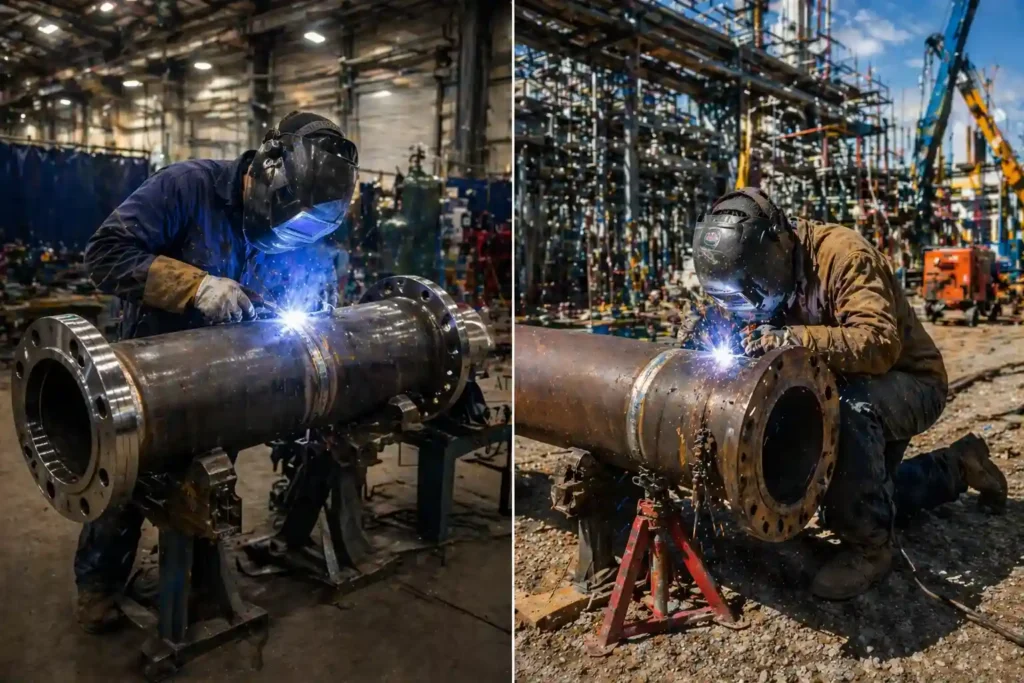
Shop welds are made in a controlled environment where temperature, positioning, access, and inspection are all tightly managed. Field welds are made at the installation site under conditions that vary by season, location, and project phase. What matters is matching the weld type to the actual conditions, code requirements, and project economics at hand.
For procurement managers and project engineers, understanding how this decision gets made helps avoid a common trap: deferring too many joints to the field because it feels easier upfront, only to discover the cost and schedule impact during construction.
Access and Working Conditions
The first filter is simple. Can the weld be made in a shop, or does the geometry, location, or installation sequence require it to be made in the field?
Some joints have no choice. A weld connecting a prefabricated spool to existing in-place piping is a field weld by definition. A vessel nozzle weld completed after the vessel is set on its foundation is a field weld. These are tie-in welds, planned as field joints from the start.
For joints that could go either way, working conditions become the deciding factor. Shop welding allows the fabricator to rotate the pipe or vessel to the most favorable position, typically flat or horizontal. Field welding often requires fixed positions: vertical, overhead, or restricted access configurations that slow production and raise the probability of defects.
Poor weather adds more risk. Wind disrupts shielding gas on MIG and TIG welds. Low temperatures require preheating. Moisture creates porosity. None of these variables exist in a controlled shop environment. Red River’s prefabrication services are built around keeping as many joints as possible in the shop before anything reaches the site.
Code and Inspection Requirements
ASME codes often drive the shop vs field decision before any other factor. Certain joints on pressure-rated systems must be inspected by an authorized inspector at specific hold points. Completing those joints in a shop is significantly more practical than managing hold points in the field.
Under ASME Section VIII and ASME B31.3, radiographic examination (RT) or ultrasonic examination (UT) is required on specific joint categories. Shop RT runs in a dedicated bay with controlled scheduling and no impact on surrounding crews. Field radiography requires exclusion zones, trade coordination, and often night-shift scheduling.
Joints designated as RT or UT required should be identified early and incorporated into shop spool scope wherever possible. For projects requiring ASME-certified pressure vessel fabrication, keeping code-required welds in the shop protects both schedule and quality.
Weld Quality and Consistency
Shop welding consistently produces higher quality welds than field welding for the same joint configuration. The difference is process control, not welder skill.
In a shop, spools are held on positioners and rotators at the optimal angle throughout the weld. Preheat is applied in a controlled sequence. Filler material is stored in a climate-controlled environment. Interpass temperatures are monitored without the variability that wind, rain, and sunlight introduce in field conditions.
For high-pressure systems, corrosive service, or code-stamped vessels, maximizing shop scope is a risk management decision. Learn more about Red River’s fabrication capabilities and how the shop environment supports consistent weld quality on every project.
Cost and Schedule Economics
Shop welding is almost always less expensive per weld than field welding. The reasons include:
Labor productivity: Shop welders produce more weld inches per shift than field welders working in variable conditions and fixed positions.
Overhead efficiency: Supervision, inspection, material handling, and tooling are concentrated in one location. Field operations spread these resources across a construction site.
Rework cost: Field weld repairs cost more. Scaffolding, access equipment, weather mitigation, and production disruption all add up compared to a straightforward shop repair.
Inspection cost: RT and UT in a shop is cheaper to schedule and execute than field inspection requiring exclusion zones and trade coordination.
The economic case favors shop welding for any joint that can reasonably go into a spool. Red River’s modular skid packages take this further, consolidating joints into shop-fabricated assemblies that arrive on site pre-tested and ready to connect.
Shipping and Logistics Constraints
Shop fabrication scope is bounded by what can be transported from the facility to the site. Large vessels, long pipe runs, and wide assemblies all have shipping envelope limits that determine maximum spool size.
When a spool is too large to ship legally, it must be broken into smaller pieces, adding field joints, or permitted as an oversized load, adding cost and lead time. The engineering team and fabricator need to establish the shipping envelope early and plan joint locations around it.
According to ASME’s published guidance on pressure piping, proper joint planning during design is the most effective step in reducing field construction risk. Red River’s team works through these constraints during the pre-fabrication planning process to keep spool design within practical limits.
Welder Qualification and Continuity
ASME requires welders to be qualified for the specific processes, positions, and material groups used on code work. A shop maintains a stable, qualified workforce under an active quality system. Continuity is predictable.
Field crews change as construction phases shift. Welders must be re-qualified for specific field joint configurations, and on union projects, jurisdiction rules add another layer of complexity.
The National Board of Boiler and Pressure Vessel Inspectors sets the standards for welder qualification documentation on repair and alteration work. Red River holds both the ASME U Stamp and NBBI R Stamp, with active qualification records maintained across all applicable processes and material groups.
Make the Decision Before Spool Drawings Are Issued
The shop vs field weld decision has the most value when made early. Once spool drawings are issued, changing joint locations adds redesign cost and compresses the schedule. The six factors above do not operate independently. Access sets the floor on field joint count. Code requirements narrow which joints can move to the field at all. Quality, cost, logistics, and qualification management all point in the same direction: maximize shop scope, plan field joints deliberately, and decide before fabrication starts.
Red River has been working with engineering teams on this since 2003, across oil and gas, power generation, biogas, and industrial projects in Wyoming and nationally. The team helps optimize spool breaks, reduce field joint count, and deliver prefabricated assemblies that arrive on site ready to connect.
Ready to Plan Your Shop Fabrication Scope?
The earlier this decision gets made, the more value it creates. Request a quote or call 1-307-257-5332 to talk through your project scope with Red River’s fabrication team.
Frequently Asked Questions
1. What is a tie-in weld and why is it always a field weld?
A tie-in weld connects a new prefabricated assembly to existing in-place piping or equipment. Because one side of the joint is already fixed in position, the weld must be made in the field. These should be identified early in the design phase so the joint location can be optimized for access and NDE requirements.
2. Can field welds meet the same quality standards as shop welds?
Yes, field welds can meet code quality requirements. The difference is probability, not capability. Field conditions introduce more variables that increase the likelihood of defects requiring repair. With proper preheat, qualified welders, and thorough inspection, field welds on ASME code systems are routinely accepted. The goal is to make sure field joints are well planned and properly resourced.
3. How does prefabrication reduce field weld count?
Prefabrication moves weld joints into a shop by designing piping systems into transportable spools or modules. Each spool is fabricated and tested in the shop, leaving only connection joints to be made in the field. A well-planned strategy can reduce field weld count by 50 to 70 percent on large piping systems, cutting field labor hours, inspection costs, and schedule risk.
4. What NDE methods are most commonly specified for field welds?
Radiographic testing (RT) and ultrasonic testing (UT) are the most common volumetric examination methods for field welds on ASME code piping and vessels. Magnetic particle testing (MT) and liquid penetrant testing (PT) are used for surface examination. The method and extent of examination are determined by the applicable code, service fluid, design pressure, and joint category.
5. When should the shop vs field weld decision be made?
During the detailed engineering phase, before spool drawings are issued. Late decisions force redesign, add avoidable field joints, and compress the fabrication schedule. The most effective projects treat spool break planning as a first-order engineering task from day one.
Related Blog Post
Can Condensate Storage Improve Reliability?
Energy Storage Tank Construction: A Complete Guide
Which Materials Suit Make-Up Water Service?
How Big Should Make-Up Water Tanks Be?
Make-Up Water Tanks: Design, Sizing, and Fabrication
About Author