
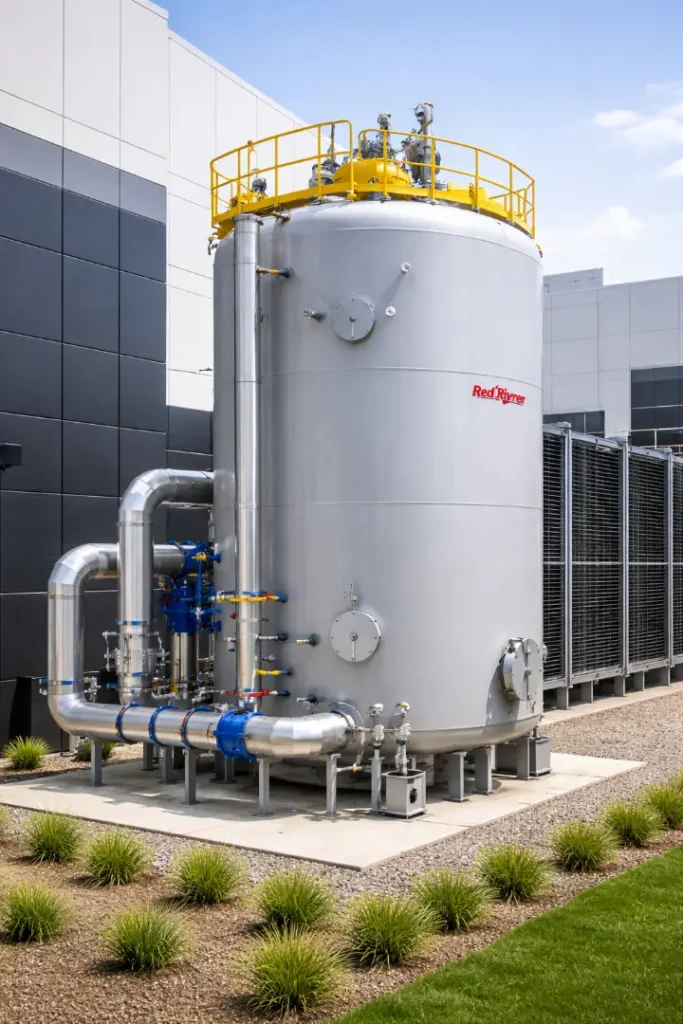
How do you size thermal storage for data centers without undersizing or burning capital? This guide is for data center engineers, facilities managers, and procurement leads, covering the four sizing inputs and a worked example.
Why Sizing Accuracy Matters More Than Ever
Data center cooling loads have climbed fast. High-density AI racks now pull 30 to 80 kilowatts per cabinet, and liquid-cooled GPU clusters can exceed 100 kilowatts. The thermal storage tank that served a traditional colocation facility five years ago is usually undersized for today’s compute density.
Oversizing is not the safe default it used to be. A tank sized for theoretical worst-case load ties up capital, floor space, and piping complexity. A tank sized on rule-of-thumb ratios rather than load data is the most common reason data center cooling fails during the first extended chiller outage.
Red River has fabricated custom thermal storage vessels out of Gillette since 2003. Every build is backed by our ASME U Stamp and NBBI R Stamp certifications. When clients ask how do you size thermal storage for data centers, every project starts with the same four inputs.
The Four Inputs That Drive How Do You Size Thermal Storage for Data Centers
Sizing a thermal storage tank is an engineering calculation, not a lookup table. Four inputs define the required capacity. Miss any one and the result is wrong.
How do you size thermal storage for data centers: peak cooling load
The starting point is the data center’s peak cooling load, measured in tons of refrigeration or kilowatts. For a 5-megawatt IT load, plan on roughly 1,400 tons of cooling at standard efficiency ratios. For liquid-cooled high-density deployments, the ratio shifts closer to one-to-one between IT load and cooling load.
Use measured data if the facility is operational. Use the design day load from the mechanical engineer if the facility is new construction. Never use nameplate chiller capacity as a proxy, because chillers are typically sized with redundancy factored in.
Required ride-through time
Ride-through time is the duration the tank must carry the full cooling load during a chiller outage. Most data centers target 10 to 15 minutes of thermal ride-through, which matches the time needed for chillers to restart after a utility event or for generators to pick up full load.
Mission-critical facilities sometimes spec 30 minutes or more. Edge sites with less redundancy may accept five to seven minutes. The number is set by the facility’s uptime tier and the operator’s risk tolerance, not by the tank fabricator.
Chilled water supply and return temperatures
The temperature differential between supply and return water (delta T) drives the tank’s storage density. A traditional 10-degree delta T needs a larger tank than a 16-degree delta T system to store the same cooling energy.
Modern data center designs push delta T higher to reduce pump energy and shrink the thermal storage envelope. An 18-degree delta T on a chilled water loop can cut tank volume by 30 to 40 percent compared to a 10-degree design.
Stratification efficiency
Thermal storage tanks work by stratifying warm return water at the top and cold supply water at the bottom. The sharpness of that thermocline determines how much of the tank’s nominal volume is actually usable. Well-designed tanks deliver 85 to 95 percent usable capacity. Poorly designed tanks drop to 60 to 70 percent.
Diffuser design, inlet and outlet placement, and tank aspect ratio all affect stratification. A tank that is too squat mixes easily and loses capacity. A tank that is too tall introduces pumping and maintenance complications.
The Sizing Calculation
With those four inputs confirmed, the calculation is straightforward:
Tank Volume (gallons) = (Cooling Load in tons x Ride-Through Minutes x 24) / (Delta T x Stratification Efficiency)
For a 1,400-ton data center with 10-minute ride-through, 14-degree delta T, and 0.90 stratification efficiency:
(1,400 x 10 x 24) / (14 x 0.90) = 26,667 gallons
Round up for freeboard and safety margin, and the design target lands at roughly 28,000 to 30,000 gallons. For a 10-megawatt facility with the same parameters, the tank roughly doubles to 55,000 to 60,000 gallons.
These are working numbers. Accurate thermal energy storage tank sizing should always go through a mechanical engineer with full access to load profiles and operational data.
Tank Geometry and Site Integration
Volume alone does not finish the sizing spec. Three geometry decisions shape how the tank integrates with the facility.
Vertical vs horizontal orientation
Vertical tanks stratify better than horizontal tanks, making them the default choice for data center chilled water storage systems. Aspect ratios between 1:1 and 2:1 (diameter to height) hit the engineering sweet spot for stratification without excessive pumping head.
Horizontal orientation comes into play when height is restricted, such as indoor mechanical rooms or sites with helicopter flight path limits. Horizontal tanks need internal baffling to maintain acceptable stratification.
Indoor vs outdoor placement
Outdoor placement is common for large-capacity installations, and it requires insulation rated for local climate extremes plus freeze protection on piping. Indoor placement simplifies thermal management but consumes floor space that usually commands premium value in a data center.
Modular vs single-tank configuration
For capacities above 50,000 gallons, modular tank configurations often make more sense than a single large vessel. Multiple smaller tanks provide redundancy for inspection cycles, easier transport to restricted sites, and phased installation that matches data center commissioning schedules. See Red River’s modular skid packages for how this approach is structured in practice.
Codes and Certifications That Apply
Data center thermal storage tanks typically operate at atmospheric pressure, placing them under AWWA D100 or API 650 depending on construction method. However, pressurized chilled water loops operating above 15 PSI bring ASME Section VIII requirements into play, requiring a formal ASME Section VIII design and ASME U Stamp.
For any tank tied into a critical cooling loop, specify a fabricator with current ASME U Stamp and NBBI R Stamp certifications even if the current design is atmospheric. Future upgrades to pressurized systems are common, and a non-code tank cannot be retrofitted to code service. Red River’s pressure vessel fabrication covers both atmospheric and ASME-rated thermal storage vessels. Verify active certifications at nationalboard.org.
Ready to Size Your Data Center Thermal Storage Tank?
If you need to confirm how do you size thermal storage for data centers for a new build or expansion, Red River works through load profile, delta T, ride-through time, and tank geometry before the design is locked. Getting it right before fabrication is far less expensive than modifying a completed vessel.
Request a quote or call 1-307-257-5332 to walk through your load data with Red River’s fabrication team.
Frequently Asked Questions
1. What design data sheets are required for thermal storage sizing?
At minimum, provide peak cooling load in tons, chilled water supply and return temperatures, required ride-through time, site location for seismic and wind loads, and chilled water chemistry. For ASME-rated tanks, add design pressure, design temperature, and corrosion allowance.
2. Which codes govern thermal storage design for data centers?
Atmospheric tanks follow AWWA D100 or API 650 depending on construction method. Pressurized systems above 15 PSI fall under ASME Section VIII and require the ASME U Stamp. ASHRAE 90.1 and local mechanical codes also apply to integration with the chilled water loop.
3. Can an existing thermal storage tank be upsized for more capacity?
Usually no. Tank shell thickness, foundation design, and piping connections are sized for the original capacity. Adding a supplementary modular tank in parallel is almost always cheaper than modifying the existing vessel.
4. What materials work best for chilled water thermal storage?
Carbon steel with a two-part epoxy interior coating is the standard. Stainless steel is specified for facilities with water chemistry concerns or longer design life requirements, typically 30-plus years.
5. How long does fabrication take for a data center thermal storage tank?
Standard configurations up to 50,000 gallons run 10 to 14 weeks from purchase order to delivery. Larger or specialized tanks, including ASME-stamped pressure vessels, run 14 to 20 weeks. Rush timelines can be accommodated with design freeze.
Key Takeaways
- Size thermal storage based on peak cooling load, required ride-through time, delta T, and stratification efficiency. Rule-of-thumb gallons-per-ton ratios are not reliable for modern high-density deployments.
- Push delta T as high as the chilled water loop allows to shrink tank volume and reduce capital cost.
- Specify vertical orientation with a 1:1 to 2:1 aspect ratio for best stratification performance.
- Consider modular tank configurations above 50,000 gallons for redundancy and phased installation flexibility.
- Confirm your fabricator carries ASME U Stamp and NBBI R Stamp certifications even for atmospheric tanks, since future code upgrades are common.
Related Blog Post
Condensate Tanks: Types, Fabrication, and ASME Code
Which Tests Validate Deaeration in Pressure Systems?
Equalization Tanks: Design, Sizing, and Fabrication
What Are Thermal Storage Testing Standards for TES Vessels?
What Hydro Tests Are Required for Pressure Vessels?
About Author



