
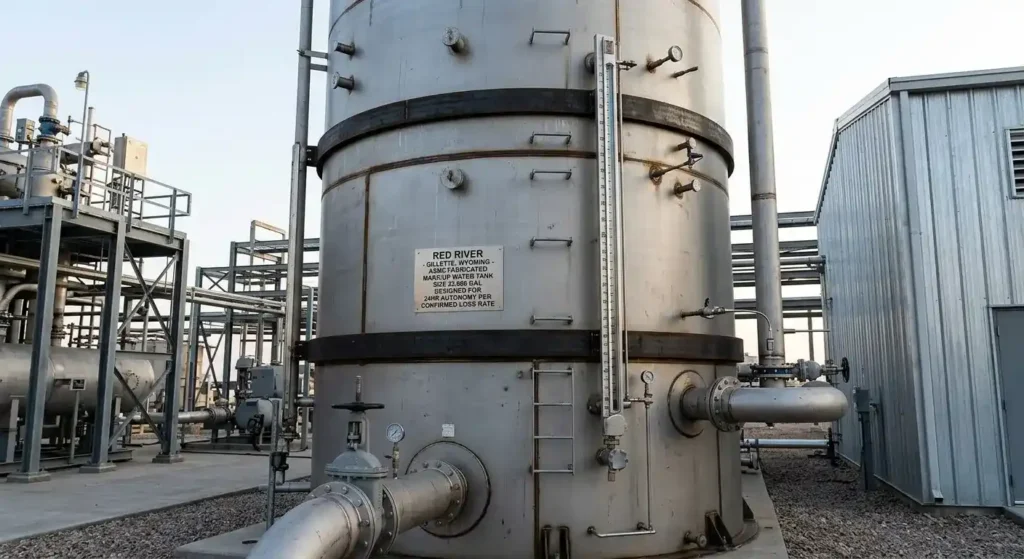
Make-up water tanks should be sized to cover the system’s total daily fluid loss rate multiplied by the required autonomy period in days, plus a reserve margin of 20 to 25 percent above the calculated minimum. The two variables that determine makeup water tank capacity are how fast the system loses fluid and how long the tank must supply makeup water before it is refilled or replenished from the utility supply.
Key Takeaways
- Make up water tank size is determined by the daily fluid loss rate and the required autonomy period. A system losing 200 gallons per day that must run five days between refills needs a minimum of 1,000 gallons of usable storage before the reserve margin is added.
- Makeup water tank capacity should include a 20 to 25 percent reserve margin above the calculated minimum to account for unexpected loss events and unusable dead volume below the pump suction nozzle.
- The four primary sources of fluid loss that drive makeup water storage sizing are evaporation, blowdown, leakage, and maintenance drains. All four must be quantified before the tank size is set.
- When the tank also serves as a chemical feed point, the makeup water tank sizing calculation must include the batch volume needed to treat the loop at the required chemical concentration.
- Industrial makeup water tank sizing for pressurized closed loops must confirm the ASME U Stamp requirement for vessels operating above 15 psig before the fabrication scope is defined.
- Red River fabricates make-up water tanks sized to the confirmed daily loss rate and autonomy period for each specific system from Gillette, Wyoming, since 2003.
How Is Make-Up Water Tank Size Calculated?
The sizing calculation for a make-up water tank follows a straightforward three-step method that converts the system’s fluid loss characteristics into a minimum usable storage volume.
Step 1: Quantify the Daily Fluid Loss Rate
The daily fluid loss rate is the sum of all fluid that leaves the closed loop and is not returned. Evaporation from cooling towers or evaporative surfaces removes water continuously from open circuits. Blowdown from boilers and cooling towers intentionally discharges concentrated water to control dissolved solids and must be replenished with fresh treated water. Leakage at shaft seals, flange joints, and valve packing accumulates over days and weeks. Maintenance drains for equipment service remove larger volumes intermittently. The total daily loss rate is the sum of all four sources at design operating conditions.
Step 2: Determine the Required Autonomy Period
The autonomy period is how long the tank must supply the loop without refill. Systems with continuously available treated water and automatic refill control can use one to two days. Remote systems, infrequently attended facilities, or processes where running dry has serious consequences use five to seven days. Systems where makeup water requires off-site treatment before delivery may size for ten days or more. The autonomy period is a decision about risk, operations frequency, and the consequence of the tank running dry before the next replenishment.
Step 3: Apply the Reserve Margin and Confirm the Vessel Size
The specified makeup water tank volume adds 20 to 25 percent above the calculated minimum to account for flow measurement uncertainty, unexpected high-loss events, unusable dead volume below the outlet nozzle, and chemical feed batch requirements. Red River works through these three steps with clients before the fabrication scope is confirmed, so the vessel that leaves the shop is sized for the actual system. See Red River’s process tank and pressure vessel fabrication scope for how makeup water tank sizing translates into vessel geometry and fabrication scope.
What Do Sizing Examples Show About Make-Up Water Tank Capacity?
Two worked examples show how the daily loss rate and autonomy period combine to set the required makeup water tank capacity.
Example 1: Small Industrial Cooling Loop
A closed process cooling loop loses 50 gallons per day from shaft seal leakage and maintenance drains. The facility operates seven days per week with daily operator attendance. The required autonomy period is two days.
Minimum volume: 50 × 2 = 100 gallons. With 25 percent reserve: 125 gallons. A 150-gallon vessel provides comfortable margin for this application.
Example 2: Remote Process Cooling System
A remote oil and gas process cooling loop loses 150 gallons per day. The location is staffed weekly, requiring seven days of autonomy.
Minimum volume: 150 × 7 = 1,050 gallons. With 25 percent reserve: 1,312 gallons. A 1,500-gallon vessel covers the weekly service interval. Red River’s capabilities cover make-up water vessels at this volume and service condition in both carbon steel and stainless steel. For biogas or remote industrial sites, Red River’s modular skid packages can integrate the make-up water vessel with level controls and make-up pump into a pre-tested assembly.
What Additional Factors Affect Make-Up Water Tank Size?
Two additional factors can increase the required makeup water storage above the baseline loss-rate-times-autonomy calculation.
Chemical Feed Batch Volume
When the make-up water tank also serves as the point of introduction for corrosion inhibitors, biocides, or pH adjustment chemicals, the tank must hold enough treated water to dilute the chemical batch to the correct loop concentration. A full-batch inhibitor addition to a large loop may require the tank to hold the entire loop treatment volume at one time, which can significantly exceed the daily loss volume. Chemical feed batch sizing is confirmed during the engineering review before the vessel volume is finalized.
Seasonal Variation in Loss Rate
Systems exposed to outdoor conditions experience significantly different loss rates in summer versus winter. An evaporative cooling system losing 400 gallons per day at peak summer conditions may lose only 100 gallons per day in winter. Sizing to the seasonal maximum with an autonomy period that reflects seasonal access difficulty produces the correct year-round makeup water tank capacity. Red River’s thermal energy storage and process cooling vessel scope covers seasonal-use make-up water tanks for hydronic and cooling systems.
What ASME Requirements Apply When Sizing a Make-Up Water Tank?
Any make-up water tank operating above 15 psig must be fabricated to ASME BPVC Section VIII, Division 1, by a U Stamp-certified fabricator and registered with the National Board of Boiler and Pressure Vessel Inspectors. The vessel size does not change the code requirement: a 200-gallon pressurized make-up tank carries the same ASME obligations as a 2,000-gallon one.
What ASME Certification Covers
ASME code governs the design calculation, material traceability through certified MTRs, weld joint classification and examination, hydrostatic testing at 1.3 times the MAWP, and the documentation package required for National Board registration. Red River holds active ASME U Stamp and NBBI R Stamp certifications. Every coded make-up water vessel ships with the ASME Form U-1, certified MTRs, weld qualification records, NDE examination reports coordinated through qualified inspection personnel, and the hydrostatic test record.
Atmospheric Tanks and Other Applicable Standards
Atmospheric tanks below the ASME pressure threshold may carry NSF 61, EPA, or local plumbing code requirements for potable water contact or chemical-bearing fluid containment. The applicable requirements are confirmed during the design review before the fabrication scope is set.
Make-Up Water Tanks Sized for Your System From the Start
How big should make-up water tanks be is answered by three numbers: the daily fluid loss rate, the required autonomy period, and the reserve margin. Getting any one wrong produces a vessel that runs dry before the next refill or wastes capital on oversized storage. The sizing belongs in the engineering scope before the vessel is ordered, not in the field after the system is already operating. Red River has fabricated coded make-up water vessels from Gillette, Wyoming, since 2003.
Ready to Confirm Your Make-Up Water Tank Size?
Request a quote or call 1-307-257-5332 to discuss your make-up water tank size, daily loss rate, autonomy period, and fabrication scope with Red River’s team. The sizing review starts before the fabrication scope is defined.
Frequently Asked Questions
1. How Do You Calculate the Size of a Make-Up Water Tank?
Multiply the daily fluid loss rate by the required autonomy period in days to get the minimum usable volume. Add 20 to 25 percent for reserve margin, chemical feed batch requirements, and dead volume below the outlet connection. A system losing 200 gallons per day with a five-day autonomy period needs a minimum of 1,000 gallons plus the reserve, typically a 1,200 to 1,250-gallon vessel.
2. What Is the Autonomy Period for a Make-Up Water Tank?
The autonomy period is how many days the tank must supply makeup water without refill. It depends on operator attendance frequency, the reliability of the treated water supply, and the consequence of the tank running dry. Daily attended systems may use one to two days. Remote or critical systems use five to seven days or more.
3. Should Chemical Feed Requirements Affect Tank Size?
Yes. When the make-up water tank also serves as the chemical dosing point, the tank must hold enough treated water to dilute the chemical batch to the correct loop concentration. This requirement can exceed the daily loss volume for systems with large loop inventories and may be the dominant sizing factor.
4. Does Tank Size Affect Whether ASME Certification Is Required?
No. The ASME certification requirement is triggered by operating pressure above 15 psig, not by tank volume. A 150-gallon pressurized make-up tank requires the same ASME U Stamp certification as a 5,000-gallon one. Atmospheric tanks below the pressure threshold carry other applicable standards.
5. What Is a Typical Make-Up Water Tank Size for an Industrial System?
Industrial makeup water tank sizing spans a wide range. Small process cooling loops typically use 150 to 500-gallon vessels. Mid-size industrial systems commonly use 500 to 2,000 gallons. Large boiler or cooling tower makeup systems may require 2,000 to 10,000 gallons depending on the daily loss rate and autonomy period. Red River fabricates across this full range.
Related Blog Post
Which Materials Suit Make-Up Water Service?
Make-Up Water Tanks: Design, Sizing, and Fabrication
When to Spec Equalization Tanks for Industrial Systems
How Do Equalization Tanks Balance Flow?
What Is an Equalization Tank?
About Author



