
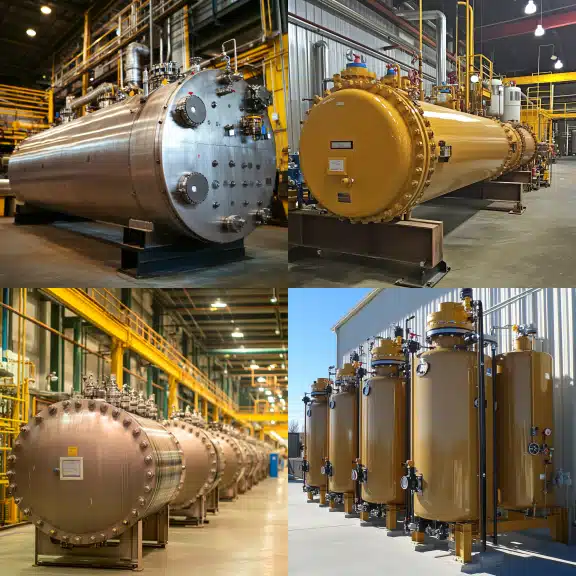
Horizontal separators offer superior liquid-handling capacity, better separation efficiency, and easier maintenance making them ideal for oil-rich flows and large-scale industrial applications. Vertical separators, with their compact design, are better suited for space-constrained environments and high gas-to-liquid ratio scenarios. Choosing the right type depends on your operational goals, flow dynamics, and installation footprint.
The Differences Between Horizontal and Vertical Separators
When it comes to deciding between horizontal and vertical separators, knowledge of their variations is essential. At Red River, we specialize in production pressure vessels, and we recognize that the proper choice can considerably impact your operation’s performance and bottom line. Let’s dive into what horizontal separators offer compared to their vertical counterparts.
Overview of Horizontal Separators
Horizontal separators are designed with a long, horizontal vessel that allows for greater liquid retention time, which is vital in efficiently separating gas, oil, and water levels. One of the key benefits of horizontal separators is their enhanced separation performance. The extended floor area provides more space for the different phases to settle out, resulting in cleaner separation. This makes horizontal separators perfect for operations where liquid handling is a primary concern.
In industries like oil and gas, where precise separation is critical, the horizontal separator’s design can be the best fit. Its shape allows for higher phase separation and flexibility in managing fluctuating flow rates, which are common in industrial processes. For consistent, smooth operation, a horizontal separator may be the ideal solution.
Overview of Vertical Separators
Vertical separators, on the other hand, are compact, cylindrical vessels that are often preferred in space-limited environments. These separators are particularly effective in scenarios with higher gas-to-liquid ratios, making them a popular choice in certain oil and gas operations. However, their design can limit liquid retention time, which may not suit operations with heavy liquid phases.
While vertical separators can be the go-to solution for confined spaces, it’s essential to consider whether they deliver the separation efficiency your process requires. Industries that prioritize footprint over functionality often favor vertical separators, but operational needs must guide the decision.
Horizontal and Vertical Separators: Key Operational Differences
When evaluating horizontal vs vertical separators, several operational differences emerge. Horizontal separators’ larger footprint allows for superior phase separation, especially in liquid-heavy processes. Their design also enables easier inspection and maintenance, which can reduce long-term operational costs. Horizontal units generally handle large liquid slugs better, offering more versatility in dynamic environments.
Vertical separators, with their smaller footprint, excel in limited-space conditions. However, they may require more frequent maintenance due to their design, which can increase long-term operational expenses. Their efficiency in separating liquids from gases may also be lower depending on the application.
Primary Benefits of Horizontal Separators
Enhanced Separation Efficiency
One of the main advantages of horizontal separators is their advanced separation performance. The extended surface area inside the vessel allows for more effective separation of gas, oil, and water, ensuring a cleaner process, which is critical in industries like oil and gas.
Improved Liquid Handling Capacity
Horizontal separators are excellent at handling high volumes of liquid, making them ideal where liquid phase management is crucial. Their design ensures consistent performance even with fluctuating flow rates.
Space and Installation Advantages
While horizontal separators do require a bigger footprint, they provide installation flexibility, especially in environments wherein peak regulations are subject. This makes them a practical desire in facilities with low ceilings or other spatial boundaries.
Maintenance and Operational Cost Savings
Horizontal separators are easier to maintain and inspect, resulting in lower operational costs over time. Routine maintenance is less disruptive compared to vertical separators.
Applications and Industries That Prefer Horizontal Separators
Oil and Gas Industry Use Cases
In oil and gas, horizontal separators are vital for managing the separation of oil, gas, and water phases. Their design ensures superior phase separation, which directly impacts product quality. Horizontal separators are particularly suited for onshore and offshore facilities.
Petrochemical and Refining Applications
The petrochemical and refining sectors rely on horizontal separators for their ability to manage high flow rates and maintain separation integrity under varying operational conditions. They are ideal for processes with multiple liquid phases that demand precise separation.
Other Industrial Applications
Beyond oil, gas, and petrochemicals, horizontal separators are used in wastewater treatment, chemical processing, and power generation. Their robust design and liquid handling capabilities make them a preferred choice wherever effective phase separation is key.
Partner with Red River for Reliable Separator Solutions
Looking for high-performance horizontal or vertical separators tailored to your operation? Red River specializes in design and manufacturing of production pressure vessels, including prefabricated skids and spool packages.
Reach out today to explore solutions that maximize efficiency, reduce maintenance costs, and keep your processes running smoothly. Experience the Red River difference where American-made quality meets dependable service.
Frequently Asked Questions
1. What elements ought to be considered whilst determining among a horizontal and vertical separator?
When deciding between a horizontal and vertical separator, numerous elements ought to be considered, together with the character of the fluid being separated, the space available for setup, and the particular requirements of the procedure. Horizontal separators are generally favored for dealing with big liquid volumes and making sure green separation of gas, oil, and water stages. Vertical separators, on the other hand, are highly desirable for conditions wherein the area is limited and where the gasoline-to-liquid ratio is high. Additionally, the benefit of preservation and long-term operational fees need to be factored into the decision.
2. How does a horizontal separator enhance separation performance compared to a vertical separator?
A horizontal separator improves separation efficiency on the whole via its layout, which gives a bigger surface region and greater liquid retention time. This prolonged place allows for greater powerful settling of various stages, which includes fuel, oil, and water. The result is a cleanser and a greater particular separation process. The ability to address fluctuations in drift fees without compromising the first-rate of separation similarly enhances the efficiency of horizontal separators, making them a favored desire in many commercial applications.
3. In which scenarios may a vertical separator be nicer than a horizontal separator?
Vertical separators may be finer in eventualities in which space is at a premium or where the processing of fluids with an excessive gasoline-to-liquid ratio is needed. Their compact, vertical layout permits them to match into tighter areas, making them ideal for offshore structures or different environments with peak regulations. Additionally, vertical separators can be extra powerful in managing fuel-dominant flows, where the primary task is to split a small amount of liquid from a massive volume of gas.
4. What are the commonplace demanding situations related to the operation of horizontal separators?
While horizontal separators provide many blessings, there are some demanding situations to don’t forget. One commonplace problem is the ability for choppy liquid distribution throughout the separator, which can arise if the float isn’t well managed. This can cause decreased separation efficiency and might require careful layout considerations to mitigate. Additionally, horizontal separators commonly require an extra area for installation, which may be a proscribing component in certain centers. Finally, coping with upkeep for horizontal separators may be greater complex in environments in which admission to the entire vessel is restricted.
5. How do horizontal separators manage fluctuating waft fees?
Horizontal separators are specifically well-ideal to handle fluctuating flow rates due to their layout, which permits better control of large liquid slugs and ranging phase compositions. The horizontal orientation presents a greater area for the levels to split, even if the waft charge changes all at once. This flexibility is a vast advantage in industries like oil and gas, wherein go with the flow prices can vary appreciably at some stage in operation. The ability to hold efficient separation no matter those fluctuations facilitates making sure constant method performance and product excellent.
Key Takeaways
- Horizontal separators offer better separation efficiency and liquid-handling capacity due to larger surface area and retention time.
- They are ideal for liquid-heavy flows in industries like oil & gas, petrochemicals, and water treatment.
- Vertical separators are compact and best suited for space-constrained sites and processes with high gas-to-liquid ratios.
- Maintenance is generally easier and less costly with horizontal separators due to better access and simpler design.
- Choosing the right separator depends on space availability, flow characteristics, separation goals, and long-term operational costs.
- Horizontal units manage fluctuating flow rates more effectively, while vertical units are preferred when footprint limitations are critical.
Related Blog Post
Condensate Tanks: Types, Fabrication, and ASME Code
Which Tests Validate Deaeration in Pressure Systems?
Equalization Tanks: Design, Sizing, and Fabrication
What Are Thermal Storage Testing Standards for TES Vessels?
What Hydro Tests Are Required for Pressure Vessels?
About Author



