

They are the disciplined alignment of accurate process data, correct code selection, suitable materials, credible load combinations, robust welding/PWHT procedures, targeted NDE, thermal and fatigue management, sound support design, clean documentation, and risk-based inspection.
Understanding What are the key factors in pressure vessel engineering
What are the key factors in pressure vessel engineering is more than a checklist; it’s a lifecycle framework that converts process conditions into a safe, code-compliant vessel with audit-ready documentation. Understanding these prevents rework, de-risks fabrication, accelerates approvals, and extends asset life.
Factor 1: Accurate Inputs and Stable Scope
It starts with credible, frozen inputs. Without stable data, every downstream decision is a guess.
Capture the right data (and freeze it):
- Design/operating pressures and temperatures, credible transients (startup, shutdown, cleaning, quench)
- Corrosion allowance and corrosion mechanisms (choosing the right material)
- Fluid properties (phase, density, viscosity, contaminants)
- Cleanliness requirements (sanitary finishes, drainability)
- Documentation deliverables (calculation set, drawings, MDR)
Factor 2: Code Basis and Compliance Path
Selecting and tracing code rules is central to the key factors in pressure vessel engineering and design.
- Choose the governing design-by-rules path and where design-by-analysis is warranted
- Map clauses to calculations, drawings, weld efficiencies, impact testing/MDMT, PWHT rules, and NDE acceptance criteria
- Maintain revision control so documentation always reflects the current state
Factor 3: Materials, Toughness, and Corrosion Strategy
Material choice converts environment and temperature into durability, another pillar of the key factors in pressure vessel engineering.
Select materials that match service:
- Carbon and low-alloy steels for general duty
- Stainless/duplex for chloride exposure and cleanliness
- Nickel alloys for aggressive or high-temperature media
Validate MDMT with toughness data, and at high temperature check time-dependent strength/creep. Linings, overlays, or cladding often beat full-alloy builds. Document hardness controls for sour/hydrogen service.
Factor 4: Load Cases, Stress Categories, and External Pressure
Loads drive thickness and details. Missing one undermines the rest of the key factors in pressure vessel engineering and design.
Compile and combine loads:
- Internal pressure, vacuum/external pressure, deadweight
- Wind/seismic, nozzle loads, thermal gradients
- Test, transport, lifting, settlement
Using finite element analysis or FEA for complex intersections supports the key factors in pressure vessel engineering with quantified margins.
Factor 5: Geometry, Thickness, Heads, and Openings
Turning loads into buildable geometry is where the key factors in pressure vessel engineering become real.
Design choices that matter:
- Head selection for pressure vessels: hemispherical (stress-efficient), 2:1 ellipsoidal (balanced), torispherical (cost-effective)
- Thickness with forming and corrosion allowances considered
- Nozzle reinforcement that accounts for shell contribution, pad effects, spacing interaction
- Flange/gasket selection for seating stress across temperature cycles
Factor 6: Thermal Behavior, MDMT, and Fatigue Life
Temperature is a load. Treating it that way is core to the key factors in pressure vessel engineering.
Design for thermal reality:
- Model ramp rates, mixing, and gradients
- Provide baffles or insulation details to (prefabrication & insulation solutions) limit shock
- Validate MDMT; use impact-tested plate, local thickness, or PWHT as levers
- For cyclic duty, apply permitted fatigue methods and blend transitions/weld toes
Factor 7: Welding, PWHT, and NDE That Find What Matters
Quality is engineered. In practice, the key factors in pressure vessel engineering demands predictable weld integrity and targeted inspection.
Qualify and verify:
- WPS tied to P-/F-Numbers; PQRs for procedure soundness; welder qualifications aligned to essential variables
- Preheat/interpass controls to limit HAZ hardness
- PWHT when required or beneficial for residual stress relief and toughness
- NDE tailored to risk: UT/RT (volumetric), MT/PT (surface), PMI (alloy verification)
Factor 8: Dimensional Control, Tolerances, and Shop Reality
Bridging calculations with fabrication is an unsung part of the key factors in pressure vessel engineering.
- Rolling/out-of-roundness limits, head fit, nozzle projection
- Minimum remaining thickness after forming
- Hold points for forming, fit-up, and critical NDE
- Traceability via heat numbers and weld maps
Factor 9: Proof Tests, Leak Tests, and Safe Procedures
Proving integrity under controlled conditions is integral to the key factors in pressure vessel engineering.
Test with intention:
- Hydrostatic tests: defined pressure, temperature, venting, safety boundaries
- Pneumatic tests: reserved for special cases with strict exclusion zones
- Leak tests (helium/bubble) where tightness is critical
- Calibrated gauges, charts, certificates captured in the turnover package
Factor 10: Supports, Skirts, Saddles, and Foundations
Loads must flow into the ground cleanly; support design is squarely within the key factors in pressure vessel engineering.
Design supports that quietly do their job:
- Skirts sized for overturning; check skirt-to-shell transitions
- Anchor bolts, base ring, grout height coordinated with erection
- Saddle spacing to limit bending; local shell compression checks; wear pads when needed
- Lift lugs and transport saddles defined and verified
Factor 11: Piping Interfaces and External Loads
Interfaces fail when ignored. Early coordination is a hallmark of the key factors in pressure vessel engineering.
Integrate external loads early:
- Request nozzle loads from piping stress analysis
- Reconcile with reinforcement and local stress checks
- Collaborate on routing, spring supports, or flexibility when loads are high
Factor 12: Documentation, Digital Thread, and MDR
If it isn’t traceable, it isn’t done. Documentation discipline anchors the key factors in pressure vessel engineering.
Keep one source of truth:
- Datasheets, calculation files, CAD models, weld maps
- MTRs, NDE reports, heat-treat charts, test records
- Nameplate data and the final MDR (pressure vessel documentation)
Factor 13: Risk-Based Inspection (RBI) and Lifecycle Integrity
Design insights must inform operation. RBI operationalizes the key factors in pressure vessel engineering after handover.
Inspect where risk lives:
- Tie calculated hot spots to inspection points and intervals
- Update plans using field data and condition monitoring
- Focus resources on probability × consequence, not calendars
Factor 14: Cost, Schedule, and Sustainability
Practical constraints are part of the job; integrating them completes the key factors in pressure vessel engineering.
Design for total value:
- Optimize head selection for pressure vessels, nozzle count, and insulation for mass and energy
- Consider materials/consumables with favorable embodied carbon
- Justify life-extension (coatings, CP, selective upgrades) with clear ROI
- Plan make-or-buy and transport constraints early to avoid late surprises
Why RedRiver LLC for turning factors into outcomes
If you’re aligning teams around the head selection for pressure vessel engineering, RedRiver LLC integrates analysis, shop-ready drawings, qualified welding, targeted NDE, disciplined testing, and an audit-ready MDR under one accountable workflow. That integration reduces handoffs, clarifies ownership, and delivers vessels that perform as specified. Learn more: https://www.redriver.team/.
What are the key factors in pressure vessel engineering in closing
Head selection for pressure vessels engineering come down to: accurate inputs, sound code application, materials matched to service, complete load sets, buildable geometry, qualified welding/PWHT, targeted NDE, thermal and fatigue control, credible testing, stable supports, early piping alignment, a clean digital thread, and RBI-driven operations. Apply these consistently and the key factors in pressure vessel engineering become a repeatable recipe for safe startups, smooth audits, and long service life.
Talk to a Vessel Expert
Ready to turn factors into a predictable outcome? Share your datasheet and constraints with RedRiver LLC to receive a practical, code-compliant plan that de-risks delivery, from concept to nameplate, backed by clear schedules and auditable records.
Frequently Asked Questions
1. What is pressure vessel design and engineering?
It’s the lifecycle discipline that converts process conditions into a safe, code-compliant vessel with traceable calculations, shop-ready drawings, qualified welding, targeted NDE, controlled testing, and a complete MDR, exactly the backbone behind in the pressure vessel design factors.
2. How do you design a pressure vessel?
Follow a disciplined sequence: lock inputs; choose the code; size shells/heads; design nozzles and reinforcement; select materials and PWHT; plan NDE; verify supports; execute hydro/pneumatic and leak tests; compile the MDR.
3. How do you design a pressure vessel for external pressure or vacuum?
Treat it as a separate failure mode. Use code charts or FEA for buckling, add stiffeners or thickness as needed, and control test sequences to avoid collapse during proof tests, a critical piece within the key factors in pressure vessel engineering.
4. Where does PWHT fit among the key factors?
PWHT reduces residual stress and can improve toughness. Specify soak temperature/time and controlled heat-up/cool-down with calibrated charts; record everything for the turnover package.
5. How should nozzle loads be handled?
Get piping stress data early, integrate loads into local checks, and collaborate on routing or flexibility (springs, loops) when loads are high.
6. What belongs in a robust MDR?
Calculations, drawings, weld maps, MTRs, WPS/PQR/WPQ, NDE reports, heat-treat charts, test records, and nameplate data, all cross-checked.
Key Takeaways
- Weld quality, PWHT, and targeted NDE translate design intent into real integrity; hydro/pneumatic and leak tests provide proof.
- Supports that quietly carry loads, early piping alignment, and a clean digital thread simplify audits and future changes.
- RBI turns design insights into reliable operation; sustainability and cost are integrated, not afterthoughts.
- RedRiver LLC unifies these factors into an accountable, traceable workflow from datasheet to MDR.
Related Blog Post
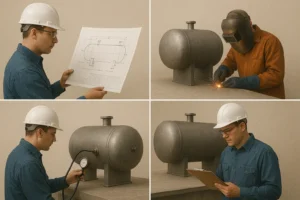
Pressure Vessel Design & Engineering: Concept to Launch

What is Pressure Vessel Design and Engineering: Code-Ready Guide
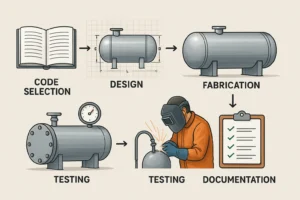
How Do You Design a Pressure Vessel: A Step-By-Step Guide
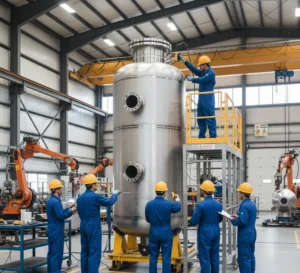
What is Pressure Vessel Fabrication and Manufacturing
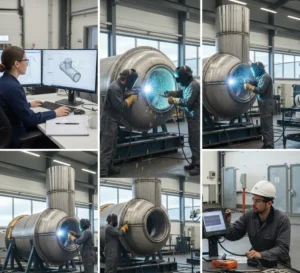
Pressure Vessel Fabrication and Manufacturing: RedRiver LLC
About Author



