Bladder and diaphragm expansion tanks both use a flexible barrier to manage system pressure, but they differ in serviceability, lifespan, and failure cost. This guide breaks down when to specify each type, covering construction differences, failure modes, and sizing considerations for data center HVAC and chilled water applications. Mechanical engineers and procurement managers will leave with a clear framework for making the right call before the spec is locked.
How Bladder and Diaphragm Tanks Differ
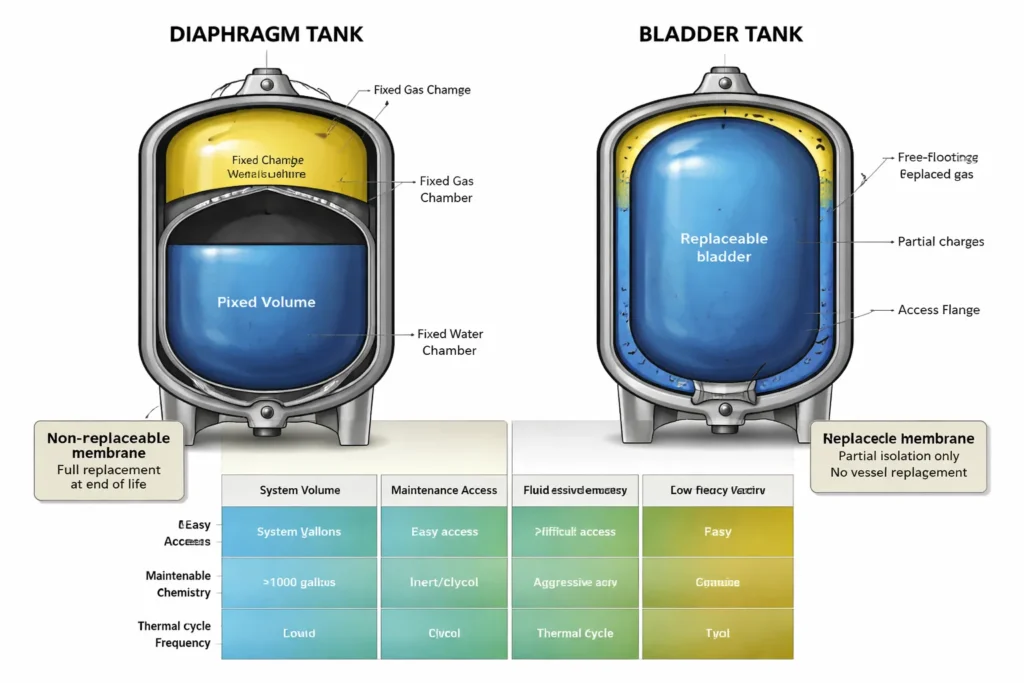
Both tank types use a flexible barrier to separate the pre-charged gas cushion from system water. The difference lies in how that barrier is attached to the vessel.
Diaphragm expansion tanks
Use a membrane bonded or clamped to the interior of the pressure vessel shell. The diaphragm divides the tank into a fixed gas side and a fixed water side. As system pressure changes, the diaphragm flexes moving toward the gas side as water volume increases and toward the water side as volume decreases. Because the diaphragm is permanently integrated into the vessel, it cannot be removed or replaced without destroying the tank. When the diaphragm fails, the entire vessel must be replaced.
Bladder expansion tanks
Use a free-floating rubber bladder inside the pressure vessel shell. The bladder contains the pre-charged gas and is surrounded by the system water on its outer surface. As system pressure changes, the bladder compresses and expands within the shell. Because the bladder is a separate component inside the vessel, it can be removed through an access flange on the tank shell and replaced without replacing the entire vessel. A new bladder restores the tank to full operating condition.
Both types are available in ASME-certified configurations for pressurized chilled water systems. Red River fabricates pressure vessels in both configurations with U-stamp certification, hydrostatic test records, and full material traceability.
When to Choose a Diaphragm Expansion Tank
Diaphragm tanks are the correct choice in four specific scenarios.
Small to medium system volume
For systems with total water volumes below approximately 5,000 gallons, diaphragm tanks in the 5–100 gallon range are the standard specification. At this size, the cost difference between a diaphragm tank and a bladder tank is significant, and the replacement cost of the entire vessel at end of diaphragm life is manageable. The economics favor the simpler, lower-cost diaphragm configuration.
Space-constrained installations
Diaphragm tanks are available in inline configurations that mount directly in the piping without requiring floor space. For data center HVAC rooms where equipment density is high, inline diaphragm tanks provide expansion volume without consuming rack or floor space. Bladder tanks of equivalent volume are floor-mounted vessels that require a dedicated footprint and access clearance.
Lower operating pressure applications
Diaphragm tanks perform reliably at the 50–125 psig operating pressures typical of most chilled water systems. For systems operating above 125 psig where high-pressure diaphragm materials are required, bladder tank configurations may offer better long-term membrane durability.
Predictable replacement cycles
In facilities with structured capital replacement programs, diaphragm tank replacement can be planned as part of the equipment life cycle. A 10–15 year diaphragm service life at standard operating conditions allows facilities to budget for replacement vessels without emergency procurement. For modular chilled water skid packages where multiple small tanks are integrated into a pre-engineered assembly, diaphragm tanks simplify the configuration and reduce connection points.
When to Choose a Bladder Expansion Tank
Bladder tanks are the correct choice when the economics of bladder replacement versus vessel replacement favor the higher upfront cost of the bladder configuration.
Large vessel size
For systems requiring expansion tanks above 100 gallons, common in large data center chilled water plants with system volumes of 50,000 gallons or more, bladder replacement cost is a small fraction of vessel replacement cost. A 500-gallon ASME-certified expansion tank represents a significant capital investment. Bladder replacement at the end of the membrane’s service life costs 10–20% of the vessel replacement cost. Over a 30-year facility life cycle with two or three bladder replacements, the total cost of ownership favors the bladder tank configuration by a substantial margin.
Limited system shutdown access
Bladder replacement can be performed with the system partially pressurized down to fill pressure, a less disruptive maintenance procedure than vessel replacement, which requires complete system shutdown and depressurization. In data centers where planned maintenance windows are limited and cooling system downtime has direct operational cost, bladder replacement with minimal system disruption is a significant operational advantage.
Aggressive fluid chemistry
Systems using high glycol concentrations, low-pH water treatment, or process fluids with elevated chemical aggressiveness degrade membrane materials faster than standard treated water. Bladder tanks allow membrane replacement when the current bladder degrades without replacing the more expensive pressure vessel shell. This is particularly relevant in pharmaceutical and food processing cooling applications adjacent to data center infrastructure.
High-cycle applications
Data centers with highly variable IT loads experience more frequent expansion and contraction cycles than standard commercial cooling systems. Each thermal cycle flexes the membrane. Higher cycle counts accelerate membrane fatigue. In hyperscale data centers where chiller staging occurs multiple times daily, bladder replacement at more frequent intervals is more cost-effective than full vessel replacement on a compressed schedule. For guidance on ASME material requirements for bladder tank pressure vessel shells, Red River evaluates each project’s operating conditions before specifying shell material and bladder compatibility.
The Decision Framework, 5 Questions
The choice between bladder and diaphragm tanks comes down to five questions evaluated against the specific system and facility:
- What is the required expansion tank volume? Below 100 gallons diaphragm tank is typically the cost-effective choice. Above 100 gallons, evaluate bladder tank economics against diaphragm tank replacement cost.
- What is the facility’s maintenance access and shutdown tolerance? Limited maintenance windows and high downtime cost bladder tank’s partial-shutdown replacement procedure is an operational advantage. Planned shutdown windows available; diaphragm tank replacement is acceptable.
- What is the system fluid chemistry? Standard treated water with a maintained inhibitor program, both configurations perform equally. High glycol concentration, aggressive chemistry, or unreliable inhibitor maintenance in the bladder tank allows membrane replacement without vessel replacement when chemistry degrades the membrane faster than expected.
- What is the expected thermal cycle frequency? For standard commercial or industrial cooling with predictable load patterns, the diaphragm tank service life is adequate. Highly variable IT loads or frequent chiller staging, higher cycle counts may favor the bladder tank’s replaceable membrane for long-term cost management.
- What is the installation space available? Space-constrained inline diaphragm tank configurations minimize footprint. Floor space available bladder tank configurations provide full access for bladder replacement without system isolation.
For chilled water system design projects where expansion tank type selection affects the overall system life cycle cost, Red River’s engineering team evaluates all five factors during the specification phase.
ASME Requirements for Both Tank Types
Both bladder and diaphragm expansion tanks operating above 15 psig are pressure vessels under ASME Section VIII Division 1. The shells, heads, nozzles, and pressure-containing welds of both tank types must meet the same ASME fabrication, inspection, and testing requirements.
Shell and head design
Wall thickness calculated from design pressure, material allowable stress from ASME Section II Part D, and vessel geometry. Carbon steel grade SA-516-70 is the standard shell material for both configurations. Stainless steel SA-240 304L is specified where fluid chemistry requires it.
Hydrostatic testing
Both tank types are performed at 1.3 times the MAWP with the bladder or diaphragm installed and the gas side vented to atmosphere. An Authorized Inspector witnesses the test and signs the Manufacturer’s Data Report (Form U-1) before the U-stamp is applied.
Bladder and diaphragm materials
While ASME Section VIII does not directly govern the flexible membrane, manufacturer documentation must confirm compatibility with the system fluid, operating pressure rating, and temperature range. Butyl rubber is the standard bladder material for water service. EPDM and nitrile are specified where glycol or hydrocarbon contamination is possible.
The National Board of Boiler and Pressure Vessel Inspectors maintains registration records for ASME-certified vessels and provides jurisdiction-specific guidance on inspection intervals for expansion tanks in pressurized systems.
ASHRAE provides reference data on expansion tank sizing and membrane compatibility for chilled water system design in the ASHRAE HVAC Systems and Equipment handbook.
Making the Right Choice for Your System
Bladder and diaphragm expansion tanks both control loop pressure reliably when correctly sized and pre-charged. The choice between them is an economic and operational decision not a performance decision.
For small systems below 100 gallons of required expansion volume, diaphragm tanks are almost always the cost-effective choice. For large systems where a single bladder replacement at 15 years costs less than full vessel replacement, bladder tanks deliver lower total cost of ownership over the facility’s service life. For systems with aggressive fluid chemistry or high thermal cycle frequency, bladder tanks provide the maintenance flexibility that diaphragm tanks cannot.
Red River’s engineering team evaluates system volume, operating conditions, fluid chemistry, and maintenance access requirements during the specification phase and recommends the configuration that delivers the lowest total cost of ownership over the facility’s planned service life, not just the lowest upfront equipment cost.
Need a Reliable Partner?
Red River fabricates ASME U-stamp certified bladder and diaphragm expansion tanks for data center HVAC and industrial chilled water systems sized, configured, and documented for each project’s system volume, operating pressure, fluid chemistry, and maintenance requirements. Every tank includes full material traceability, certified weld documentation, and hydrostatic test records. Contact our team to discuss expansion tank type selection and fabrication for your chilled water system.
Frequently Asked Questions
1. What is the main difference between a bladder and a diaphragm expansion tank?
A diaphragm tank uses a membrane permanently bonded to the vessel interior. When the diaphragm fails, the entire vessel must be replaced. A bladder tank uses a removable rubber bladder inside the shell. When the bladder fails, only the bladder is replaced through an access flange, restoring the tank to full operation without vessel replacement
2. At what system size does a bladder tank become more cost-effective than a diaphragm tank?
The crossover point is typically around 100 gallons of required expansion tank volume. Below this size, the diaphragm tank’s lower purchase price and simpler installation outweigh the replacement cost advantage of the bladder configuration. Above 100 gallons, bladder replacement at 10–20% of vessel cost typically produces a lower total cost of ownership over the facility life cycle.
3. Can bladder replacement be performed without a full system shutdown?
Yes. Bladder replacement requires depressurizing the tank to fill pressure and isolating it from the system, not a complete system shutdown and draining. This partial isolation procedure is significantly less disruptive than vessel replacement, which requires full system shutdown, draining, and re-commissioning.
4. Which membrane material is standard for chilled water expansion tanks?
Butyl rubber is the standard bladder and diaphragm material for water and glycol service in chilled water systems. EPDM is specified where higher temperature resistance is needed. Nitrile is used where hydrocarbon contamination from process fluids is possible. All membrane materials should be confirmed compatible with the system fluid before specification.
5. Do both tank types require ASME certification for chilled water systems?
Yes, when operating above 15 psig. Both bladder and diaphragm expansion tanks are pressure vessels under ASME Section VIII Division 1 when installed in pressurized closed-loop chilled water systems. Red River fabricates both configurations with U-stamp certification, Form U-1 documentation, and hydrostatic test records.
6. How long do bladder and diaphragm membranes last in chilled water service?
In standard treated water systems at normal operating pressures and temperatures, both membrane types typically achieve 10–15 years of service life. Systems with high glycol concentrations, aggressive water treatment chemistry, or high thermal cycle frequency experience accelerated membrane degradation, potentially reducing service life to 5–8 years. Fluid chemistry analysis should inform membrane type selection and expected replacement intervals.
7. How do expansion tanks control loop pressure?
Expansion tanks contain a pre-charged gas cushion separated from the system water by a diaphragm or bladder. As water temperature rises and volume increases, the water compresses the gas cushion, absorbing the volume change and preventing pressure from rising beyond the system’s operating range. As the temperature drops, the gas expands and maintains positive pressure throughout the loop.
8. What precharge and rating do expansion tanks need?
Pre-charge pressure must equal the static fill pressure at the tank connection point, the pressure of the water column above the tank at ambient temperature, before system pressurization. The pressure rating must meet or exceed the system’s maximum allowable working pressure. ASME Section VIII Division 1 governs tanks operating above 15 psig; most closed-loop data center systems operate between 50–150 psig.
Key Takeaways
- Diaphragm tanks use a permanently bonded membrane; when it fails, the entire vessel is replaced. Bladder tanks use a removable bladder; when it fails, only the bladder is replaced through an access flange, preserving the more expensive pressure vessel shell.
- Below 100 gallons of required expansion volume, diaphragm tanks are typically more cost-effective. Above 100 gallons, bladder replacement at 10–20% of vessel cost usually produces a lower total cost of ownership over the facility life cycle.
- Bladder replacement requires only partial system isolation, not full shutdown, making bladder tanks the operationally preferred choice in data centers and facilities where cooling system downtime has direct operational cost.
- High glycol concentrations, aggressive water treatment chemistry, and high thermal cycle frequency all accelerate membrane degradation. Bladder tanks allow membrane replacement without vessel replacement when chemistry or cycles reduce service life below the standard 10–15 year range.
- Both bladder and diaphragm expansion tanks operating above 15 psig are pressure vessels under ASME Section VIII Division 1. Red River fabricates both configurations with U-stamp certification, Form U-1 documentation, and full material traceability.
- The membrane material must be confirmed compatible with the system fluid, butyl rubber for standard water and glycol service, EPDM for higher temperatures, and nitrile where hydrocarbon contamination from adjacent process fluids is possible.
Related Blog Post
Which Materials Suit Make-Up Water Service?
How Big Should Make-Up Water Tanks Be?
Make-Up Water Tanks: Design, Sizing, and Fabrication
When to Spec Equalization Tanks for Industrial Systems
How Do Equalization Tanks Balance Flow?
No subpillar set for this blog post.
About Author