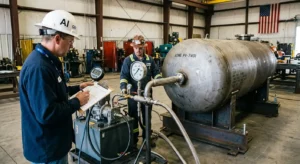
Engineers and procurement teams specifying TES tanks for chilled water systems often don’t know whether ASME Section VIII applies to their application or which division governs the design. Getting this wrong means either over-engineering the tank at unnecessary cost or under-building it in ways that fail inspection. This guide is for mechanical engineers and data center facility managers who need to understand when ASME Section VIII applies to TES tanks, which division is relevant, and what that means for material selection, fabrication, and inspection.
Understanding What ASME Section VIII Applies to TES Tanks in Modern Systems
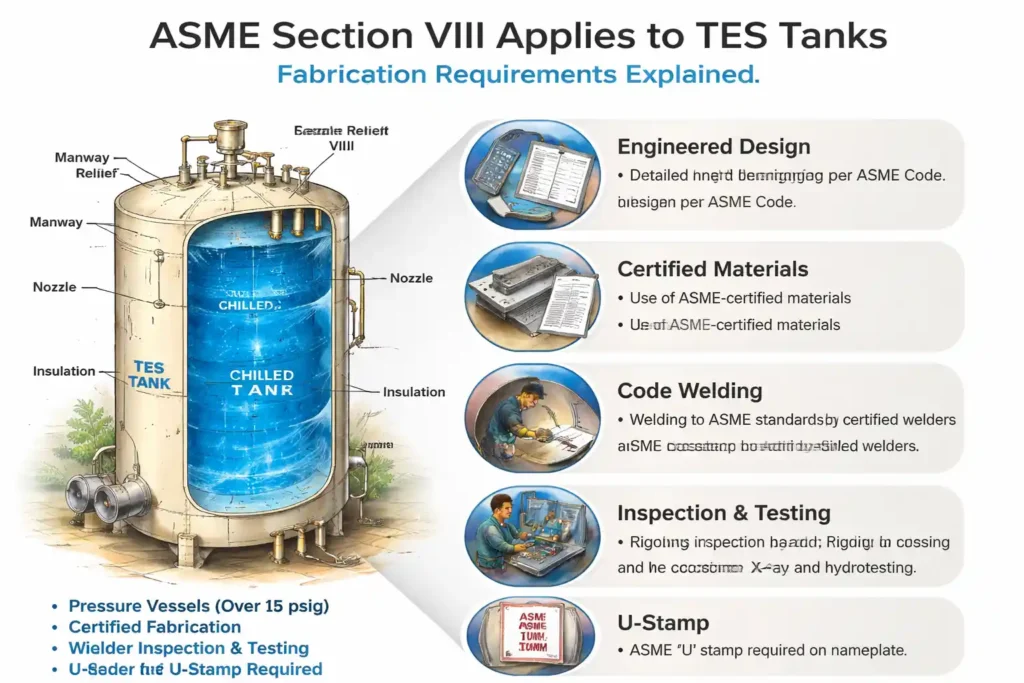
TES tanks that operate above 15 psig internal pressure fall under ASME Section VIII, the primary code governing pressure vessel design and fabrication in the United States. Section VIII is divided into three divisions. Division 1 covers most standard TES tank applications using prescriptive design rules. Division 2 applies when higher pressure ratings or advanced stress analysis are required. Division 3 governs ultra-high-pressure vessels above 10,000 psi, which is rarely relevant to chilled water TES applications. The full code is published by ASME.
Section VIII provides the foundational rules guiding engineers and fabricators on pressure ratings, safety factors, and inspection processes. For TES systems that store chilled water or glycol blends under pressure, it ensures the tank is built to withstand long-term operational stresses.
Many TES systems work directly with Chilled Water Storage Tanks, making ASME compliance even more important. Understanding what a chilled water storage tank is helps explain why code requirements matter these tanks hold large volumes of pre-cooled water for peak cooling needs, and their operating conditions determine whether ASME rules apply. Design must also consider how much volume is needed for chilled water storage, which affects tank size and pressure levels, and which materials suit chilled water service, because the wrong choice can lead to corrosion, early failure, or non-compliance.
Why ASME Compliance Matters for Pressurized TES Systems
TES tanks experience continuous pressure fluctuations as thermal loads shift and chilled water is charged and discharged. Without ASME-governed design, these repeated cycles accelerate fatigue in welds, shells, and nozzle connections. ASME Section VIII sets the allowable stress values, safety factors, and weld quality requirements that ensure structural integrity across the tank’s service life.
ASME Section VIII supports TES tank safety by providing guidance for:
- Pressure integrity during system operation
- Weld quality requirements for structural stability
- Thickness rules to prevent tank deformation
- Inspection processes that verify compliance
- Overpressure protection and design considerations
- Long-term material durability in chilled water environments
These standards protect both the tank and the cooling system it serves.
ASME Requirements for Chilled Water Storage Integration
When TES tanks are integrated with chilled water storage tanks in the same hydronic loop, both vessels may require ASME certification depending on operating pressure. Supply and return temperatures, system pressure, and glycol concentration determine which requirements apply.
Because chilled water may be stored at varying pressures, ASME Section VIII helps define requirements for:
- Shell and head thickness
- Allowable stresses for chosen materials
- Seam welding methods
- Inspection intervals and test processes
- Fabrication quality that protects water purity
- Overall tank design based on system conditions
Revisiting what is a chilled water storage tank in this context makes it easier to identify where ASME standards apply. TES tanks supporting hydronic cooling must withstand constant temperature cycling, and proper design keeps them safe and efficient under repeated thermal transitions.
Material Selection Under ASME Section VIII
ASME Section VIII requires that all materials used in pressure vessel construction appear in the approved material specifications listed in ASME Section II Part D. For TES tanks in chilled water service, the most common approved materials are carbon steel plate grades SA-516 and SA-285, and stainless steel grades SA-240 304L and 316L. Each has an allowable stress value at operating temperature that governs the required shell thickness.
Materials that suit chilled water service typically include:
- Carbon steel with internal protective linings
- Stainless steel for enhanced corrosion resistance
- Alloy materials where water chemistry demands special compatibility
- High-integrity weld materials that maintain bond strength
Knowing which materials suit chilled water service ensures dew-point control, chemical stability, and extended tank life. RedRiver LLC evaluates both application requirements and ASME standards to ensure every TES tank is built with materials that match operational demands.
When Does ASME Section VIII Apply to a TES Tank?
ASME Section VIII Division 1 applies when a TES tank operates above 15 psig internal pressure. Below that threshold, the vessel may be exempt depending on jurisdiction. Most chilled water TES systems operate between 20 and 150 psig well within the Division 1 range. Closed-loop hydronic systems with pressurized expansion are the most common scenario where ASME certification becomes mandatory.
Key factors include:
- Whether the tank will operate under pressure
- The magnitude of operating and design pressures
- The use of chilled water, glycol, or other stored mediums
- Thermal cycling frequency and temperature differentials
- The need for long-term structural reliability
When designing systems, engineers must also evaluate how much volume is needed for chilled water storage, because larger volumes can create greater wall stress if pressurized.
Inspection Requirements for ASME-Certified TES Tanks
ASME Section VIII Division 1 requires hydrostatic testing at 1.3 times the maximum allowable working pressure (MAWP) before a vessel is placed in service. An Authorized Inspector independent of the fabricator must witness key fabrication stages and sign off on the Manufacturer’s Data Report (Form U-1) before the U-stamp is applied. This documentation is what data center operators reference during audits and insurance reviews. The National Board of Boiler and Pressure Vessel Inspectors maintains a registry of certified vessels and inspection agencies.
TES tanks benefit from inspection practices that may include:
- Visual checks for coating integrity and corrosion
- Review of weld conditions and structural connections
- Examination of nozzles, connections, and access points
- Assessment of pressure relief devices
- Evaluation of internal surfaces in chilled water tanks
Consistent inspection supports long-term reliability and keeps cooling systems stable. RedRiver LLC fabricates tanks with inspection access and serviceability built in.
How Red River Builds ASME-Compliant TES Tanks
Red River holds ASME U-stamp certification, meaning our quality control system, welding procedures, and inspection processes have been audited and approved by ASME. Every TES tank we fabricate under Division 1 is documented with a Form U-1 Manufacturer’s Data Report, hydrostatic test records, material certifications, and certified weld procedures the full compliance package needed for commissioning and regulatory compliance.
Partner With Red River for ASME-Certified TES Tank Fabrication
RedRiver LLC provides ASME-certified TES tanks engineered for chilled water storage and thermal energy applications. If your project requires code-compliant fabrication or custom tank engineering, Contact Red River to discuss ASME-certified TES tank fabrication for your facility.
Choosing the Right ASME Division for Your TES Tank Project
For most chilled water TES applications operating above 15 psig, ASME Section VIII Division 1 is the governing standard. It governs the full design and testing process, ending in U-stamp certification. Specifying a tank without ASME compliance creates liability exposure, complicates insurance coverage, and can prevent the system from passing jurisdiction inspection.
Frequently Asked Questions
1. How do TES tanks support data center cooling?
TES tanks store chilled water during low-demand periods and release it when server loads spike, giving chillers time to respond without allowing temperatures to rise to unsafe levels. This stabilizes the cooling loop and prevents thermal overload.
2. Can TES tanks reduce energy costs?
Yes. By storing chilled water during off-peak hours when electricity rates are lower, TES tanks reduce how often chillers run at full capacity during peak periods cutting both energy consumption and demand charges.
3. Which materials are approved for ASME TES tank fabrication?
Materials include carbon steel, stainless steel, and compatible alloys that meet ASME performance standards.
4. How does tank volume affect ASME classification?
Tank size does not determine ASME applicability alone, but larger volumes may increase wall stress if pressurized.
5. Why are TES tanks important in chilled water systems?
TES tanks support thermal stability, reduce load spikes, and provide stored cooling energy for peak periods.
6. Does ASME Section VIII address internal tank coatings?
ASME does not mandate specific coatings but requires materials and fabrication standards that support safe operation.
Key Takeaways
- ASME Section VIII Division 1 applies to TES tanks operating above 15 psig most chilled water systems in the 20–150 psig range fall under this division.
- Division 1 uses a design safety factor of 3.5, prescriptive thickness formulas, and requires hydrostatic testing at 1.3× MAWP before the U-stamp is issued.
- Approved materials under ASME Section II Part D include carbon steel grades SA-516 and SA-285 and stainless steel grades SA-240 304L and 316L material choice determines required shell thickness.
- A Manufacturer’s Data Report (Form U-1) signed by an Authorized Inspector is required for every U-stamped vessel this document is essential for commissioning, insurance, and regulatory compliance.
- Red River holds ASME U-stamp certification and fabricates TES tanks with complete documentation including hydrostatic test records, material certifications, and certified weld procedures.
Related Blog Post
Condensate Tanks: Types, Fabrication, and ASME Code
Which Tests Validate Deaeration in Pressure Systems?
Equalization Tanks: Design, Sizing, and Fabrication
What Are Thermal Storage Testing Standards for TES Vessels?