
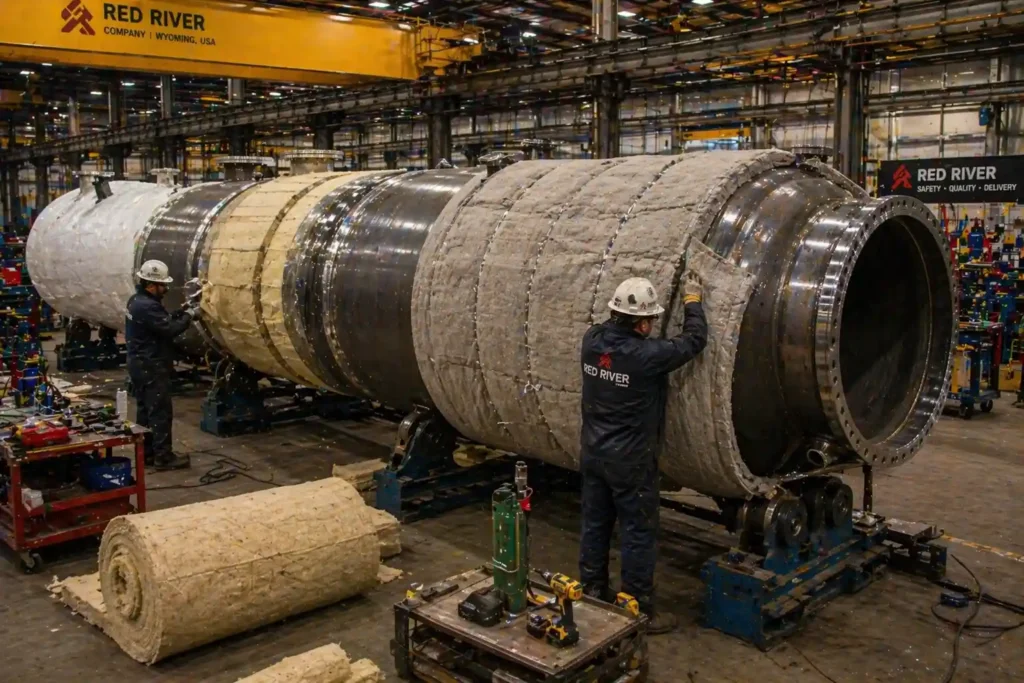
Knowing how to determine insulation thickness requires checking four requirements, not just one temperature reading. This guide is for project engineers and procurement managers who need the key factors and calculation inputs before specifying an industrial insulation system.
Why Insulation Thickness Is Not a One-Size-Fits-All Decision
Two vessels with identical operating temperatures can require very different insulation thicknesses depending on the ambient environment, the insulation material selected, and the surface temperature requirement on the outside of the insulated system.
Insulation on industrial vessels serves multiple functions: conserving heat or cold, protecting personnel from hot surfaces, controlling condensation, and preventing freezing in cold climates. Each function can drive a different minimum thickness, and the governing requirement is the one that produces the greatest thickness.
A system designed only for energy conservation may be under-insulated for personnel protection. A system designed only for personnel protection may be under-insulated for freeze protection in a Wyoming winter. Red River incorporates insulation requirements into the design review for all pressure vessel and prefabrication projects where insulation is part of the scope.
The Key Factors That Drive Insulation Thickness
How to Determine Insulation Thickness: Starting With Operating Temperature
The temperature differential between the process fluid and the ambient environment is the primary driver of heat flow through insulation. A larger differential requires greater thickness to limit losses to an acceptable level.
For hot systems, operating temperature also sets the maximum service temperature the material must withstand. For cold systems, it determines the condensation and freeze risk. Cold vessel insulation must be thick enough to keep the outer surface above the ambient dew point, otherwise condensation forms and degrades insulation over time.
Insulation Material and Thermal Conductivity
Thermal conductivity is the single most important material property in the thickness calculation. Lower conductivity means more effective insulation per unit of thickness.
Mineral wool
Moderate conductivity, suitable for a wide temperature range across oil and gas and power generation applications.
Calcium silicate
Slightly higher conductivity with excellent compressive strength. Preferred for high-temperature applications where the insulation must support mechanical loads.
Cellular glass
Low conductivity with zero water absorption. Preferred for cold and cryogenic systems where moisture ingress is a primary concern.
Aerogel blankets
Very low conductivity allowing thin profiles where space constraints prevent conventional insulation thicknesses.
Material selection affects installed cost, maintenance requirements, and long-term performance. Red River’s fabrication capabilities include insulation material coordination as part of the vessel design process.
Ambient Conditions and Personnel Protection
ASHRAE publishes design ambient conditions widely used as the basis for insulation calculations in the United States. For outdoor installations in Wyoming and the Rocky Mountain region, design ambient temperatures can range from well below zero in winter to above 100 degrees Fahrenheit in summer. Both conditions must be checked.
OSHA and industry guidelines generally require that insulated surfaces accessible to personnel not exceed 140 degrees Fahrenheit on the outer surface. For high-temperature systems, this requirement frequently governs insulation thickness regardless of the energy conservation calculation. A vessel operating at 400 degrees Fahrenheit in an area where workers routinely pass within arm’s reach needs enough insulation to bring the outer surface below 140 degrees Fahrenheit at the design ambient condition.
Vessel Geometry and the Cylindrical Correction
Heat flow through cylindrical vessel shells and pipe systems behaves differently than heat flow through flat surfaces. The cylindrical geometry means the outer surface area is larger than the inner surface area, which affects the effective thermal resistance of the insulation layer.
For large diameter vessels, the cylindrical correction is small and flat-wall approximations are often acceptable. For small diameter pipe, the correction is significant and must be applied correctly. This is one of the more common errors on pipe insulation specifications, and it consistently produces undersized systems when ignored. Red River accounts for these geometry corrections during the design phase for all modular skid packages and pipe spool work.
How the Calculation Works
Knowing how to determine insulation thickness starts with confirming these inputs: operating temperature, design ambient temperature, wind speed, thermal conductivity of the selected material, vessel or pipe outside diameter, and the required outer surface temperature or maximum allowable heat loss rate.
NAIMA publishes calculation tools including the 3E Plus software, a standard reference for pipe and vessel insulation thickness selection. Each applicable requirement is calculated separately and the greatest resulting thickness governs.
Where Insulation Thickness Calculations Go Wrong
Using the wrong ambient design temperature
Specifying insulation for moderate conditions and installing in a location with much colder winters produces a system that does not perform as designed in the actual environment.
Ignoring the cylindrical correction on small pipe
Applying a flat-wall thickness to small diameter pipe underestimates the required thickness. The error grows as pipe diameter decreases.
Selecting material without confirming service temperature limits
An insulation material applied above its rated limit degrades rapidly, loses thermal performance, and can create a safety hazard.
Designing for one requirement and missing another
All four requirements must be checked before the governing thickness is selected. Missing one produces a system that fails in service.
Neglecting thermal bridging at supports and fittings
Vessel saddles, pipe supports, flanges, and valves create thermal bridges that require special detailing. Red River’s prefabrication services include insulation support detailing as part of the skid and vessel design scope.
Get the Insulation Specification Right Before Fabrication
Knowing how to determine insulation thickness before fabrication begins is easier and cheaper than fixing an undersized system after installation. A skid package or custom pressure vessel that leaves the fabrication facility with the wrong insulation thickness creates a field problem that costs more to fix than getting it right the first time. Red River works through insulation requirements as part of the design coordination process for all vessel and skid projects where insulation is in scope.
Ready to Get Your Insulation Thickness Right From the Start?
If you are specifying insulation for a pressure vessel, pipe spool, or modular skid package and need to confirm how to determine insulation thickness for your specific application, Red River works through the requirements before fabrication begins. That means checking all four governing requirements, energy conservation, personnel protection, condensation control, and freeze protection, confirming the right material for the operating conditions, and ensuring nozzle projections, support details, and cladding clearances are built into the fabrication scope from the start.
Getting insulation thickness right at the design stage costs nothing extra. Getting it wrong after installation costs significantly more to fix.
Request a quote or call 1-307-257-5332 to discuss how to determine insulation thickness for your specific project with Red River’s fabrication team.
Frequently Asked Questions
1. What is the standard outer surface temperature limit for personnel protection on hot systems?
The widely referenced limit is 140 degrees Fahrenheit on the outer surface of the insulation. Some owner specifications use lower limits, typically 120 to 130 degrees Fahrenheit, for surfaces in areas with high foot traffic. Always confirm the applicable project specification before finalizing thickness for personnel protection.
2. How does insulation thickness change for outdoor installations in cold climates?
Cold climate installations require checking for freeze protection in addition to energy conservation and personnel protection. The freeze protection calculation determines the minimum thickness needed to keep the process fluid above its freeze point at the design winter ambient with no process flow. For stagnant or intermittently operated systems, this frequently governs.
3. Can the same insulation material be used for both hot and cold systems?
Materials are not interchangeable across all applications. Cellular glass is preferred for cold and cryogenic systems because of its zero water absorption. Calcium silicate is preferred for high-temperature applications because of its compressive strength and service temperature rating.
4. What happens if insulation thickness is undersized on a cold system?
Undersized insulation on a cold system allows the outer surface to drop below the dew point. Condensation forms, migrates into the insulation, and degrades thermal performance over time. In freeze conditions, that moisture can freeze within the insulation layer, causing physical damage.
5. Does Red River supply insulation as part of vessel and skid fabrication?
Insulation scope varies by project. Some clients specify and supply insulation separately, while others include it as part of the fabrication scope. Red River coordinates insulation requirements during the design phase regardless of who supplies the material, so vessel and skid design accounts for insulation thickness, support detailing, and jacketing allowances before fabrication begins.
Key Takeaways
- Insulation thickness is governed by the most demanding of four requirements: energy conservation, personnel protection, condensation control, and freeze protection. All four must be checked and the greatest thickness governs.
- Thermal conductivity of the insulation material is the single most important material property in the thickness calculation. Lower conductivity allows thinner insulation to achieve the same thermal performance.
- Design ambient temperature must reflect actual site conditions, checked for both summer and winter scenarios, not assumed moderate values.
- Personnel protection typically requires the outer insulation surface to stay below 140 degrees Fahrenheit on systems accessible to workers. This frequently governs thickness on high-temperature systems.
- Thermal bridges at supports, flanges, and fittings require special detailing. Standard insulation thickness on straight pipe or vessel shell does not address thermal bridging at these locations.
Related Blog Post
Condensate Tanks: Types, Fabrication, and ASME Code
Which Tests Validate Deaeration in Pressure Systems?
Equalization Tanks: Design, Sizing, and Fabrication
What Are Thermal Storage Testing Standards for TES Vessels?
What Hydro Tests Are Required for Pressure Vessels?
About Author



