
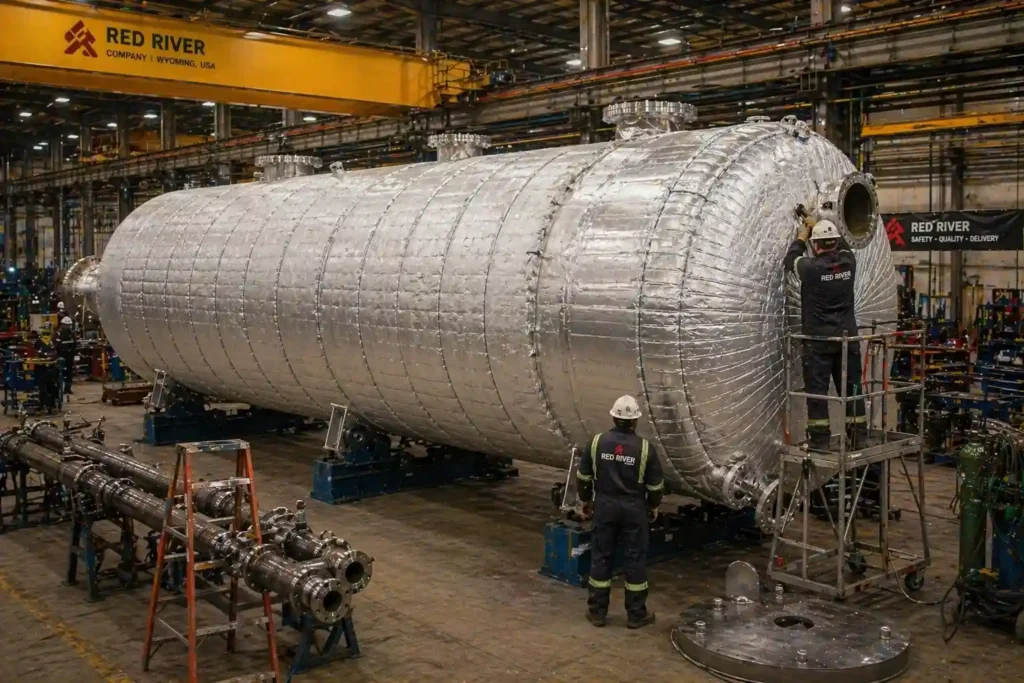
Can insulation improve energy savings on tank projects? Yes, and the calculation is straightforward. This guide is for project engineers and procurement managers specifying industrial insulation systems, covering which applications benefit most and what correct specification looks like.
Why Insulation Matters More Than Most Project Budgets Reflect
Heat loss and heat gain through uninsulated or poorly insulated vessel walls are continuous costs. They show up in fuel consumption, chiller load, process efficiency losses, and in some cases product quality degradation. Unlike a one-time fabrication cost, the energy penalty from inadequate insulation accumulates every hour the vessel is in service.
For a vessel operating at elevated temperature, every degree of heat lost through the shell is energy that has to be replaced by the heating system. For a cryogenic or chilled storage tank, every BTU of heat gained is cooling load that has to be removed. A correctly specified insulation system has a defined upfront cost and a calculable payback period. Many industrial insulation applications pay back the incremental cost within one to three years and continue delivering savings for the life of the vessel.
Red River incorporates insulation planning into the design review for pressure vessel and storage tank projects where thermal performance is a defined requirement. When clients ask whether can insulation improve energy savings on their specific application, the answer starts with the operating conditions and the insulation specification, not a general estimate. The earlier insulation is specified, the better the outcome on both cost and performance.
The Applications Where Can Insulation Improve Energy Savings Most
Can insulation improve energy savings on high-temperature process vessels?
Vessels operating above ambient temperature, including steam drums, hot oil vessels, and reactor vessels, lose heat continuously through the vessel shell and heads if insulation is absent or inadequate. That heat loss is direct fuel cost. Mineral wool and calcium silicate are the most common insulation materials for these applications and perform reliably at sustained temperatures common in oil and gas and power generation environments.
Cryogenic and low-temperature storage tanks
Tanks storing liquefied gases or chilled process fluids face the opposite problem: heat gain from the surrounding environment. Without effective insulation, the heat entering the vessel increases the load on the refrigeration system and in some cases causes boil-off or product loss. Closed-cell foam systems are the primary approach for cryogenic applications, and material selection must account for thermal cycling during filling and draw-down.
Thermal energy storage tanks
Thermal storage systems depend on insulation to maintain the stored temperature differential between charge and discharge cycles. Heat gain into a chilled water storage tank during the discharge period reduces effective cooling capacity when it is needed most. The insulation specification must account for the full operating envelope including standby period and acceptable temperature drift.
Cold climate process storage
In Wyoming and Rocky Mountain operating environments, ambient temperatures drop well below freezing for extended periods. Produced water tanks and process fluid vessels that are not adequately insulated can experience freezing or viscosity changes that disrupt operations and damage equipment. Red River’s prefabrication services incorporate insulation and vapor barrier detailing for cold climate applications as part of the fabrication scope.
What Good Insulation Specification Looks Like
Specify thickness based on calculated heat loss
The correct insulation thickness is a function of vessel operating temperature, ambient design temperature, insulation material thermal conductivity, and acceptable heat loss rate. These inputs are known at the design stage. Using them produces a system that performs to a defined standard. Estimating produces a system that may or may not be adequate.
Select materials compatible with the operating environment
Material selection must account for operating temperature range, moisture exposure, chemical compatibility, and mechanical loads imposed by jacketing systems. A material correct for a high-temperature steam application is not necessarily correct for a cold climate produced water tank.
Design the jacketing and vapor barrier for the installation environment
The insulation material is only one component of the system. The jacketing that protects it from weather and UV exposure, and the vapor barrier that prevents moisture ingress, are equally important. In outdoor industrial installations in Wyoming, aluminum jacketing with sealed laps and properly detailed penetrations is the standard minimum. Red River’s fabrication capabilities include surface preparation, coating application, and insulation detailing all completed under the same quality system that governs vessel fabrication.
Coordinate insulation with nozzle design and access requirements
Nozzles, manholes, instrument connections, and support attachments are all penetrations through the insulation system. Each one must be detailed to prevent thermal bridging and moisture ingress. Red River’s modular skid packages are designed with insulation access and maintenance in mind from the start.
The Hidden Cost of Getting Insulation Wrong
Corrosion under insulation (CUI) is the most serious long-term consequence of a poorly designed insulation system. CUI occurs when moisture penetrates the insulation and contacts the vessel wall, creating a corrosive environment hidden from visual inspection. By the time CUI is detected, wall loss can be significant enough to require vessel repair or replacement.
The other hidden cost is energy drift. An insulation system that performs correctly at commissioning but degrades over time due to moisture absorption or mechanical damage delivers progressively worse thermal performance without triggering an obvious alarm. Regular infrared thermography inspection of insulated vessels identifies degraded areas before the energy penalty becomes significant.
ASTM International publishes widely referenced standards for insulation material testing and performance evaluation that inform both specification and inspection practices. A fabrication project that coordinates insulation at the design stage avoids the field modifications and rework that make correcting insulation in service cost three to five times more than getting it right upfront.
Improve Energy Efficiency Before Fabrication Begins
Insulation is easier to specify correctly at the design stage than to fix after installation. Understanding whether can insulation improve energy savings on a specific project requires knowing the operating temperature, ambient conditions, and acceptable heat loss rate before any plate is cut. Whether the project involves a single custom pressure vessel or a full modular skid package, Red River works through insulation requirements as part of the design coordination process so the vessel and skid design accounts for insulation thickness, support detailing, and jacketing allowances before fabrication begins. Understanding how can insulation improve energy savings on your specific project starts with getting the specification right before any plate is cut.
Ready to Improve Energy Savings on Your Tank Project?
If you are evaluating whether can insulation improve energy savings on a new vessel or storage tank project, Red River works through insulation requirements before fabrication begins. That means calculating correct thickness for the operating conditions, confirming material selection for the environment, and coordinating jacketing and vapor barrier details with the vessel design so every component works together from day one.
Request a quote or call 1-307-257-5332 to discuss how insulation can improve energy savings on your specific project with Red River’s fabrication team.
Frequently Asked Questions
1. What is the most common insulation mistake on industrial tank projects?
Specifying insulation thickness based on rule of thumb rather than calculated heat loss for the specific application. A vessel operating at a different temperature, in a different climate, or with a different process fluid than a previous project may require significantly different insulation to achieve the same thermal performance.
2. What is corrosion under insulation and how is it prevented?
CUI occurs when moisture penetrates the insulation system and contacts the vessel wall, creating a hidden corrosive environment. Prevention requires correct vapor barrier design, properly sealed and lapped jacketing, insulation materials that do not absorb or retain moisture, and a maintenance program that inspects jacketing integrity on a defined schedule.
3. Does insulation affect the ASME pressure vessel design?
Insulation does not change the ASME design directly, but it affects several related decisions. External insulation adds load to support structures and nozzle connections. Insulation thickness affects accessibility for inspection and maintenance. These interactions are best coordinated during the design phase.
4. How often should insulation systems be inspected on operating vessels?
In outdoor or wet environments, annual visual inspection of jacketing integrity is a reasonable baseline. Infrared thermography every two to three years provides a more comprehensive picture of insulation system performance. Vessels in aggressive environments or with a history of CUI should be inspected more frequently.
5. Can Red River assist with insulation specification as part of a fabrication project?
Yes. For projects where thermal performance is a defined requirement, Red River coordinates insulation requirements with vessel design, surface preparation, and coating application. Clients who bring insulation requirements into the design conversation get vessels built to support the insulation system from the start.
Key Takeaways
- Insulation on pressure vessels and storage tanks is a continuous energy cost item. The energy penalty from inadequate insulation accumulates every hour the vessel is in service.
- High-temperature process vessels, cryogenic storage tanks, thermal energy storage systems, and cold-climate process vessels all have distinct insulation requirements that must be addressed at the design stage.
- Insulation thickness should be calculated from defined inputs including operating temperature, ambient design temperature, and acceptable heat loss rate, not estimated from rule of thumb.
- CUI is the most serious long-term consequence of a poorly designed insulation system. Vapor barriers, sealed jacketing, and compatible materials are required elements, not optional upgrades.
- Coordinating insulation requirements with vessel design, nozzle layout, and surface preparation at the fabrication stage produces better outcomes than specifying insulation as an afterthought.
Related Blog Post
Condensate Tanks: Types, Fabrication, and ASME Code
Which Tests Validate Deaeration in Pressure Systems?
Equalization Tanks: Design, Sizing, and Fabrication
What Are Thermal Storage Testing Standards for TES Vessels?
What Hydro Tests Are Required for Pressure Vessels?
About Author



