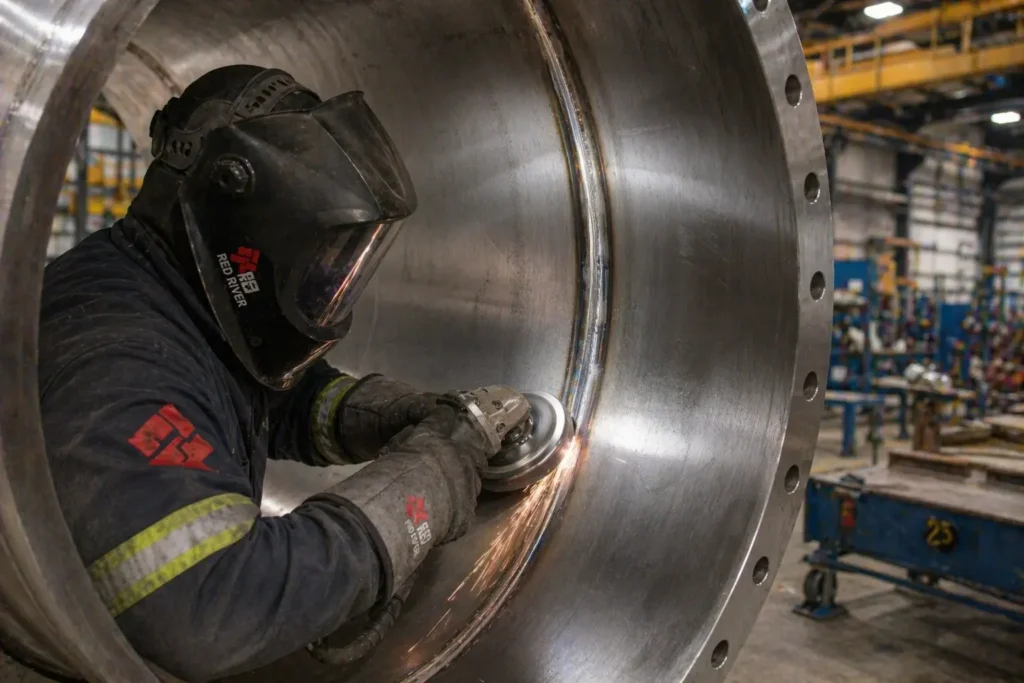
Weld finishing is not a cosmetic step. This guide covers how weld finishing affects cleanliness in pressure vessels and process equipment, which methods apply to which applications, and what happens when finishing is treated as an afterthought.
Why Weld Surface Condition Matters for Cleanliness
A weld bead as it comes off the torch is rarely acceptable for service in a clean process environment. On stainless steel, heat input during welding creates a discolored oxide layer called heat tint that depletes chromium content at the surface and compromises corrosion resistance. That zone is also a site where contaminants, bacteria, and process residues accumulate and resist cleaning.
In carbon steel applications, weld spatter, slag inclusions, and surface irregularities create crevices that trap moisture, accelerate corrosion, and interfere with coating adhesion. A vessel that looks complete but has poorly finished welds has built-in failure points that surface in service, not on the shop floor.
The relationship between weld finishing and cleanliness is direct. A smooth, correctly treated weld surface resists contamination, supports effective cleaning in service, and maintains the corrosion resistance the base material was specified to provide. Red River’s fabrication capabilities treat weld finishing as an integral part of the fabrication scope. The finishing method is specified at the design stage based on application, base material, and the cleanliness requirements the vessel must meet.
The Main Weld Finishing Methods and What They Address
How Weld Finishing Affects Cleanliness: Grinding and Blending
Grinding removes weld crown height, blends the weld profile into the surrounding base metal, and eliminates surface irregularities including undercut, overlap, and spatter. For vessels where coating adhesion is critical, grinding produces the surface profile that coatings require to bond correctly. For sanitary applications, grinding removes macro-level surface features that harbor contamination.
Grinding discs used on stainless steel must be clean and dedicated to stainless only. Cross-contamination from carbon steel grinding media embeds iron particles in the stainless surface, which corrode and defeat the purpose of the finishing work entirely.
Pickling and Passivation
Pickling uses an acid solution, typically a nitric-hydrofluoric acid blend, to chemically remove the heat-affected oxide layer from stainless steel welds. It strips the heat-tinted zone and restores the chromium-depleted surface to a condition where the passive oxide layer can reform. Passivation follows using a less aggressive acid treatment to promote the formation of that protective chromium oxide layer across the entire surface.
Together, pickling and passivation are the standard treatment for stainless steel pressure vessels in chemical, food, pharmaceutical, and biogas applications. ASTM A380 and A967 are the reference standards for passivation work across these industries.
Electropolishing
Electropolishing is an electrochemical process that removes a controlled layer of surface material from stainless steel, producing a smooth, bright, highly corrosion-resistant finish. It removes micro-surface irregularities that mechanical finishing leaves behind and produces a surface that is measurably easier to clean and less susceptible to bacterial adhesion.
Electropolishing is specified for pharmaceutical, biotech, and high-purity process applications where surface roughness values, expressed as Ra in microinches, are part of the equipment specification. It cannot be substituted by mechanical finishing alone.
Abrasive Blasting and Coating Preparation
For carbon steel vessels that will receive a protective coating, abrasive blasting prepares the weld area and surrounding base metal to the surface profile specified for the coating system. SSPC surface preparation standards such as SSPC-SP 6 for commercial blast and SSPC-SP 10 for near-white blast define the cleanliness and profile requirements that coating manufacturers specify for their systems.
Weld seams not properly ground before blasting retain surface irregularities that blasting alone cannot address. The finishing sequence matters: grind first, blast second, coat third. Skipping or reversing any step creates coating failures that begin at the weld. Red River’s abrasives and coatings work follows this sequence on all coated carbon steel vessels, with surface preparation documented as part of the quality record.
Cleanliness Standards That Govern Weld Finishing Requirements
ASME BPE: Sets surface finish requirements for vessels used in pharmaceutical and biotech manufacturing. Defines surface roughness in Ra values and specifies acceptable finishing methods for product-contact surfaces.
ASTM A380 and A967: Cover cleaning, descaling, and passivation of stainless steel for general and specific applications. The reference standards for passivation work on stainless vessels across oil and gas, chemical, and food processing.
3-A Sanitary Standards: Govern equipment used in dairy, food, and beverage production. Weld surface finish requirements under 3-A are specific and measurable. Equipment that does not meet them cannot be certified for regulated food contact applications.
Knowing which standard applies before fabrication begins determines which finishing steps are required and which documentation must accompany the finished equipment.
What Happens When Weld Finishing Is Underspecified
Heat tint left on a stainless steel weld in a chloride-containing environment can initiate crevice corrosion within the first service cycle. In sanitary applications, poorly finished welds fail cleaning validation, resulting in regulatory findings and equipment removal for remediation. In coated carbon steel applications, weld areas not properly prepared are the first places coating failures appear.
Red River incorporates finishing and surface treatment requirements into the fabrication plan for every pressure vessel and modular skid package from the design review stage, not selected after fabrication.
Specify Weld Finishing Before Fabrication Begins
Weld finishing requirements belong in the fabrication specification, not in the punch list. Remediation of poorly finished welds in installed equipment is significantly more expensive and disruptive than correct shop finishing. Red River works through finishing requirements as part of the design coordination process for all vessel and skid projects so the specified method matches the actual service and cleanliness requirements.
Ready to Confirm the Right Weld Finishing Approach for Your Project?
Request a quote or call 1-307-257-5332 to discuss weld finishing requirements with Red River’s fabrication team.
Frequently Asked Questions
1. What is heat tint and why does it matter for cleanliness?
Heat tint is the discolored oxide layer that forms on stainless steel in the heat-affected zone surrounding a weld. It forms when chromium in the stainless alloy oxidizes at elevated temperature, depleting the chromium content at the surface. That depleted zone has reduced corrosion resistance and is more susceptible to contamination and bacterial adhesion than properly finished stainless steel. Pickling removes the heat tint zone and allows the passive chromium oxide layer to reform correctly.
2. Does every pressure vessel require pickling and passivation?
No. Pickling and passivation are required for stainless steel vessels in corrosive, sanitary, pharmaceutical, and high-purity process applications. Carbon steel vessels do not undergo pickling and passivation. The required surface treatment depends on the base material, the service environment, and the applicable industry standard. The fabricator should specify the correct treatment during the design review, not leave it as a post-fabrication decision.
3. What surface roughness is required for sanitary weld finishing?
Requirements vary by standard and application. ASME BPE specifies Ra values for product-contact surfaces in bioprocessing equipment, typically in the range of 25 to 32 Ra microinches for mechanically finished surfaces and finer for electropolished surfaces. 3-A Sanitary Standards specify surface finish requirements for dairy and food contact applications. The applicable standard determines the target Ra value and acceptable finishing methods.
4. Can weld finishing be done after a vessel is installed?
In some cases yes, but it is significantly more difficult, more expensive, and in confined spaces, more hazardous than shop finishing. Interior weld finishing on an installed vessel requires confined space entry, limited tool access, and extended labor hours that far exceed the same work completed in a fabrication shop. Correct shop finishing before shipment is the right approach for every application where cleanliness requirements apply.
5. How does Red River document weld finishing for regulated applications?
Finishing records are included in the vessel documentation package. For stainless steel vessels requiring passivation, Red River documents the passivation procedure, chemical concentrations used, treatment duration, and verification method. For coated vessels, surface preparation is documented against the applicable SSPC standard before coating application begins. These records are part of the permanent quality file that ships with the vessel.
Key Takeaways
- Weld finishing directly affects surface cleanliness by removing heat tint, surface oxides, spatter, and irregularities that compromise corrosion resistance and harbor contamination.
- The correct finishing method depends on the base material, the application, and the applicable cleanliness standard. Grinding, pickling, passivation, electropolishing, and abrasive blasting each address different requirements.
- On stainless steel, heat tint from welding depletes chromium at the surface and must be removed by pickling before passivation can restore the protective oxide layer.
- Cross-contamination from carbon steel grinding media on stainless surfaces is a common finishing error that introduces corrosion sites and defeats the purpose of the finishing work.
- Weld finishing requirements should be specified at the design stage, not addressed after fabrication is complete. Remediation of poorly finished welds in installed equipment is significantly more expensive than correct shop finishing.
- Industry standards including ASME BPE, ASTM A380, ASTM A967, and 3-A Sanitary Standards define measurable cleanliness requirements that weld finishing must satisfy for regulated applications.
Related Blog Post
Can Condensate Storage Improve Reliability?
Where Do Condensate Tanks Fit in a Steam System?
Which Nozzles Simplify Maintenance on Pressure Vessels?
How to Vent Condensate Tanks in Steam Systems
How Do Baffle Layouts Affect Stratification in TES Tanks?
About Author