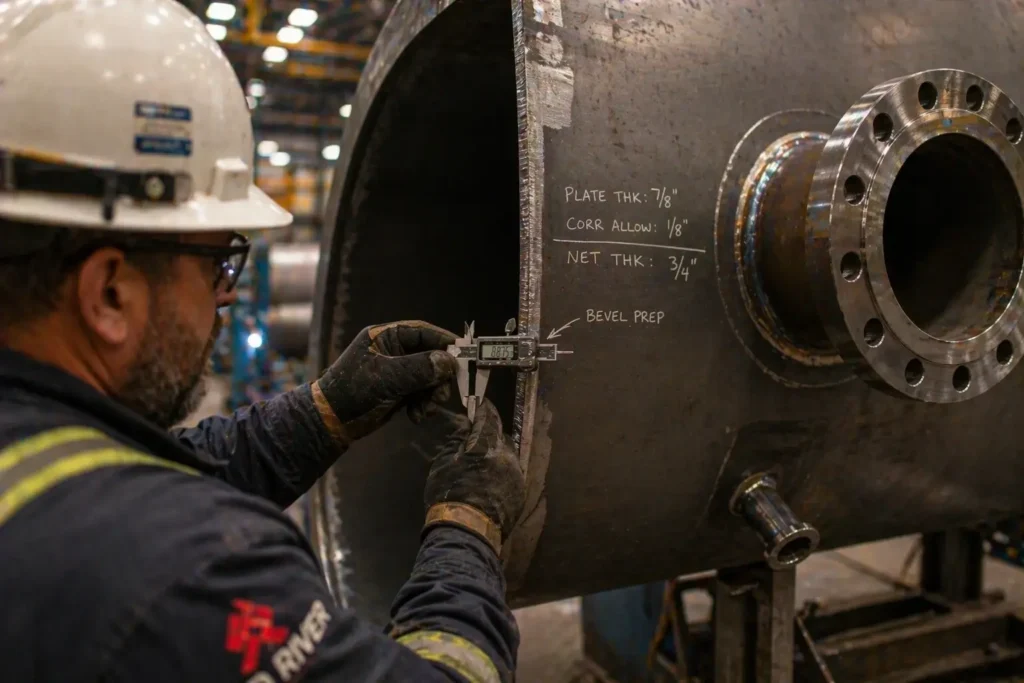
Corrosion allowance is the sacrificial wall thickness, and typical values range from 0.0625 to 0.250 inches, depending on the fluid, temperature, and service life. This guide covers how the number gets selected and what happens when it is set too low.
What Corrosion Allowance Actually Represents
Corrosion allowance is the additional wall thickness added to a pressure vessel beyond what is required for mechanical strength. It is not a structural safety margin. It is sacrificial material, planned and deliberate, intended to be consumed by corrosion over the vessel’s design service life without compromising pressure integrity.
The calculation logic is straightforward. If a vessel is designed for a 20-year service life and the expected corrosion rate is 5 mils per year (0.005 inches per year), the corrosion allowance should be at least 0.10 inches. The vessel starts service with that extra thickness in the wall. As corrosion proceeds, the effective wall thickness decreases toward the minimum required for pressure containment. At the end of the design life, the remaining wall should still meet the minimum thickness requirement.
In practice, corrosion rates are not always known with precision, service environments change, and inspection intervals determine how closely actual corrosion is tracked against the design assumption.
Typical Corrosion Allowance Values by Service
There is no universal standard that mandates a specific corrosion allowance value for all vessels. ASME Section VIII requires that a corrosion allowance be considered but leaves the selection to the designer based on the service environment. What exists in practice is a set of widely applied conventions that experienced engineers use as starting points.
General carbon steel in non-corrosive service: For vessels handling relatively benign fluids such as dry gas, steam, or clean water at moderate temperatures, 0.0625 inches is a common starting point. Some specifications use 0.125 inches as a conservative default where fluid corrosivity is not precisely characterized.
Carbon steel in moderate corrosive service: For vessels handling produced water, dilute acids, wet gas, or other moderately corrosive fluids, 0.125 inches is a typical minimum. Many oil and gas operators specify 0.125 to 0.250 inches for carbon steel vessels in produced water or crude oil service, depending on water cut, hydrogen sulfide content, and operating temperature.
Carbon steel in aggressive corrosive service: High hydrogen sulfide concentrations, high chloride content, or acidic process fluids push corrosion allowances to 0.250 inches or higher. At some point, increasing the allowance on carbon steel becomes less economical than upgrading to a more corrosion-resistant material.
Stainless steel and corrosion-resistant alloys: Often carry a corrosion allowance of zero or a nominal 0.0625 inches. The material itself is selected for corrosion resistance, so the allowance is minimal. This does not mean corrosion is impossible in stainless steel service, but expected rates in the design environment are low enough that a large sacrificial thickness is not warranted.
Red River works through corrosion allowance selection with clients as part of the design review process for every custom pressure vessel project. The number on the data sheet should be defensible, not defaulted.
What Drives Corrosion Allowance Selection
Fluid composition: The corrosivity of the process fluid is the primary driver. Water content, hydrogen sulfide concentration, carbon dioxide partial pressure, chloride levels, pH, and the presence of oxygen all influence corrosion rate. Sour service environments with high H2S content require specific material and corrosion allowance considerations, often governed by NACE International standards.
Operating temperature: Corrosion rates are temperature-dependent. Higher temperatures accelerate most corrosion mechanisms. A corrosion allowance adequate at ambient temperature may be insufficient at elevated process temperatures for the same fluid.
Design service life: A vessel designed for 10 years needs less total corrosion allowance than one designed for 30 years at the same annual corrosion rate. Service life assumptions are sometimes carried forward from one project to the next without being revisited for the actual application.
Inspection intervals: A vessel inspected every two years and retired or relined if corrosion exceeds projections can be designed with a tighter allowance than one operating a decade between inspections. API 510 provides the framework for in-service inspection intervals and minimum remaining thickness calculations that govern ongoing fitness-for-service assessments.
What Happens When Corrosion Allowance Is Set Too Low
Under-specifying corrosion allowance is one of the more common sources of premature vessel retirement in industrial service. A vessel that reaches minimum allowable thickness before its intended service life ends faces three options: continued service with reduced allowable working pressure, repair or relining, or replacement. All three are expensive relative to specifying an adequate allowance at the design stage.
Adding 0.125 inches to the wall thickness of a pressure vessel during fabrication is a modest material cost. Replacing that vessel five years early is not. Wall thinning is typically detected during scheduled inspection through ultrasonic thickness measurement. The vessel is then assessed against its minimum required thickness, and a remaining life calculation determines how much service life is left.
Red River builds corrosion allowance discussions into the early project design conversation for all ASME pressure vessel fabrication work. If a client’s data sheet arrives with a corrosion allowance that does not match the service environment, the team flags it before fabrication begins.
Corrosion Allowance and Material Selection
Corrosion allowance and material selection are related decisions. For aggressive service environments, there are two approaches: use a base material with a generous corrosion allowance, or upgrade to a more corrosion-resistant material with a lower allowance. The right choice depends on the economics of each option for the specific application.
Modular skid packages that incorporate vessels, piping, and instrumentation require a consistent corrosion allowance specification across all pressure-containing components. Mismatched allowances between the vessel and associated piping create inspection and replacement scheduling problems later in the asset’s life.
Corrosion Allowance in the Fabrication Documentation
The corrosion allowance specified on the vessel data sheet must appear in the fabrication documentation. It is recorded on the ASME Manufacturer’s Data Report (Form U-1) and is part of the design basis that the Authorized Inspection Agency reviews during fabrication. It also becomes part of the in-service inspection record, as future thickness measurements are compared against the original design minimum thickness to determine remaining life.
Clients who receive a complete documentation package from Red River get a vessel whose corrosion allowance is traceable from the data sheet through the U-1 report and into the inspection baseline. Red River’s fabrication capabilities and documentation process are built around giving clients the records they need for the full service life of the asset, not just initial commissioning.
Talk to Your Fabricator Before Locking In the Number
Corrosion allowance deserves more attention than it typically gets in the specification process. If your vessel data sheet carries a number carried forward from a previous project, or selected without a review of the actual service environment, it is worth revisiting before fabrication begins. Red River works through corrosion allowance selection as part of the prefabrication design review for every project where the service environment warrants it.
Ready to Review Your Corrosion Allowance Before Fabrication Begins?
Request a quote or call 1-307-257-5332 to discuss what corrosion allowance is typical for your specific service environment with Red River’s fabrication team.
Frequently Asked Questions
1. Is there a minimum corrosion allowance required by ASME?
ASME Section VIII does not mandate a specific minimum corrosion allowance value. It requires that the designer consider corrosion and erosion in establishing the required thickness. The selection is left to engineering judgment based on the service environment. What exists in practice are industry conventions and owner specifications that set minimum values for specific service categories.
2. Can corrosion allowance be added after fabrication if the original allowance was insufficient?
Not directly. Once a vessel is fabricated, the wall thickness is fixed. If the original corrosion allowance proves inadequate, the options are to rerate the vessel to a lower maximum allowable working pressure as the wall thins, apply an internal lining or cladding to reduce the corrosion rate, repair corroded areas under NBBI R Stamp authorization, or replace the vessel. None of these are as cost-effective as specifying the correct allowance at the design stage.
3. How does hydrogen sulfide affect corrosion allowance selection?
Hydrogen sulfide introduces sulfide stress cracking and hydrogen-induced cracking mechanisms that go beyond simple general corrosion. In sour service environments, material selection and heat treatment requirements often govern the design rather than corrosion allowance alone. NACE MR0175 and ISO 15156 define the material requirements for sour service. Simply increasing the corrosion allowance on standard carbon steel is not a complete solution in these environments.
4. What is the relationship between corrosion allowance and vessel inspection intervals?
The corrosion allowance, combined with the actual measured corrosion rate determined during in-service inspections, determines the remaining useful life of the vessel at each inspection point. API 510 provides the calculation methodology for remaining life assessment and maximum inspection intervals. A vessel with a generous corrosion allowance and a low actual corrosion rate will have longer allowable inspection intervals than one with a tight allowance in an aggressive environment.
5. Does Red River recommend corrosion allowances or just fabricate to the client’s specification?
Both. Red River fabricates to the client’s specification when one is provided. When clients come without a defined corrosion allowance or with one that does not appear to match the service environment, the team raises it and works through the selection together. Getting that number right before fabrication begins is in everyone’s interest.
Key Takeaways
- Corrosion allowance is a sacrificial wall thickness added beyond the minimum required for mechanical strength, intended to be consumed by corrosion over the vessel’s design service life.
- There is no single ASME-mandated corrosion allowance value. Selection is driven by fluid composition, operating temperature, design service life, and planned inspection intervals.
- Common starting points are 0.0625 inches for non-corrosive carbon steel service, 0.125 inches for moderate corrosive service, and 0.250 inches or higher for aggressive environments.
- Stainless steel and corrosion-resistant alloy vessels typically carry zero to 0.0625 inches of corrosion allowance because the material itself provides the corrosion resistance.
- Under-specifying corrosion allowance leads to premature vessel retirement. The cost of an adequate allowance at fabrication is almost always less than early replacement or repair.
Related Blog Post
Can Condensate Storage Improve Reliability?
Where Do Condensate Tanks Fit in a Steam System?
Which Nozzles Simplify Maintenance on Pressure Vessels?
How to Vent Condensate Tanks in Steam Systems
How Do Baffle Layouts Affect Stratification in TES Tanks?
About Author