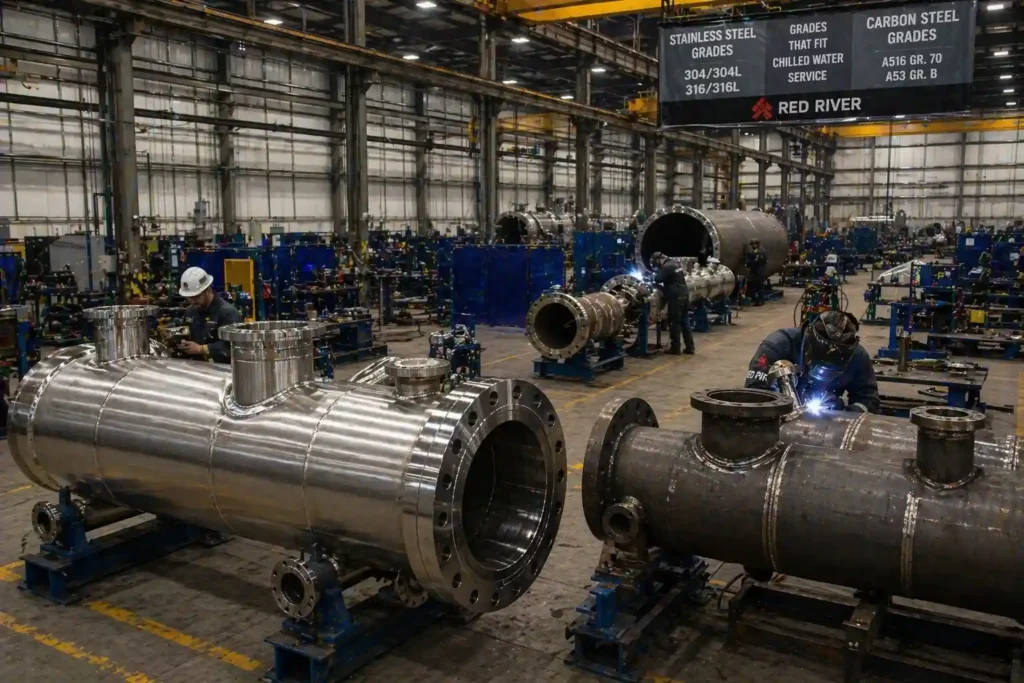
Choosing the wrong material grade for chilled water service leads to corrosion, reduced thermal efficiency, and premature vessel replacement. This guide covers which grades fit chilled water service and what drives the selection between them.
Why Material Grade Matters in Chilled Water Applications
Chilled water systems operate at temperatures typically ranging from 35 to 55 degrees Fahrenheit at relatively moderate pressures. The real challenges come from condensation, oxygen content, water treatment chemistry, and the long service life these systems are expected to deliver.
A vessel that corrodes internally over ten years does not fail dramatically. It degrades gradually, introducing corrosion byproducts, reducing thermal efficiency, and eventually requiring replacement at a cost far exceeding the original material upgrade. The right grade selected at the design stage is almost always less expensive than the wrong grade selected at a lower initial cost. Red River works through material selection as part of the design review for every custom pressure vessel project, addressing chilled water-specific considerations before fabrication begins.
Carbon Steel Grades in Chilled Water Service
SA-516 Grade 70: The most frequently specified grade for chilled water storage tanks. Offers a minimum tensile strength of 70 ksi, good weldability, and broad availability. For chilled water service, SA-516-70 performs well when the internal surface is protected against corrosion through a fusion-bonded epoxy lining, a cementitious lining, or a cathodic protection system. Without internal protection, carbon steel corrodes at a rate that shortens vessel life significantly, particularly where dissolved oxygen is not tightly controlled.
SA-516 Grade 60: Occasionally specified where lower strength is acceptable and improved notch toughness at lower temperatures is a design consideration. For most chilled water applications operating above freezing, Grade 70 is the standard choice.
Any carbon steel vessel in chilled water service should have an internal corrosion protection system specified at the design stage. Red River’s fabrication capabilities include surface preparation and coating application coordination as part of the vessel completion scope. Specifying the lining system after fabrication adds cost and schedule risk that early coordination avoids.
Stainless Steel Grades in Chilled Water Service
304 and 304L: Type 304L is the preferred specification for welded fabrication. Its low carbon content reduces sensitization risk in weld heat-affected zones and suits most chilled water applications where chloride levels are low to moderate. High-chloride environments, including coastal facilities or systems using aggressive water treatment chemicals, can cause pitting and crevice corrosion in 304L that would not occur in a higher-alloy grade.
316 and 316L: Adds molybdenum to the 304L composition, typically two to three percent, significantly improving resistance to chloride-induced pitting and crevice corrosion. For chilled water systems with elevated chloride content, aggressive treatment programs, or coastal installation environments, 316L is the appropriate upgrade. The cost premium is frequently justified by extended service life and reduced maintenance in chloride-present environments. The decision between 304L and 316L should be driven by water chemistry analysis, not budget pressure alone.
Red River fabricates vessels in both 304L and 316L under ASME-qualified stainless welding procedures. Material traceability from mill certifications through final documentation is maintained for every stainless vessel, consistent with the ASME-certified fabrication process.
Duplex Stainless Steel in Chilled Water Service
Duplex grades including 2205 offer higher strength than austenitic grades and superior resistance to chloride stress corrosion cracking. For chilled water applications, duplex is rarely the first choice because operating temperatures and pressures do not typically push austenitic grades to their limits.
Duplex becomes relevant in high-chloride coastal environments, desalination-adjacent applications, or where vessel design pressure is high enough that duplex’s strength allows a meaningful wall thickness reduction. For most conventional chilled water storage and buffer tank applications, 316L covers the corrosion requirement at lower cost. Red River’s modular skid packages can accommodate any of these grades as part of a fully integrated fabricated system.
Key Selection Criteria
Water chemistry and chloride content: The primary driver. Low chloride, well-treated systems call for carbon steel with lining or 304L. Moderate to high chloride calls for 316L. Aggressive chloride with stress corrosion cracking risk calls for duplex or higher alloy.
System glycol content: Glycol-based systems have different material interactions than straight water. Lining selection for carbon steel must account for glycol compatibility with the specific formulation in use.
Expected service life and maintenance cycle: A facility with a rigorous water treatment program and scheduled inspection can manage carbon steel effectively. A facility wanting a lower-maintenance system over 30 years may find the stainless premium justified on a lifecycle cost basis.
Fabrication and delivery schedule: SA-516-70 plate is available from domestic service centers with short lead times. Stainless plate in heavier gauges carries longer procurement lead times that must be factored into the project schedule. Red River’s prefabrication team confirms material availability during the early design phase so the schedule is not caught off guard.
Get the Grade Right Before Fabrication Begins
Material selection is one of the few decisions in a fabrication project that is genuinely difficult to change after the fact. Switching grades after plate is ordered creates cost, schedule, and documentation complications that are entirely avoidable. Red River works through grade selection as part of the early design conversation on every pressure vessel and modular skid project.
Ready to Confirm Which Grades Fit Chilled Water Service for Your Project?
Request a quote or call 1-307-257-5332 to discuss material grade selection with Red River’s fabrication team.
Frequently Asked Questions
1. Can carbon steel be used in chilled water service without a lining?
Technically yes, but it is not recommended for any system where long service life and low maintenance are priorities. Unlined carbon steel in chilled water service corrodes at a rate driven by dissolved oxygen content, water treatment chemistry, and flow velocity. The cost of a lining system at fabrication is significantly less than the cost of internal corrosion remediation five to ten years into service.
2. What water chemistry test results are needed before specifying a stainless grade?
At a minimum, chloride concentration, pH, dissolved oxygen, and total dissolved solids are the parameters most relevant to grade selection between 304L and 316L. If chloride levels are consistently below 200 parts per million in a well-treated system, 304L is typically adequate. Above that threshold, or where treatment consistency is uncertain, 316L is the safer specification.
3. Does the ASME code specify which grades are acceptable for chilled water vessels?
ASME Section VIII Division 1 lists acceptable material specifications including SA-516 for carbon steel plate and SA-240 for stainless plate. The code does not prescribe which grade to use for a specific service. That selection is the responsibility of the design engineer based on operating conditions, fluid chemistry, and applicable industry standards.
4. Is there a cost-effective middle ground between carbon steel with lining and full stainless construction?
Clad plate, which bonds a thin stainless layer to a carbon steel substrate, is used in some applications to achieve corrosion resistance at lower cost than solid stainless construction. For most chilled water vessel sizes, fabrication complexity of clad plate typically makes it less cost-effective than either a lined carbon steel vessel or a straightforward 304L stainless vessel.
5. How does glycol affect material selection for chilled water vessels?
Glycol-based chilled water systems require confirming that the internal lining selected for carbon steel vessels is compatible with the glycol type and concentration. Most epoxy and cementitious linings are compatible with ethylene glycol and propylene glycol at standard concentrations, but this should be verified with the lining manufacturer. For stainless vessels, glycol compatibility is generally not a concern at concentrations used in chilled water systems.
Key Takeaways
- SA-516 Grade 70 carbon steel is the standard grade for chilled water storage vessels and performs well when paired with an appropriate internal lining or corrosion protection system.
- 304L stainless eliminates the internal lining requirement and suits most chilled water applications with low to moderate chloride content.
- 316L stainless adds molybdenum for improved chloride resistance and is the correct choice when water chemistry indicates elevated chloride levels or aggressive treatment chemicals.
- Duplex stainless is rarely required for conventional chilled water service but becomes relevant in high-chloride coastal environments or high-pressure applications where its strength advantage is meaningful.
- Water chemistry, glycol content, design pressure, expected service life, and procurement lead time should all be evaluated together before a grade is specified.
- Material grade selection is one of the few decisions in a fabrication project that is difficult to reverse. Confirm the grade before the plate is ordered.
Related Blog Post
Can Condensate Storage Improve Reliability?
Where Do Condensate Tanks Fit in a Steam System?
Which Nozzles Simplify Maintenance on Pressure Vessels?
How to Vent Condensate Tanks in Steam Systems
How Do Baffle Layouts Affect Stratification in TES Tanks?
About Author