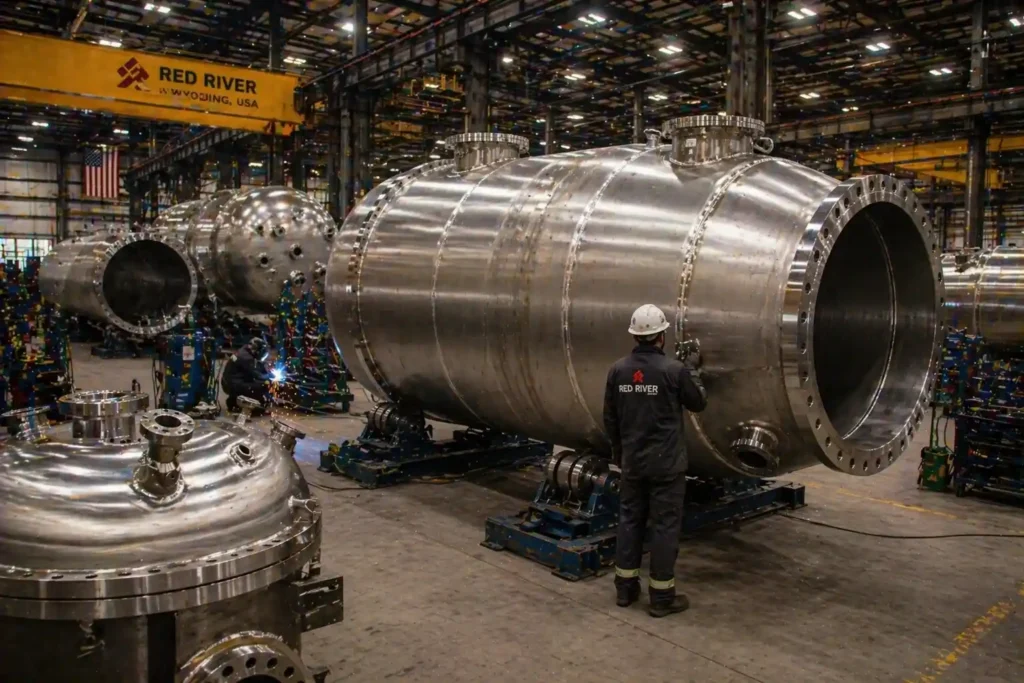
Specifying stainless steel tanks without understanding the grade, surface finish, and fabrication standard your application demands is one of the most expensive mistakes in industrial procurement. This guide covers what buyers, engineers, and project managers need to know before a purchase order is issued.
Why Stainless Steel Tanks Are Specified Over Carbon Steel
Carbon steel is the default material for most industrial pressure vessels and storage tanks. When a project specification calls for stainless steel instead, the reason usually comes down to one of three things: corrosion resistance, cleanliness requirements, or temperature performance.
Stainless steel gets its corrosion resistance from chromium content, which forms a passive oxide layer that resists attack from a wide range of chemicals, gases, and process fluids. In environments where carbon steel would require extensive internal coating systems or accelerated inspection intervals, stainless eliminates or significantly reduces those maintenance requirements.
For food processing, pharmaceutical, biotechnology, and high-purity chemical applications, stainless is specified not just for corrosion resistance but because the material itself does not contaminate the process fluid. At elevated temperatures, certain stainless grades also maintain mechanical properties and oxidation resistance that carbon steel cannot match. Red River fabricates stainless steel pressure vessels and storage tanks for oil and gas, biogas, power generation, and industrial process applications under an active ASME U Stamp certification.
Stainless Steel Grades: Choosing the Right Alloy
304 and 304L: The most widely used austenitic stainless steel. Suitable for mildly corrosive environments and moderate temperature applications. The 304L low-carbon variant reduces sensitization and intergranular corrosion risk in weld heat-affected zones. For most fabricated vessels, 304L is the preferred choice over standard 304.
316 and 316L: Adds molybdenum to the 304 composition, significantly improving resistance to chloride-induced pitting and crevice corrosion. In environments with chloride exposure, including seawater, brine, and many chemical process streams, 316L is the correct specification where 304 would corrode in service.
Duplex stainless steel: Duplex grades including 2205 offer approximately twice the yield strength of standard austenitic grades, allowing thinner wall sections at equivalent design pressures. Provides excellent resistance to chloride stress corrosion cracking. For aggressive chemical or offshore environments, duplex grades are increasingly the preferred specification.
Higher alloy grades: For concentrated acids, high-temperature oxidizing environments, and applications where 316L is insufficient, grades such as 317L, 904L, and super austenitic families provide additional corrosion resistance at substantially higher material cost. These require fabricators with specific welding procedure qualifications for their grade family. Red River’s fabrication capabilities cover standard austenitic grades through duplex materials under the same ASME-certified quality management system.
ASME Fabrication Standards for Stainless Steel Tanks
The ASME Boiler and Pressure Vessel Code applies to stainless steel pressure vessels the same way it applies to carbon steel. For a fabricated stainless vessel to carry the ASME U Stamp, the fabrication shop must hold an active certification, operate under an approved quality management system, and have a commissioned Authorized Inspector on-site during fabrication.
Buyers specifying stainless steel vessels for oil and gas, power generation, chemical processing, and government contracts should require an active ASME U Stamp as a baseline vendor qualification. A shop fabricating stainless steel vessels without ASME certification cannot legally stamp those vessels for most commercial applications.
Material traceability is especially critical for stainless steel. Every plate, fitting, and weld filler must be traceable to a certified mill test report (CMTR) confirming actual chemistry and mechanical properties. Grade mix-ups in stainless fabrication are not always visually detectable. Documented traceability is the only reliable protection against this risk.
Surface Finish Requirements and Why They Matter
Surface finish on stainless steel tanks is a functional requirement, not an aesthetic one. It directly affects corrosion performance, cleanability, and compliance with application-specific standards.
For general industrial service, a mill finish or mechanically polished surface to a defined Ra value is typical. For food, pharmaceutical, and high-purity process applications, surface finish requirements are more stringent and often specified to ASME BPE standards, which define finish grades and electropolishing requirements for wetted surfaces.
Electropolishing removes the outermost layer of the stainless surface, eliminating embedded contaminants and enhancing the passive oxide layer. Internal weld seams require particular attention. Poorly finished internal welds trap contamination, create crevice corrosion initiation sites, and are difficult to clean in service. Internal weld finish requirements must be explicitly specified and verified during fabrication inspection.
Welding Stainless Steel to Code
All welding on ASME-coded stainless vessels must be performed by certified welders using qualified Welding Procedure Specifications (WPS) covering the specific base metal grade, filler metal, and welding process. A WPS qualified for 304L does not automatically cover 316L or duplex grades. Each material family requires its own qualified procedure.
Interpass temperature control is critical for stainless steel. Excessive heat input increases sensitization risk in austenitic grades and can affect the phase balance in duplex grades. Post-weld cleaning, including pickling and passivation, removes heat tint and restores the passive oxide layer in weld heat-affected zones. Red River’s prefabrication and welding processes include post-weld passivation as a standard element of stainless fabrication scope.
Modular Skid Packages in Stainless Steel
Stainless steel vessels are increasingly specified as part of complete modular skid packages that integrate the vessel with stainless process piping, valves, instrumentation, and structural steel, all fabricated and tested as a single unit before delivery.
The advantage of skid fabrication for stainless applications is that all stainless-to-stainless and stainless-to-dissimilar-metal connections are made and inspected in the controlled shop environment rather than in the field. Field welding on stainless piping introduces risks related to contamination, heat control, and post-weld treatment that are significantly harder to manage on a construction site. For biogas, chemical, and pharmaceutical applications where process cleanliness and documentation are critical, skid-mounted stainless systems that arrive pre-tested and passivated are the preferred delivery format.
How to Evaluate a Stainless Steel Tank Fabricator
Qualified WPS documents: Confirm the shop holds qualified Welding Procedure Specifications covering the specific stainless grade being specified. A WPS qualified for 304L does not cover 316L or duplex. Ask whether they have direct experience with your grade family.
Material traceability process: A fabricator who cannot explain how they maintain grade identity and CMTR traceability from material receiving through fabrication is a risk on stainless work where grade mix-ups are not visually detectable.
Complete documentation package: Review a sample documentation package for a completed stainless vessel. It should include CMTRs for all wetted materials, WPS and welder qualification records, NDE reports, passivation records, and the ASME Form U-1. Gaps in any of these represent compliance risk.
Post-weld treatment capability: Confirm that pickling, passivation, and electropolishing where required are performed in-house or under a documented subcontract scope. These steps must be documented and are not optional on stainless work.
Red River’s pressure vessel and skid fabrication work includes stainless-specific process controls as part of the same ASME-certified framework that governs all fabrication work.
Specify Your Stainless Steel Tank Project Correctly From the Start
The wrong grade corrodes in service, surface finish traps contamination and the fabrication standard creates compliance problems that surface during inspection. Red River has fabricated stainless steel pressure vessels and process equipment for demanding industrial applications since 2003, serving clients from startup operators to international energy companies. Whether the project is a single custom stainless vessel or a full modular skid package, the team brings grade selection, surface finish, and documentation requirements into the design conversation at the point where it creates the most value.
Ready to Specify Your Stainless Steel Tank Project?
Request a quote or call 1-307-257-5332 to discuss your stainless steel tank requirements with Red River’s fabrication team.
Frequently Asked Questions
1. What is the difference between 304L and 316L stainless steel for tank fabrication?
Both are low-carbon austenitic grades preferred for welded fabrication. The key difference is molybdenum content. Grade 316L contains two to three percent molybdenum, which significantly improves resistance to chloride-induced pitting and crevice corrosion. In environments with chloride exposure, including produced water, brine, and many chemical process streams, 316L is the correct specification. In environments without significant chloride exposure, 304L provides adequate corrosion resistance at lower material cost.
2. Does Red River fabricate duplex stainless steel vessels?
Yes. Red River fabricates vessels in duplex grades including 2205 for applications requiring higher strength, improved chloride stress corrosion cracking resistance, or reduced wall thickness at equivalent design pressure. Duplex fabrication requires qualified weld procedures specific to the grade and careful heat input control during welding to maintain the correct austenite-ferrite phase balance.
3. What does post-weld passivation involve and why is it required?
Passivation treats the stainless steel surface with a chemical solution, typically citric acid or nitric acid based, to remove iron contamination, heat tint, and surface deposits from welding. This treatment restores and enhances the passive chromium oxide layer that provides stainless steel’s corrosion resistance. In the heat-affected zone of welds where the passive layer is disrupted by thermal cycling, passivation is essential to restoring full corrosion protection.
4. Can stainless steel tanks be fabricated as modular skid packages?
Yes, and for many applications this is the preferred delivery format. Stainless modular skids integrate the vessel, process piping, valves, and instrumentation in the fabrication facility, where stainless welding, inspection, and post-weld treatment can be controlled and documented under the shop quality system. Field welding on stainless piping is significantly harder to control than shop welding, so moving those connections into the shop environment improves quality and reduces installation risk.
5. How does Red River handle stainless steel material traceability?
Every piece of stainless material entering the facility is received against a certified mill test report confirming grade, heat number, chemistry, and mechanical properties. Material is tracked by heat number through cutting, forming, and fabrication. The CMTR for every wetted component ships with the vessel documentation package, providing complete traceability from mill to delivery under the ASME quality management system.
6. What industries does Red River serve for stainless steel tank fabrication?
Red River fabricates stainless steel vessels and skid packages for oil and gas, biogas, power generation, and industrial process applications. Projects range from standard austenitic grades through duplex and higher alloy materials depending on the service environment, serving operators from early-stage startup facilities to international energy companies.
Key Takeaways
- Stainless steel tanks are specified over carbon steel for corrosion resistance, cleanliness requirements, and high-temperature performance. Each driver points to a different grade family.
- Grade selection is the most consequential specification decision: 304L for general service, 316L for chloride environments, duplex for high-strength or stress corrosion cracking applications, and higher alloys for aggressive chemical service.
- ASME U Stamp certification applies to stainless steel vessels the same as carbon steel. Verify active certification before awarding a purchase order.
- Material traceability through CMTRs is the only reliable protection against grade mix-ups in stainless fabrication. Require it as a standard documentation deliverable.
- Surface finish is a functional specification, not an aesthetic one. Internal weld finish, Ra values, and passivation requirements must be explicitly specified and verified during fabrication.
- Modular skid packages in stainless steel move all stainless welding and inspection into the controlled shop environment, reducing field installation risk on cleanliness-critical applications.
Related Blog Post
Can Condensate Storage Improve Reliability?
Where Do Condensate Tanks Fit in a Steam System?
Which Nozzles Simplify Maintenance on Pressure Vessels?
How to Vent Condensate Tanks in Steam Systems
How Do Baffle Layouts Affect Stratification in TES Tanks?
About Author