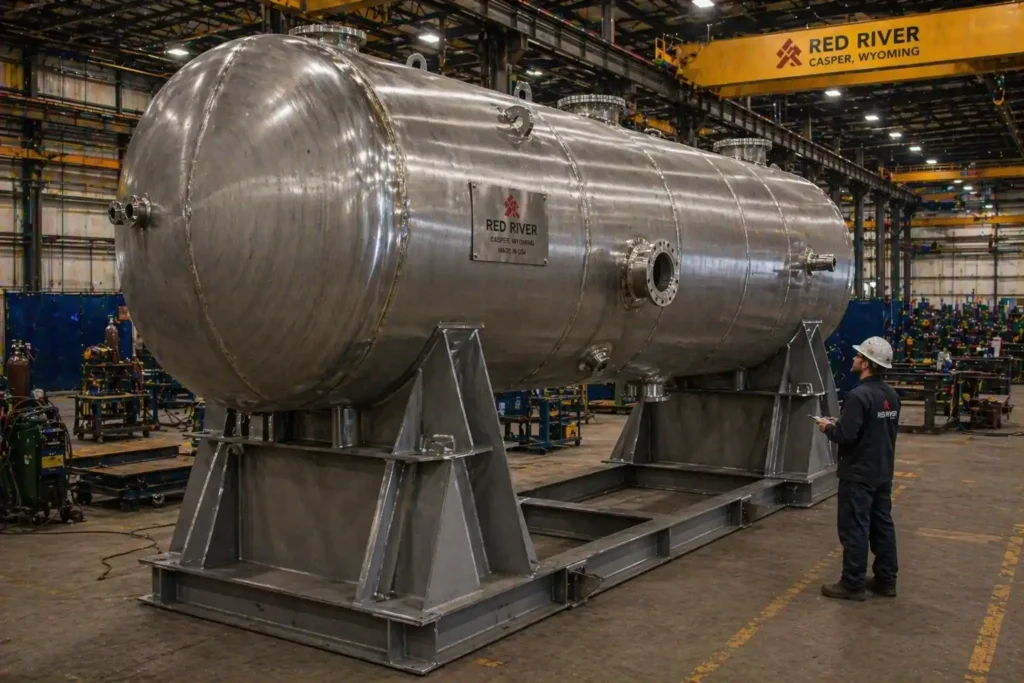
Seismic zone classification is not a checkbox on a design form. This guide covers how seismic zones impact vessel supports, which code requirements drive fabrication scope, and what fabricators need before cutting steel.
What Seismic Zone Classification Actually Determines
Seismic hazard in the United States is mapped and categorized through the International Building Code (IBC) and ASCE 7, which assigns structures to Seismic Design Categories (SDC) A through F based on the site’s mapped spectral acceleration values and the occupancy or risk category of the structure.
For pressure vessels and storage tanks, the seismic design category determines the magnitude of lateral and vertical seismic forces the support structure must resist, the detailing requirements for structural connections and welds, the inspection and testing requirements for support fabrication, and in some cases the anchorage requirements for the vessel’s connection to its foundation.
A vessel installed on SDC A or B faces modest seismic design requirements. The same vessel on a site classified as SDC D, E, or F, which covers much of the western United States including parts of Wyoming, faces substantially more demanding requirements that directly affect the weight, complexity, and cost of the support system. Red River incorporates seismic input requirements into the design coordination process for all prefabrication and vessel support scopes.
How Seismic Forces Are Applied to Vessel Supports
Seismic loading on a pressure vessel is applied as an equivalent static lateral force based on the vessel’s operating weight, center of gravity, site seismic acceleration parameters, and a response modification factor. The resulting forces are applied horizontally and, in higher seismic design categories, vertically as well.
Saddle supports on horizontal vessels: Saddle gusset plates, anchor bolt sizing, and the saddle-to-shell interface all require more detailed analysis and heavier fabrication in higher seismic zones than in low-seismic areas. One saddle is typically fixed and one sliding to accommodate thermal expansion, and the seismic design must account for the force distribution between the two.
Leg and skirt supports on vertical vessels: Vertical vessels present a more complex seismic challenge because their center of gravity is elevated, which increases the overturning moment generated by lateral seismic forces. Leg-supported vessels in high seismic zones frequently require diagonal bracing between legs for lateral resistance. Skirt-supported vessels must have skirt thickness, weld size, and anchor bolt patterns designed for the combined overturning and shear forces at the base.
Skid-mounted systems: Modular skid packages introduce an additional layer of seismic consideration because the vessel, piping, and structural frame are all interconnected. The skid’s structural frame must be designed to transfer seismic loads from the vessel through the frame to the anchor points at the foundation. The connection between the skid and its foundation is a critical seismic detail that must be engineered for the site’s specific SDC requirements.
The Code Requirements That Drive Fabrication Scope
For ASME pressure vessels installed in the United States, the vessel itself is designed under ASME Section VIII, but the support structure is typically designed under ASCE 7 and the applicable building code for the jurisdiction. This split in governing codes is a source of coordination risk on projects where the vessel fabricator and the structural engineer of record are not communicating clearly about interface requirements.
Without the seismic design category, spectral acceleration values, vessel operating weight, center of gravity, and any owner-specified requirements, a support design cannot be code-compliant for the installation site. Clients who provide site classification data early get support designs engineered for the actual environment from the start.
Anchor Bolts and Foundation Interface Requirements
The connection between a vessel support and its foundation is the critical load path for seismic forces. In low-seismic areas, anchor bolt sizing is often governed by operating loads alone. In higher seismic design categories, the anchor bolt pattern, bolt diameter, embedment depth, and edge distance requirements are all driven by seismic overturning and shear forces, which frequently govern over operating loads by a significant margin.
Anchor bolt patterns that do not match the foundation layout require either foundation modification or support redesign, both expensive and time-consuming. Red River’s fabrication capabilities include the dimensional control and documentation infrastructure to meet seismic support requirements across all design categories.
What Seismic Zone Classification Means for Fabrication Quality
Seismic support fabrication requires tighter dimensional tolerances, more detailed weld inspection, and more thorough documentation than standard support work. In higher seismic design categories, structural welds on support elements may require nondestructive examination beyond what is standard for non-seismic applications. Anchor bolt holes must be located to match engineered drawings precisely. Gusset plate geometry and weld sizes must match the structural calculations.
Red River’s pressure vessel fabrication process includes welding qualification, dimensional control, and documentation to meet seismic support requirements across all design categories.
Confirm Seismic Requirements Before Fabrication Begins
Seismic zone classification actively shapes fabrication scope and cost. Getting it wrong creates structural liability that does not show up until the ground moves. Site seismic data must be in the fabricator’s hands before the support design is finalized. Whether the project is a single custom pressure vessel or a complete modular skid package, Red River works through seismic design requirements as part of the early design coordination process so the support system is engineered for the actual installation environment.
Ready to Discuss Vessel Support Design for Your Seismic Zone?
Request a quote or call 1-307-257-5332 to discuss your project’s seismic design category and support fabrication requirements with Red River’s team.
Frequently Asked Questions
1. What is a Seismic Design Category and how is it determined?
A Seismic Design Category (SDC) is a classification assigned to a structure under ASCE 7 based on the site’s mapped seismic hazard and the structure’s risk category. SDC ranges from A (lowest hazard) to F (highest hazard). The classification uses ground motion parameters from the USGS seismic hazard maps for the project’s latitude and longitude, combined with the site’s soil classification. The SDC governs which seismic design and detailing requirements apply to the structure and its supports.
2. Do all pressure vessel installations require seismic design?
Not to the same degree. Vessels installed in SDC A locations face minimal seismic requirements, and standard support designs are typically adequate. Vessels in SDC C through F locations face progressively more demanding requirements for support design, connection detailing, and inspection. The project’s structural engineer of record determines the applicable SDC and resulting design requirements based on the installation site’s location and soil conditions.
3. How does seismic zone affect fabrication cost on vessel supports?
Higher seismic design categories increase fabrication cost through heavier structural sections, more complex connection details, larger weld sizes, additional NDE requirements on structural welds, and tighter dimensional tolerances on anchor bolt layouts. On large vertical vessels in high-seismic zones, the support fabrication cost can be significantly higher than an equivalent vessel in a low-seismic location.
4. Can a vessel be relocated from a low-seismic to a high-seismic site?
Potentially, but the existing support design must be reviewed against the new site’s seismic requirements before relocation. If the original support was not designed for the higher seismic forces at the new location, the support may require modification or replacement. This review should be performed by a structural engineer of record familiar with ASCE 7 requirements.
5. What information does Red River need to fabricate seismic vessel supports?
At a minimum: the site’s Seismic Design Category or the mapped spectral acceleration values and site class, the vessel’s operating weight including contents and insulation, the vessel’s center of gravity at operating conditions, the foundation layout and anchor bolt pattern, and any owner-specified or jurisdiction-specific supplemental requirements. The earlier this information is provided, the more efficiently the support design and fabrication can be coordinated.
Key Takeaways
- Seismic Design Category (SDC), assigned under ASCE 7, determines the lateral and vertical forces vessel supports must resist, the detailing requirements for connections and welds, and the inspection requirements for support fabrication.
- Saddle supports, leg and skirt supports, and skid-mounted systems each have distinct seismic design considerations that must be addressed based on the site’s SDC classification.
- The governing codes for vessel design (ASME Section VIII) and support design (ASCE 7 and local building codes) are different. Coordination between the vessel fabricator and the structural engineer of record is essential to avoid interface gaps.
- Anchor bolt sizing and foundation interface requirements in high-seismic zones are frequently governed by seismic overturning and shear forces, not operating loads. These must be confirmed before fabrication begins.
- Seismic support fabrication requires tighter tolerances, more detailed weld inspection, and more thorough documentation than standard support work. Confirm your fabricator’s capability before awarding the scope.
- Site seismic classification data must be provided to the fabricator early in the design process. Without it, a code-compliant support design cannot be produced for the installation site.
Related Blog Post
Can Condensate Storage Improve Reliability?
Where Do Condensate Tanks Fit in a Steam System?
Which Nozzles Simplify Maintenance on Pressure Vessels?
How to Vent Condensate Tanks in Steam Systems
How Do Baffle Layouts Affect Stratification in TES Tanks?
About Author