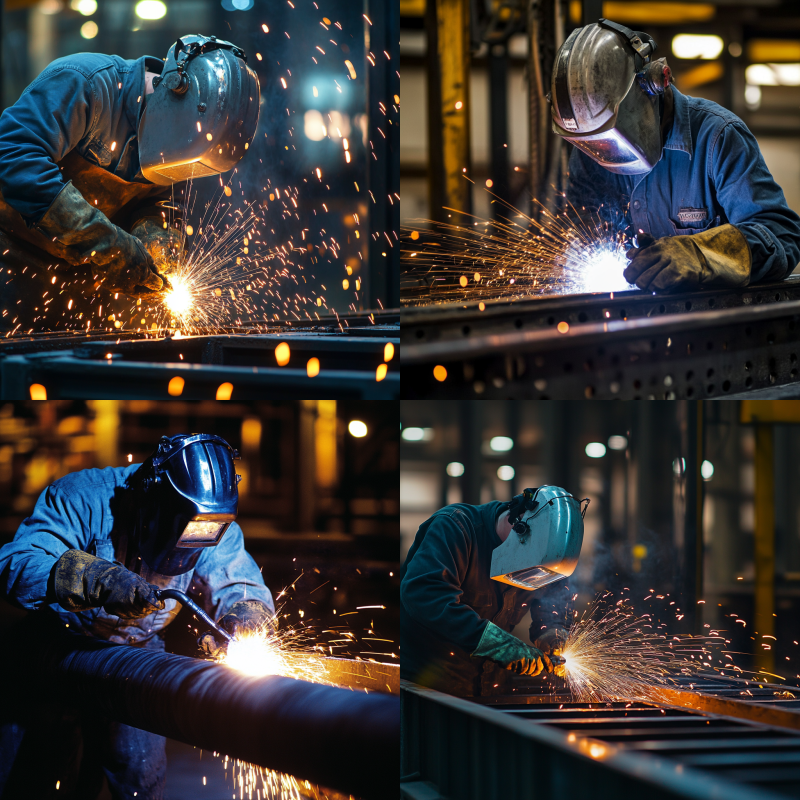
ASME Section IX is the part of the ASME Boiler and Pressure Vessel Code (BPVC) that governs the qualification of welding, brazing, and fusing procedures, and the performance qualification of the welders and operators who carry them out. It does not tell you how to design a vessel. It tells you how to prove that a weld joining that vessel will hold. Any fabricator producing code-stamped pressure vessels, boilers, or piping must qualify its procedures and personnel to Section IX before production welding begins.
Key Takeaways
- ASME Section IX qualifies welding procedures and welder performance. It does not govern vessel design, which falls under Section VIII.
- Three documents carry the qualification: the Welding Procedure Specification (WPS), the Procedure Qualification Record (PQR), and the Welder Performance Qualification (WPQ).
- Section IX is not federal law on its own, but United States regulations including 49 CFR Part 192 and 46 CFR Part 57 adopt it by reference, which makes compliance mandatory in practice.
- A welder stays qualified as long as the process is used within a six-month continuity window, with requalification triggered by changes to essential variables.
- Red River welds to ASME Section IX under its ASME U Stamp certification, with every vessel accepted by an ASME Authorized Inspector.
What Does ASME Section IX Cover?
ASME Section IX covers three things: welding and brazing procedure qualification, welder and operator performance qualification, and the essential variables that determine when either must be requalified. The official scope is published by the American Society of Mechanical Engineers on the BPVC Section IX standard page.
The code sets rules for how a welding procedure is written, how it is proven by destructive testing, and how a welder demonstrates the skill to follow it. Base materials, welding processes such as SMAW and GTAW, filler metals, electrical parameters, preheat, and post-weld heat treatment all fall inside its reach.
What Section IX does not do is set design pressure, wall thickness, or nozzle reinforcement. Those are Section VIII requirements. The two sections are read together on every code vessel.
What Is the Difference Between a WPS, a PQR, and a WPQ?
These three documents answer three different questions. The WPS says how the weld will be made. The PQR proves the weld works. The WPQ proves the welder can make it.
| Document | What It Is | What It Proves |
| WPS (Welding Procedure Specification) | The written instruction for the weld, covering base metal, process, filler, amperage, voltage, preheat, and heat treatment | That a repeatable, documented method exists |
| PQR (Procedure Qualification Record) | The test record supporting the WPS, including tensile, bend, and impact results | That the method produces welds with acceptable mechanical properties |
| WPQ (Welder Performance Qualification) | The individual welder’s qualification test record | That a specific welder can execute the WPS in production |
A WPS with no supporting PQR is not a qualified procedure. A qualified procedure welded by an unqualified welder is not code compliant. Both halves are required.
Is ASME Section IX Legally Required?
ASME Section IX is a consensus standard, not a statute, but it is adopted by reference into United States federal regulation, which gives it legal force in most industrial contexts. Federal rules covering welded pipelines and marine boilers, including 49 CFR Part 192 and 46 CFR Part 57, incorporate Section IX directly.
Beyond regulation, the National Board Inspection Code and most state jurisdictions rely on ASME qualification, and owner or EPC contracts routinely specify it. For anyone fabricating a code-stamped vessel, the practical answer is that Section IX compliance is not optional.
Which Industries Depend on ASME Section IX?
Any industry that contains pressure inside welded steel depends on Section IX. Three are the most heavily represented:
- Power generation: Boilers and steam systems run at high temperature and high pressure, where a weld defect becomes a failure mode rather than a repair item.
- Oil and gas: Separators, treaters, scrubbers, and process piping carry flammable and pressurized media where leak paths are unacceptable.
- Manufacturing and processing: Chemical, food, and pharmaceutical vessels must satisfy both code and client quality requirements before they can be put into service.
How Does Red River Apply ASME Section IX?
Red River holds the ASME U Stamp and fabricates pressure vessels, pipe spools, and modular skid packages to qualified procedures under Section IX. Welding procedures are qualified before production, welder continuity is tracked, and every completed vessel is reviewed and accepted by an ASME Authorized Inspector.
Material Test Reports and quality control documentation travel with every vessel Red River delivers, and the company coordinates and manages nondestructive examination documentation as part of the closeout package. That paperwork is what an owner’s engineer or a jurisdictional inspector actually asks for when the vessel arrives on site. You can review the full scope on the Red River capabilities page or the pressure vessel fabrication page.
What Happens When Section IX Is Ignored?
Unqualified welding is the fastest route to a rejected vessel. Weld rejections mean rework, rework means schedule slip, and a vessel without a valid WPS, PQR, and WPQ trail cannot receive an ASME Authorized Inspector’s acceptance. The cost is rarely the weld itself. It is the project delay behind it.
Conclusion
ASME Section IX is the proof layer of pressure vessel fabrication. Section VIII decides what the vessel must be. Section IX decides whether the welds holding it together were made by a qualified procedure and a qualified welder, and whether there is documentation to prove it. Buyers who understand the difference ask better questions of their fabricators and get better vessels back.
Work With an ASME Certified Fabricator
Red River has fabricated ASME code pressure vessels from Gillette, Wyoming since 2003, shipping coast to coast by direct heavy haul freight with full Material Test Report and quality control documentation on every unit. Welding procedures are qualified to ASME Section IX, welders are qualified to them, and an ASME Authorized Inspector signs off before anything leaves the shop.
Send drawings or a specification through the Red River quote request and an engineer will review scope, code requirements, and lead time with you directly. You can also call 1-307-257-5332 or reach the team through the Red River contact page.
Frequently Asked Questions
1. What does ASME Section IX cover?
ASME Section IX governs the qualification of welding, brazing, and fusing procedures and the performance qualification of welders and operators. It defines the requirements for the Welding Procedure Specification, the Procedure Qualification Record, and the Welder Performance Qualification. It applies to welding on pressure vessels, boilers, and piping systems built to ASME code.
2. Who has to comply with ASME Section IX?
Manufacturers, fabricators, welding engineers, quality assurance personnel, and welders working on code-stamped pressure equipment must comply. Subcontractors and third-party vendors welding under an ASME code stamp are held to the same standard. Authorized Inspectors verify that compliance before a vessel is accepted.
3. How long does a welder qualification last under Section IX?
A welder qualification has no fixed expiration date, but it lapses if the welder does not use the qualified process within a six-month period. Continuity records are what keep the qualification active. A change in essential variables such as material group, thickness range, or position can require requalification.
4. What is the difference between ASME Section VIII and ASME Section IX?
Section VIII governs the design, materials, and construction requirements for pressure vessels, including allowable stress and thickness calculations. Section IX governs how the welds on those vessels are qualified and who is qualified to make them. A code vessel must satisfy both.
5. Is ASME Section IX recognized outside the United States?
Yes. ASME Section IX is used internationally and is frequently specified by multinational engineering, procurement, and construction firms even in regions with their own local codes. Its global acceptance is one reason ASME qualification supports cross-border projects and export work.
6. Where can welders get trained on ASME Section IX?
Training is available through accredited technical institutions, industry bodies such as the American Welding Society, and private code training providers. Courses typically cover WPS and PQR preparation, essential and nonessential variables, and code interpretation. Red River welders are qualified in house to the procedures used on Red River work.
Related Blog Post
Condensate Tanks: Types, Fabrication, and ASME Code
Which Tests Validate Deaeration in Pressure Systems?
Equalization Tanks: Design, Sizing, and Fabrication
What Are Thermal Storage Testing Standards for TES Vessels?
What Hydro Tests Are Required for Pressure Vessels?
No subpillar set for this blog post.
About Author