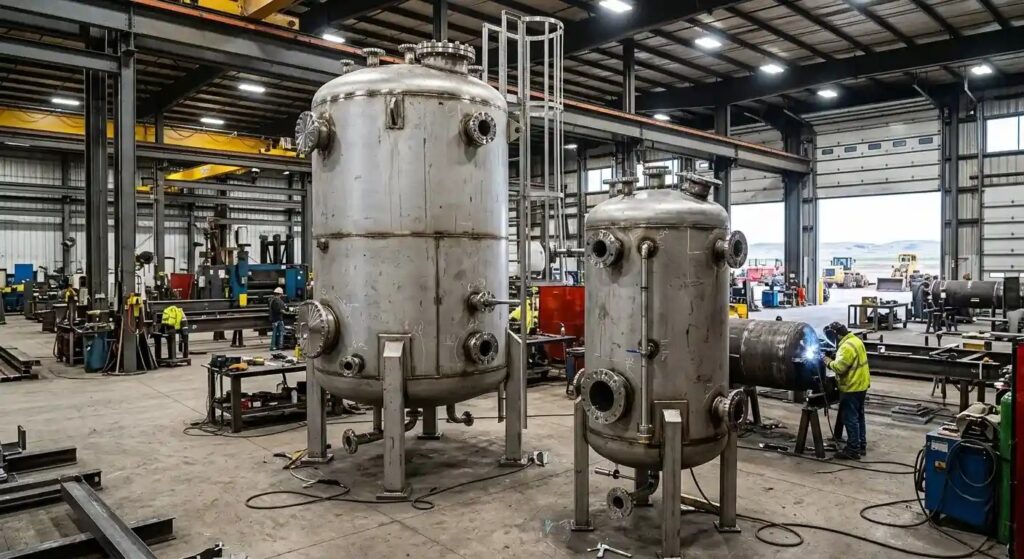
Glycol tanks are vessels that store, blend, or feed glycol-water mixtures used as heat transfer and freeze protection fluid in heating, cooling, and process systems. When they operate above 15 psig, glycol tanks are ASME-coded pressure vessels, and the tank type, material, and glycol compatibility determine whether the system runs trouble-free across its full service life.
Key Takeaways
- Glycol tanks hold the antifreeze fluid that protects a system from freezing and maintains heat transfer performance in cold operating conditions.
- The four main types are the glycol feed tank, the glycol storage tank, the mixing tank, and the buffer vessel in a glycol chilled water loop. Each performs a distinct function.
- Propylene glycol is used where the fluid may contact people or food. Ethylene glycol is used in sealed industrial loops where its better heat transfer and lower viscosity are advantages.
- Material choice matters because glycol and its inhibitors interact with the tank wall over time. Stainless steel and inhibited carbon steel are selected against the specific fluid and service conditions.
- A glycol tank operating above 15 psig is a coded pressure vessel built to ASME Section VIII with specific material, examination, and documentation requirements.
What Are Glycol Tanks and What Do They Do?
A glycol tank holds a mixture of water and glycol that circulates through a closed loop to transfer heat while resisting freezing. In outdoor process lines, rooftop chiller systems, and cold storage facilities, plain water would freeze and rupture the system in low-temperature conditions.
The Three Functions of a Glycol Tank
A glycol tank stores the glycol mixture for reserve use, blends concentrate with water to the target concentration before the fluid enters the loop, or feeds makeup fluid into the loop automatically to maintain pressure and volume. The common requirement across all three functions is that the tank keeps the right fluid at the right concentration, available to the system at all times.
Why Glycol Tanks Are Engineered Vessels
Many glycol tanks operate under pressure and circulate a fluid that reacts with the tank wall over time, which makes them engineered pressure vessels rather than plain atmospheric storage drums. Once the operating pressure exceeds 15 psig, the tank falls under ASME Section VIII and is built as a coded pressure vessel with design, examination, and documentation requirements that atmospheric tanks do not carry. Red River’s pressure vessel fabrication scope covers glycol tanks across all four types.
Why Do Systems Use Glycol Instead of Water?
Systems use glycol because water alone freezes, expands, and ruptures pipes and vessels in cold conditions. Glycol lowers the freeze point of the water mixture and protects the equipment, which is why glycol tanks appear anywhere a loop is exposed to low ambient temperatures.
Freeze Protection and Concentration Control
Adding glycol to water lowers the temperature at which the mixture freezes. A loop exposed to outdoor air or a cold process requires enough glycol that the fluid stays liquid at the lowest expected ambient temperature. The glycol tank holds that protected fluid and keeps the concentration consistent across the loop.
Burst Protection and Heat Transfer Trade-Offs
Beyond freeze protection, glycol provides burst protection by keeping the fluid slushy rather than solid even below its freeze point, preventing pipe or vessel splitting. Glycol carries slightly less heat than pure water and is more viscous, so concentration is set at the minimum needed rather than maximized. ASHRAE publishes fluid property guidance for glycol mixtures used in hydronic and process cooling applications.
What Are the Four Main Types of Glycol Tanks?
Glycol tanks are grouped by the function they perform in the system. Most glycol systems rely on one or more of four distinct types.
Glycol Feed and Makeup Tanks
A glycol feed tank, also called a makeup tank, holds a reserve of glycol mixture and feeds it automatically into the loop to maintain pressure and replace minor losses. The feed tank typically pairs with a small pump and a pressure switch so the loop stays full and protected without manual topping-off. Sizing is based on the loop volume and the acceptable pressure drop before the feed pump activates.
Glycol Storage Tanks
A glycol storage tank holds a larger volume of mixed or concentrated glycol for a facility, available for charging a loop at startup or replenishing after maintenance drains. Sizing is based on the system volume the tank serves and the reserve capacity needed between glycol deliveries.
Glycol Mixing and Blending Tanks
A mixing tank blends glycol concentrate with water to the target concentration before the fluid enters the loop. Concentration accuracy matters because too little glycol leaves the loop underprotected and too much wastes fluid cost and degrades heat transfer performance.
Glycol Buffer and Storage in Chilled Water Loops
In chilled water systems running glycol for freeze protection, the same buffer and thermal storage vessel types used in water-only loops hold the glycol mixture instead. These vessels add loop volume to prevent short cycling and store cooling capacity for peak demand. See Red River’s thermal energy storage and process tank pages for how these vessel types are fabricated for glycol service.
Ethylene or Propylene Glycol: Which Fluid Goes in the Tank?
The two common glycol fluids differ primarily in toxicity, and the choice is determined by where the fluid could travel if it escapes the loop.
Propylene Glycol
Propylene glycol is the low-toxicity option, used wherever the fluid could contact people, food, or potable water. Food processing plants, breweries, dairies, ice rinks, and HVAC systems in occupied buildings typically specify propylene glycol because a leak poses minimal hazard. It is slightly less efficient than ethylene glycol in heat transfer but far safer when the leak path cannot be fully controlled.
Ethylene Glycol
Ethylene glycol transfers heat more efficiently and resists viscosity increase at low temperatures, making it the preferred choice for sealed industrial loops where there is no path to food or drinking water. It is toxic and must be used only in systems where human and food contact can be fully excluded. Vessels in ethylene glycol service are labeled to prevent fluid confusion during maintenance.
What Materials Are Glycol Tanks Made From?
Glycol tank material is selected against the specific fluid, the inhibitor package it carries, and the service conditions. Glycol mixtures interact with the tank wall over time, so the material decision protects both the vessel and the fluid quality.
Stainless Steel
Stainless steel is the preferred material for glycol tanks in food-grade and high-purity service, particularly for propylene glycol where fluid contamination would be a product safety issue. Stainless resists corrosion and does not introduce metals into the fluid. The higher material cost is justified where fluid purity and vessel longevity matter more than first cost.
Inhibited Carbon Steel
Carbon steel is cost-effective for industrial glycol service when the fluid carries the correct corrosion inhibitor package. Inhibited glycol protects the steel from corrosive attack, but the protection depends on maintaining inhibitor concentration. Inhibitor depletion over time means periodic monitoring is required to keep both the fluid and the vessel healthy. Red River’s fabrication capabilities cover glycol vessel fabrication in both stainless and carbon steel.
Corrosion and Inhibitor Monitoring
Glycol degrades over time, and as inhibitors deplete the fluid can turn acidic and corrode the tank wall and connected piping. Periodic testing of concentration and inhibitor level is standard maintenance practice. Most facilities test on a defined schedule and replenish the inhibitor package before depletion, protecting the vessel investment across its full service life.
When Is a Glycol Tank an ASME Pressure Vessel?
A glycol tank becomes a coded pressure vessel when it operates above 15 psig internal pressure. Atmospheric feed and storage tanks may fall under simpler tank standards, but pressurized glycol vessels in closed loops cross into ASME Section VIII territory.
ASME Section VIII Requirements
Once the operating pressure exceeds 15 psig, the vessel is designed and built to ASME BPVC Section VIII, Division 1, which governs materials, welds, examination requirements, and the documentation package. The vessel carries the ASME U Stamp and is registered with the National Board of Boiler and Pressure Vessel Inspectors. Red River holds active ASME U Stamp and NBBI R Stamp certifications, both verifiable directly with the issuing bodies.
Documentation for Coded Glycol Vessels
Every coded glycol tank Red River fabricates ships with the complete documentation package: ASME Form U-1, certified mill test reports matched to the fluid and service, weld records, and NDE examination reports coordinated through qualified inspection personnel. This documentation is required for third-party inspection, insurance, and regulatory compliance.
Which Industries Use Glycol Tanks?
Glycol tanks appear wherever a system must transfer heat without freezing. The fluid choice and tank material shift with each application.
Oil and Gas
Oil and gas operations use glycol extensively for winterizing surface equipment and in glycol dehydration units that remove water vapor from natural gas streams. These vessels are frequently integrated into prefabricated skid packages that arrive pre-piped and ready to connect.
Food, Beverage, and Process Cooling
Breweries, dairies, and food processing plants use propylene glycol for safe, low-temperature process cooling. Stainless tanks protect fluid purity, and precise concentration control is required for both product safety and regulatory compliance.
Biogas, Solar Thermal, and Industrial Process
Biogas digester heating loops and solar thermal arrays use glycol for freeze protection in outdoor and seasonal service. Industrial process cooling loops in cold climates use glycol to protect heat exchangers and process equipment year-round. Many of these applications are delivered as complete modular skid packages built and tested under one quality system.
How Do You Choose a Glycol Tank Fabricator?
Choosing a fabricator for a coded glycol vessel comes down to three verifiable criteria.
Active ASME and National Board Certification
Verify the shop’s current U Stamp certificate number and National Board registration directly with the issuing bodies before awarding. Certification must be active at the time of fabrication, not simply listed in marketing materials.
Material and Glycol Compatibility Expertise
The fabricator must match the tank material to the glycol type, the inhibitor package, and the service conditions. Stainless for food-grade propylene glycol service and inhibited carbon steel for industrial ethylene glycol loops each require different fabrication and material traceability practices.
Documented Examination and Modular Delivery
Red River coordinates and manages NDE examination and pressure testing through qualified inspection personnel, with documentation built as the vessel is fabricated. A fabricator that delivers the glycol tank on a modular skid reduces field installation scope.
What This Means When Specifying a Glycol Tank
Glycol tanks are only as reliable as their material match, concentration control, and fabrication documentation. Systems that run for decades without glycol-related corrosion or fluid degradation are the ones whose tank type, fluid, material, and code requirements were confirmed in the specification before the first plate was cut. Getting the glycol-material pairing wrong shows up months or years later as fluid acidification, tank wall corrosion, and system contamination.
Work With Red River on Your Glycol Tank Project
Red River has fabricated ASME-certified glycol feed, storage, and mixing tanks in stainless and carbon steel for oil and gas, food and beverage, biogas, and industrial process applications from Gillette, Wyoming, since 2003. Red River holds active ASME U Stamp and NBBI R Stamp certifications and is an American Welding Society (AWS) member.
Ready to Discuss Your Glycol Tank Scope?
Request a quote or call us to discuss your glycol tank type, material, and fabrication scope with Red River’s team.
Frequently Asked Questions
1. What Is the Difference Between a Glycol Feed Tank and a Glycol Storage Tank?
A glycol feed tank holds a small reserve and automatically feeds makeup fluid into the loop to maintain pressure and volume. A glycol storage tank holds a larger volume of mixed or concentrated glycol for charging or replenishing systems after maintenance. Feed tanks keep a loop topped off continuously; storage tanks provide bulk reserve between deliveries.
2. Should I Use Ethylene or Propylene Glycol?
Use propylene glycol wherever the fluid could contact people, food, or potable water, because it is low in toxicity. Use ethylene glycol only in sealed industrial loops with no path to food or drinking water, where its better heat transfer and lower viscosity at low temperatures are advantages.
3. What Material Is Best for a Glycol Tank?
Stainless steel is preferred for food-grade and high-purity propylene glycol service. Inhibited carbon steel works for most industrial glycol loops at lower cost, provided the inhibitor package is maintained. The right material depends on the glycol type, the inhibitors it carries, and whether fluid purity is a requirement.
4. When Does a Glycol Tank Need to Be ASME-Coded?
A glycol tank operating above 15 psig internal pressure is built to ASME Section VIII as a coded pressure vessel. Atmospheric feed and storage tanks may use simpler standards. The design specification confirms whether the tank falls under code.
5. Why Does Glycol Need to Be Monitored Over Time?
Glycol degrades and its corrosion inhibitors deplete. When inhibitors fall below effective concentration, the fluid can turn acidic and attack the tank wall and piping. Periodic testing of concentration and inhibitor level protects both the fluid and the vessel across the service life.
6. Does Red River Fabricate Custom Glycol Tanks?
Yes. Red River fabricates custom ASME-certified glycol feed, storage, and mixing tanks in stainless or carbon steel, matched to the fluid type and service conditions. Material, concentration requirements, and connection details are confirmed during the engineering review before fabrication begins.
Related Blog Post
Which Materials Suit Make-Up Water Service?
How Big Should Make-Up Water Tanks Be?
Make-Up Water Tanks: Design, Sizing, and Fabrication
When to Spec Equalization Tanks for Industrial Systems
How Do Equalization Tanks Balance Flow?
About Author